
What Makes a Good Soccer Player: A Complete Guide

Most parents are told to look for the fastest child, the one who can juggle endlessly, or the player who scores spectacular goals. Those qualities can help, but they don't answer the more important question: what makes a good soccer player over the long term?
A strong player sees the next action before the ball arrives, chooses an effective option under pressure, executes that action reliably, and stays engaged when the game becomes difficult. Modern evaluation also considers passing, possession, defending, movement, psychology, and teamwork. The player who makes useful decisions repeatedly may contribute more than the player who produces the occasional highlight.
Redefining What Makes a Good Soccer Player
A highlight-reel move can attract attention while hiding a player's real limitations. A good soccer player is judged more accurately by the quality of their decisions, the efficiency of their actions, and their ability to repeat useful contributions throughout a match.
Speed helps a player reach space sooner, and technique provides ways to control the ball. Neither quality guarantees an effective choice. The player must still recognize pressure, identify the safest or most productive option, and act before the situation changes. A child who looks ordinary in a warm-up may become highly effective once the game requires awareness, positioning, communication, and composure.
Research on youth academy selection supports this wider view. Selected players showed stronger match ratings, completed more passes, produced better successful aerial-duel percentages, and delivered more accurate crosses than deselected players. These findings support evaluating repeated match actions rather than relying on size, speed, or a striking first impression.
The question coaches should ask
Rather than asking who looks most talented, observe five habits:
Information gathering: Does the player scan before receiving?
Choice quality: Do they select an action that fits the pressure, space, and score?
Execution: Can they complete the action with suitable accuracy and speed?
Repeatability: Do they remain effective across the match?
Response to pressure: Do they recover their usefulness after an error or challenge?
A highlight records one successful moment. Development depends on actions a player can reproduce when tired, crowded, or closely marked.
Athleticism and individual skill still matter. Acceleration can create separation, coordination can improve balance, and dribbling or striking can solve specific problems. Their value depends on how they serve the team. A step-over that creates a passing lane has a clear purpose. The same move, performed without checking the defender, teammate, or available exit, may just delay the next decision.
Why consistency matters
Performance analysts review goals, expected goals, shot accuracy, assists, key passes, pass completion, tackles won, interceptions, duels, and other defensive actions using data such as FBref performance data. They may also convert totals into per-90-minute rates, which makes comparisons between players with different playing time more useful. This approach can reveal a midfielder who repeatedly recovers possession or a defender who advances the ball, even when neither player scores often.
Parents and coaches can apply the same principle without a spreadsheet. Watch whether the player helps the team keep possession, move forward, create opportunities, recover the ball, and make the next action easier for a teammate. A good player is not the child who produces the loudest moment. It is the child who keeps making sound decisions as the match changes.
The Five Domains of Player Evaluation
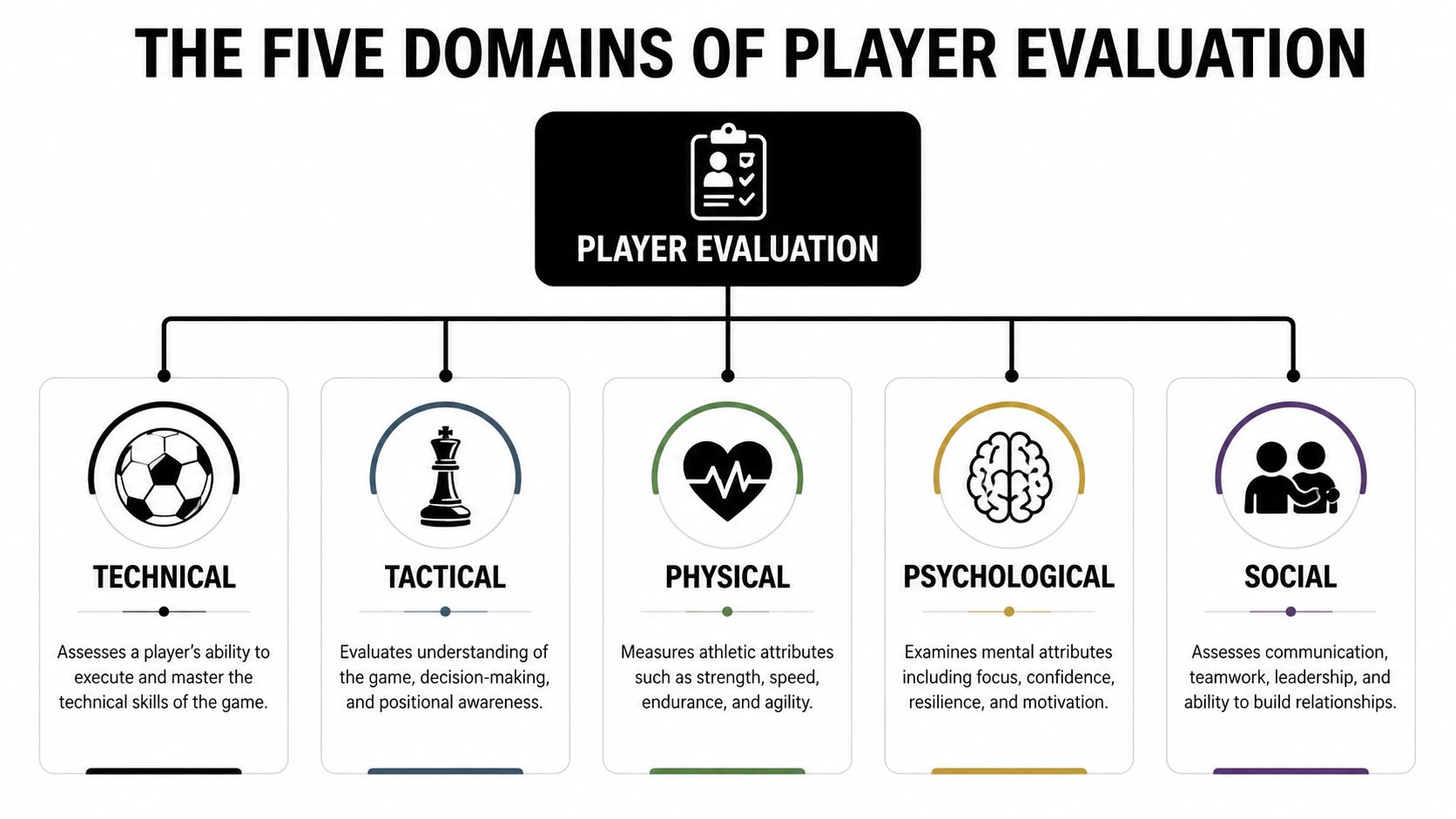
A complete evaluation combines five connected domains. They aren't separate compartments. A technically secure player still needs tactical awareness, while a tactically intelligent player needs the physical and psychological tools to act on good ideas.
Technical quality
Technical skill means controlling and using the ball effectively. Coaches should look beyond tricks and ask whether a player can receive with the correct surface, protect possession, pass with appropriate pace, dribble into useful space, and strike accurately with either foot.
First touch is a problem-solving tool. A good touch doesn't merely stop the ball. It moves the ball away from pressure, opens the body toward the next pass, or creates a path forward.
Tactical understanding
Tactical skill involves recognizing space, pressure, numbers, and timing. A midfielder may not touch the ball often, yet can influence the match by offering a safe angle, drawing an opponent away, or closing a passing lane before the opponent receives.
This is why coaches value off-ball movement and defensive positioning. The player who creates space for someone else may contribute without appearing in a highlight clip.
Physical capacity
Physical ability includes acceleration, balance, coordination, strength, mobility, and the capacity to repeat demanding actions. Elite European match analysis found that dribbling, successful dribble percentage, total distance, high-intensity and sprint distance, and maximal acceleration rose on average across the earlier seasons studied before declining later, while tackles and high-intensity accelerations trended downward across seasons (longitudinal elite soccer study).
The useful coaching question isn't, “Who is fastest?” It's, “Can this player maintain effective actions as the match develops?”
Psychological readiness
Psychological qualities include attention, emotional control, resilience, confidence, patience, and coachability. A player who listens, adjusts, and returns to the next action after a mistake gives the team dependable behavior under pressure.
Social contribution
Soccer is collective. Communication, respect, responsibility, and willingness to support teammates affect how well an individual fits into a team model. A player who helps teammates understand the next action can improve the performance of the whole group.
Practical rule: Evaluate the action, the decision behind it, and the effect on teammates. Never evaluate the highlight alone.
Age-Appropriate Expectations and Measurable Indicators
A four-year-old does not need to resemble a sixteen-year-old. Judging both by the same checklist mistakes early confidence with advanced performance. Young players need curiosity, coordination, and comfort with the ball. As they mature, evaluation can gradually include tactical detail, repeated physical actions, emotional control, and efficiency within a position.
A developmental view
Age Group | Primary Focus | Key Indicators |
|---|---|---|
Ages 4–6 | Enjoyment, coordination, and basic ball familiarity | Willingness to engage, simple changes of direction, balance, and comfort attempting actions |
Ages 7–9 | First touch, dribbling, passing, and using both feet | Ability to control a moving ball, recognize a nearby teammate, and recover after mistakes |
Ages 10–12 | Technique under pressure and basic game awareness | Scanning, supporting angles, defensive recovery, and choosing between passing and dribbling |
Ages 13–15 | Position-specific decisions and action efficiency | Reliable execution at match speed, movement away from the ball, pressing cues, and transition responses |
Ages 16–18 | Consistency, role clarity, physical repeatability, and leadership | Quality across full matches, emotional stability, communication, and adaptation to stronger opponents |
These stages are guides, not rigid gates. Children mature at different rates, and early physical development can distort what parents see. A larger or faster player may dominate temporarily. Another may develop later and pass that player through cleaner technique, better awareness, and more consistent decisions.
What measurable indicators can tell you
Older youth players can be assessed with match evidence, provided coaches interpret the numbers within context. Passing accuracy, successful aerial-duel percentage, and crossing accuracy have shown value in academy selection research. As noted earlier, these indicators should not become a child's report card after one match. Repeated observation reveals more than a single result.
Per-90-minute measures can clarify comparisons when playing time differs. A midfielder's interceptions, a defender's tackles, or a forward's chance creation should be considered with role, opponents, team style, and minutes played. A statistic is a clue, not a verdict.
Parents can also review soccer training for kids for age-specific guidance, then ask the coach which behaviors fit the player's current stage. A useful target is a development trend: receiving more cleanly under pressure, checking the shoulder earlier, or choosing the next action sooner. Those changes show learning more clearly than a fixed ranking against teammates.
Drills and Practice Habits That Build Real Players
The most useful drill is the one that prepares a player for a real decision. Isolated repetition has a place, especially when a player is learning body shape or ball contact, but training should eventually add pressure, movement, opponents, and consequences.
Small-sided games are particularly valuable because players must repeatedly perceive space, identify options, and act while the situation changes. Research on youth soccer found improvements in perceptual-cognitive and perceptual-motor decision-making after tactical training and small-sided-game programs conducted across 14–25 sessions (decision-making research).
Turn practice into a decision environment
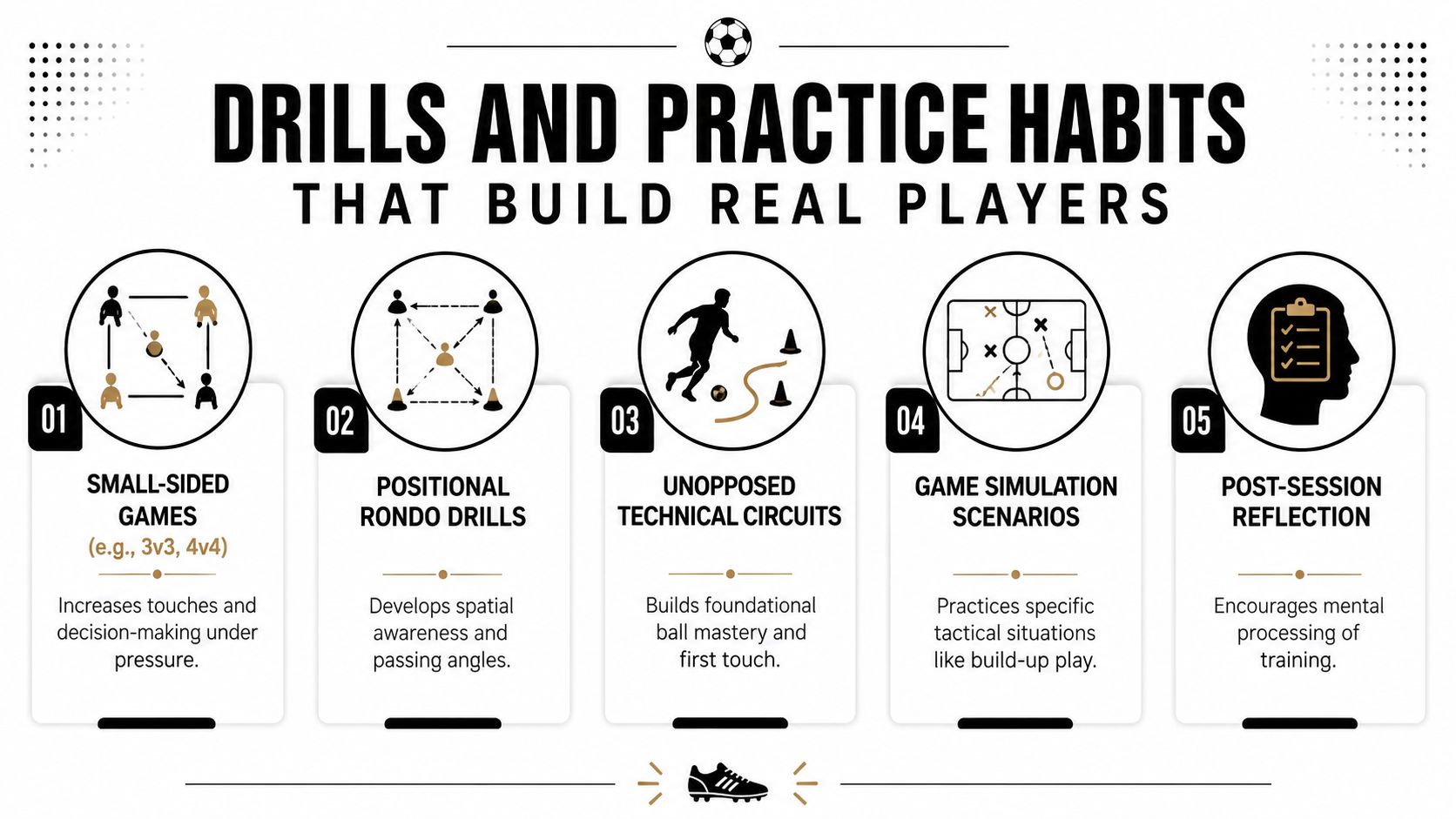
A coach might use a 3v3 game with conditions that reward switching the point of attack. Players then have to scan, recognize pressure, create width, and decide whether to pass forward or retain possession. The coach isn't only counting touches. They're watching whether players recognize the problem before receiving the ball.
A positional rondo can develop passing angles and support habits. An unopposed technical circuit can refine first touch and ball mastery. A build-up scenario can teach defenders and midfielders how to create safe options against a press. Each activity has value when the coach connects it to a game problem.
Useful habits include:
Scan before receiving: Look over both shoulders when possible, then adjust the body to play forward.
Use both feet: Practice receiving and passing with the less comfortable foot so pressure doesn't eliminate options.
Change the challenge: Once technique is controlled, reduce time, space, or available choices.
Reflect briefly: After training, identify one decision that worked and one that needs attention.
A family can combine a technical session with a small game, rather than spending every practice on stationary touches. A player might begin with wall passing and first-touch variation, move into a pressure game, then finish by discussing why certain choices succeeded.
Manage effort as part of development
Fatigue changes decision quality. Coaches and families who want a more structured way to think about training load can learn how to use HRV and RPE for fatigue monitoring. The purpose isn't to turn youth soccer into a laboratory. It's to notice when a player needs recovery, a lighter session, or a different challenge.
For practical technical ideas, technical soccer drills can help families choose activities that connect first touch, passing, and ball control to match demands. A good session leaves the player more capable of solving problems, not merely more tired.
The Mental and Social Traits That Separate Elite Youth Players
The public image of talent favors speed and confidence. Player development is less glamorous. It depends heavily on whether a young athlete can concentrate, accept instruction, manage frustration, and keep working when progress feels slow.
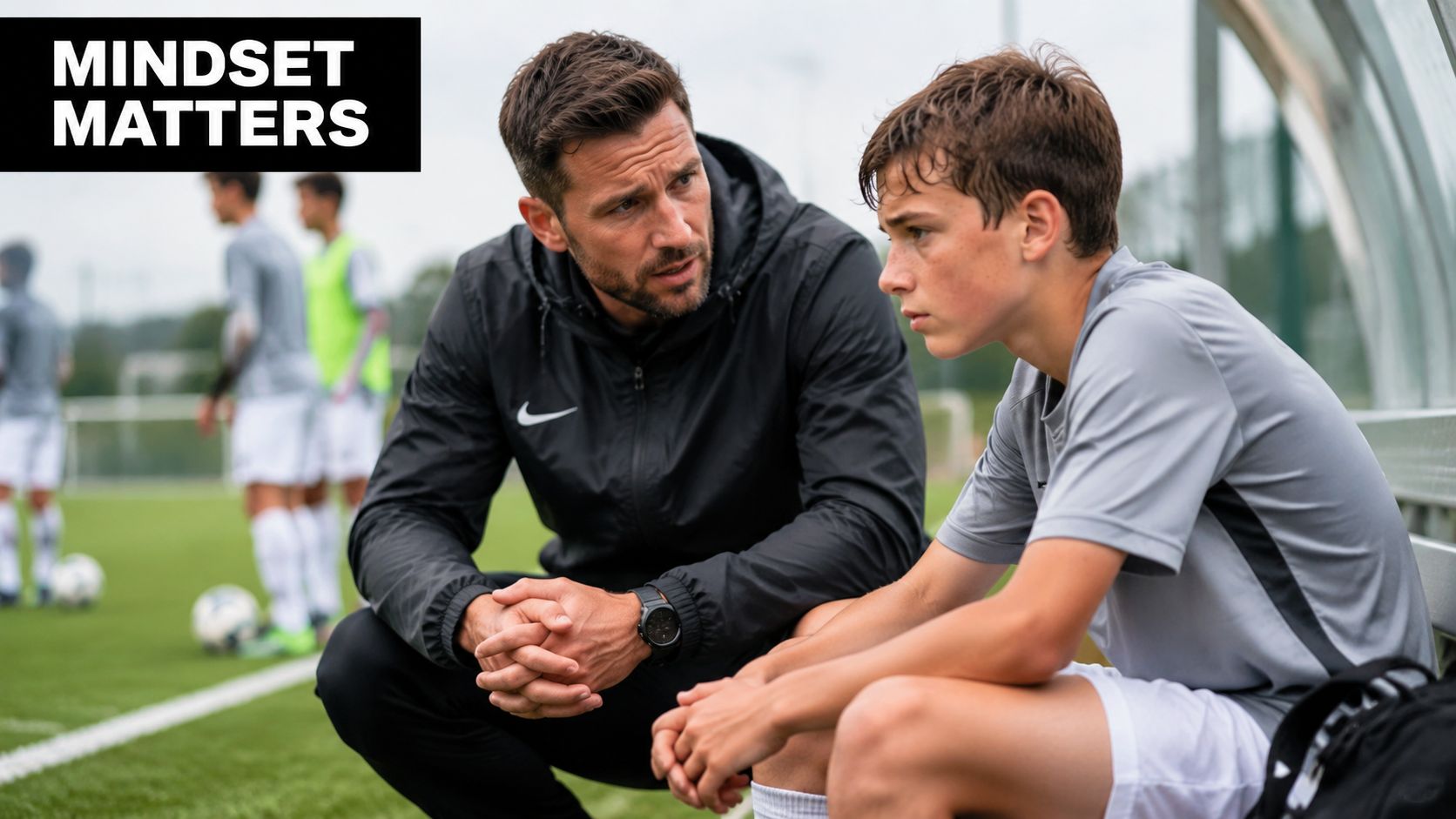
A youth development pathway study identified coaching, personal mindset, and social support as leading perceived contributors to development. A personality study reported that conscientiousness and emotional stability distinguished elite youth players from the general population, while extraversion was higher among players judged to have international potential (youth development and personality research).
The practical meaning is more nuanced than “be confident.” Confidence can help a player attempt difficult actions, but consistency, emotional control, and coachability determine whether the player keeps learning after failure.
What a healthy environment provides
A constructive academy environment gives players clear expectations, useful feedback, and enough psychological safety to make decisions. If a child fears every mistake, they may choose the safest pass even when the game demands initiative. If a coach corrects behavior specifically and fairly, the player can improve without treating criticism as a personal verdict.
Parents also shape this environment. Asking “What did you notice?” usually creates a better conversation than asking only whether the team won or whether the child scored. The first question encourages observation and ownership. The second can make performance feel dependent on visible outcomes.
Watch how the adults behave after errors. Does the coach help the player understand the next action? Do teammates communicate supportively? Can the child leave training with a clear challenge rather than fear of the next evaluation?
For families exploring this part of development, sports psychology for youth offers a useful lens for understanding confidence, concentration, resilience, and emotional regulation.
A coach's feedback should create better decisions, not dependence on constant approval. Players eventually need to solve problems independently, communicate with teammates, and stay composed when the match stops going according to plan.
Evaluation Checklist for Parents and Coaches
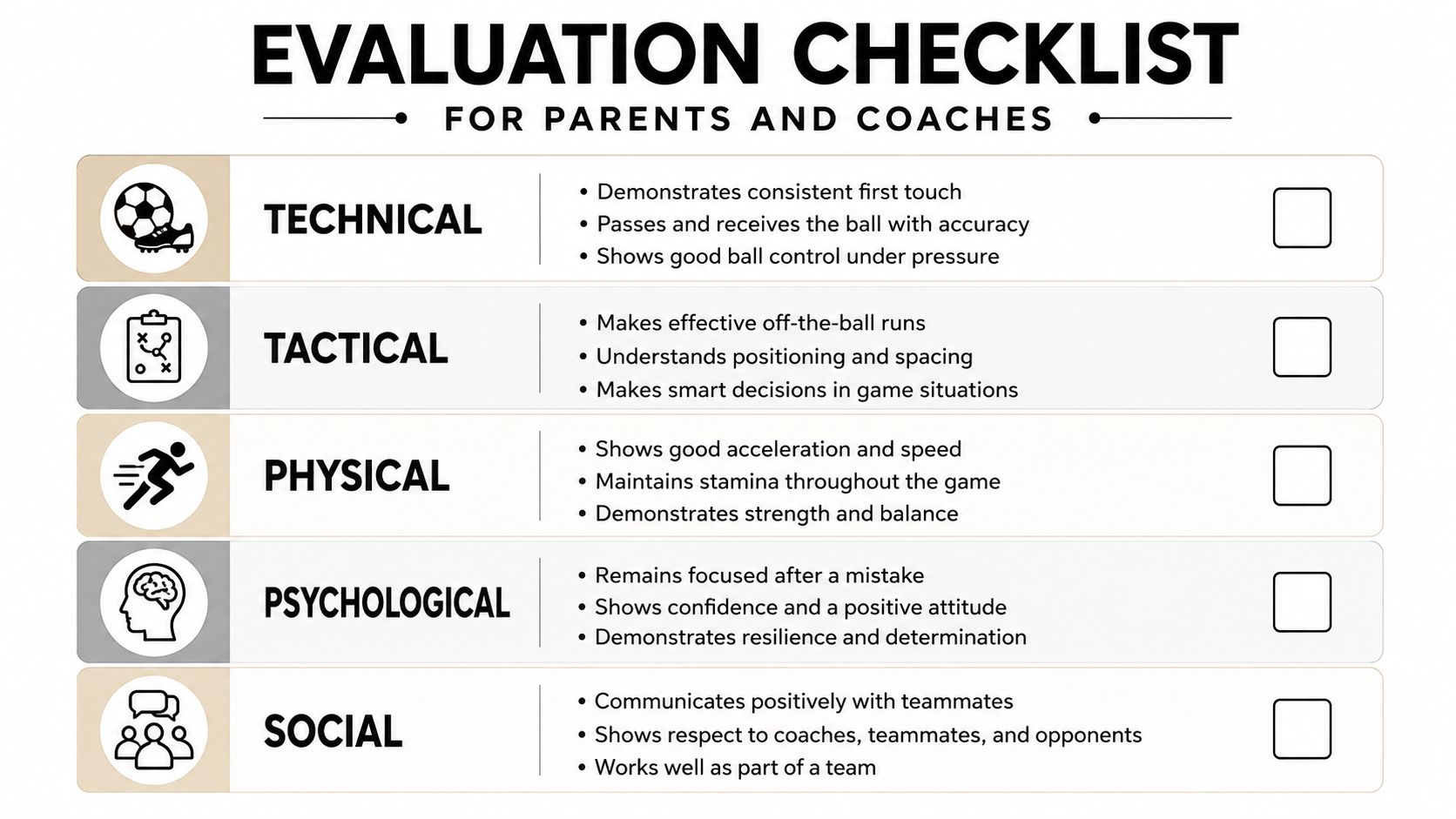
A useful evaluation checklist turns vague impressions into observable behavior. Use it during training or a match, and look for patterns across multiple sessions. One spectacular goal or one poor touch should never define a young player's pathway.
Observe the five domains
Technical: Does the player receive with control, pass with appropriate pace, and keep the ball close enough to act again?
Tactical: Do they scan, create support angles, recognize space, and make useful movements away from the ball?
Physical: Can they accelerate, decelerate, change direction, maintain balance, and repeat actions without losing technique?
Psychological: Do they stay attentive, accept coaching, recover from mistakes, and continue competing constructively?
Social: Do they communicate clearly, support teammates, respect opponents, and take responsibility for their role?
A parent can record a simple note after a game: one strength, one recurring challenge, and one next action. That keeps evaluation developmental rather than judgmental.
Ask better questions
Instead of asking whether a player “looked good,” ask:
Did the player make useful decisions before receiving?
Did their first touch help the next action?
How did they react after losing possession?
Did they help the team defend when they weren't near the ball?
Did they communicate in a way teammates could use?
The checklist should guide conversation with the coach, not replace it. A coach sees role responsibilities, training behavior, and context that may not be obvious from the sideline. Families should also protect the player's enjoyment. Honest feedback works best when the child understands that development is a process and that mistakes provide information.
How Villarreal Houston Academy Develops Complete Players
Villarreal Houston Academy applies the Villarreal CF methodology through a development model built around intelligence, skill, and character. That means technical training sits alongside tactical understanding, physical preparation, psychological support, and personal responsibility.
The academy offers select and competitive programming for boys and girls from age four upward. Age-appropriate training gives younger players room to build coordination, confidence, and ball familiarity, while older players work toward greater role clarity, decision quality, action efficiency, and consistency.
Qualified coaches lead the programs, with sports psychologists supporting the mental side of development. That combination matters because a player may understand a tactical idea but struggle to apply it under pressure, or possess technical ability but lose focus after an error. Coaching and psychological support can connect those areas.
A pathway for Greater Houston families
Training takes place across Humble, Fall Creek, Cypress, Tomball, and the Kingwood, Porter, and New Caney area. Families can explore teams, camps, clinics, and tryouts according to the player's age, goals, and current level.
Players also have opportunities to travel to Spain to train and play alongside Villarreal CF's elite academy. The value of that pathway isn't limited to the travel experience. It gives ambitious players a structured environment in which technical execution, tactical awareness, competitive behavior, and character are developed together.
A good soccer player isn't the child who looks impressive in a short clip. They're the player who reads situations, chooses well, executes reliably, responds constructively, and contributes to teammates. That is the standard families should seek when they compare development environments.
Villarreal Houston Academy offers teams, camps, clinics, tryouts, age-appropriate training, and a pathway connected to Villarreal CF for boys and girls from age 4 upward. If you want your child to develop decision-making, technical skill, tactical understanding, and character in the Greater Houston area, visit Villarreal Houston Academy to explore the right program.
Comments