


8 Soccer Tryouts Tips for Players and Parents

The night before soccer tryouts, one player is packing cleats, shin guards, water, and a change of clothes while reviewing how to respond after a bad touch. Nearby, a parent is resisting the urge to deliver one more speech about making the team. That preparation matters because coaches evaluate much more than highlight-reel skills. They watch first touch, decision-making, movement, effort, communication, coachability, and the way a player responds when the session becomes difficult.
The strongest soccer tryouts tips treat preparation as a complete player-and-parent process. The plan below covers technical quality, tactical awareness, conditioning, versatility, mental readiness, film review, character, and competitive experience. Families exploring structured development can also review Villarreal Houston Academy's teams, camps, clinics, and tryouts, which serve boys and girls from age 4 upward in the Greater Houston area.
1. Master Technical Ball Control and First Touch
A clean first touch gives a player time. A loose touch gives the defender an invitation. At tryouts, that difference appears quickly because coaches can see whether a player receives the ball with a purpose or stops it wherever it lands.
Practice receiving with the inside, outside, sole, and laces of both feet. Work on balls arriving along the ground, bouncing, and coming from different angles. The important detail is what happens next. Your first touch should move the ball into space for a pass, turn, dribble, or shot rather than leaving you flat-footed.
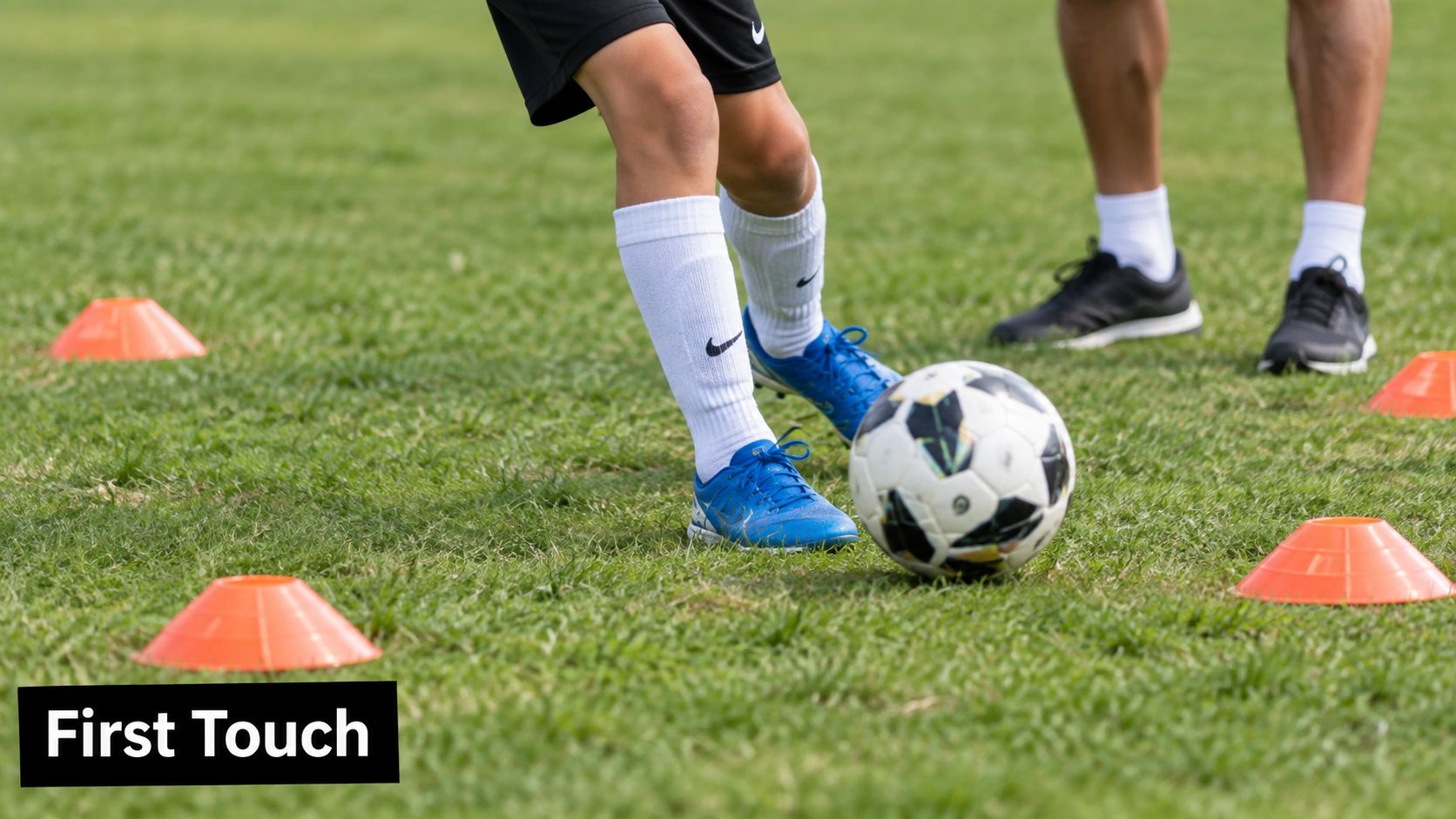
Make your touch look useful
Cone work helps, but isolated cone work isn't enough. Add movement, direction changes, and pressure so your technique resembles the decisions you'll make in a game. A player who can control the ball in a confined space while a defender closes down looks more prepared than a player who performs an elaborate move without pressure.
Receive on the move: Take the ball across your body and move into the next action.
Use both feet: Don't let your stronger foot become the only reliable option.
Change the environment: Train on grass and artificial turf when possible so your touch adapts to different surfaces.
Add pressure: Ask a teammate to close you down or restrict the time available for your next action.
For a focused technical progression, use this guide to improving first touch in soccer. Villarreal Houston Academy follows Villarreal CF's Spanish methodology, where technical proficiency supports intelligent play rather than existing as a separate trick routine.
The final test is simple. After receiving the ball, can you make the next action quickly and cleanly? That's the standard to train.
2. Demonstrate Tactical Awareness and Positional Intelligence
A player can have excellent footwork and still struggle at tryouts by standing in the wrong place. Coaches want to see whether you understand spacing, passing lanes, defensive cover, and the next phase of play. Your work without the ball often tells them more than one successful dribble.
Before the ball reaches you, scan the field. Identify where pressure is coming from, where the next pass might be available, and whether your team needs width, support, depth, or defensive balance. A midfielder who checks a shoulder before receiving appears calmer because the decision starts before the pass arrives.
Read the game instead of chasing it
Small-sided games are especially useful because they create frequent decisions. They force players to find space, defend transitions, communicate, and choose between protecting possession and attacking quickly. Watch professional or academy matches actively, too. Follow one player in your position and ask why that player moves when the ball is on the opposite side.
Use the soccer tactics guide from Villarreal Houston Academy to build vocabulary around positioning and decision-making. Then ask your coach specific questions, such as whether you should check toward the ball, stretch the field, hold your position, or press after a particular trigger.
A practical tryout example is a winger who loses possession. The memorable action isn't only the earlier dribble. It's whether the winger reacts by pressing, recovering inside, or tracking the opponent with urgency. Similarly, a defender who makes a quiet covering run may help the team more than a defender who wins one dramatic tackle.
Practical rule: Before you ask for the ball, know where your next safe and progressive options are.
Coaches notice players who make the game easier for teammates. Positional intelligence turns technical ability into useful team play.
3. Develop Physical Fitness and Game Conditioning
A player can arrive early, run hard, and still fade once the tryout becomes demanding. Soccer fitness requires repeated acceleration, deceleration, direction changes, recovery, and technical execution under fatigue. Coaches notice whether effort, concentration, and movement quality remain dependable late in a session.
Build preparation around those demands. Short intervals develop repeated high-intensity work, while steady aerobic training supports general endurance. Include age-appropriate strength, mobility, balance, and landing mechanics. Endless running alone does not prepare a player for the decisions and actions required in a match.
Make tired actions look composed
Pair a short acceleration with a pass, first touch, or finish. The exercise should resemble the sequence a player may face in a game, then repeat it with enough control to preserve technique. Stop or reduce the workload when touches become careless, posture breaks down, or recovery no longer allows quality effort.
Use the soccer conditioning exercises from Villarreal Houston Academy as a starting point, then adjust the workload to the player's age, training background, and current schedule. Parents should avoid creating a sudden high-volume program before tryouts. A player returning from a break needs a gradual build and planned recovery.
Tryout preparation also depends on what happens between sessions:
Protect recovery: Schedule rest and easier training so performance does not deteriorate.
Warm up progressively: Use mobility, dynamic movements, and controlled accelerations before harder actions.
Fuel consistently: Choose familiar meals and bring water for training and tryout day.
Respond to warning signs: Persistent pain, unusual fatigue, or declining movement quality warrants advice from a qualified professional. Families can review information about pelvic pain after soccer when that symptom is relevant.
Load management requires context. A randomized trial involving 482 elite youth footballers found that using the acute:chronic workload ratio alone did not reduce health problems, with a relative risk of 1.01 and a 95% confidence interval of 0.91 to 1.12 in the British Journal of Sports Medicine. The practical lesson is to consider previous exposure, recovery, injury history, and how the player tolerates repeated sessions. Coaches and parents should judge readiness by those factors, not by one workload formula.
4. Showcase Versatility and Positional Flexibility
A player may be tested in an unfamiliar role within the first few minutes. Versatility helps when it grows from a reliable primary position, clear responsibilities, and habits that transfer across the field. Coaches value players who can adjust without losing defensive focus, passing quality, or work rate.
Start with one position you understand thoroughly. Know your spacing, body shape, passing angles, defensive tasks, and responsibilities during transitions. Then prepare for two nearby roles. Identify what changes when you move there, and which habits should remain consistent.
A fullback may switch sides, defend narrower, or support midfield. A midfielder may shield the back line, connect play, or arrive near the box. A forward may move centrally or wide while continuing to press, combine, and attack space. These changes reveal decision-making, communication, and effort more clearly than a position label alone.
Show flexibility without losing your identity
If a coach asks about your position, answer with a clear preference and useful range: “I'm most comfortable as a central midfielder, and I've also played wide midfield and fullback.” This shows self-awareness without presenting yourself as someone who claims every role.
During the session:
Learn the assignment: Confirm where to stand, whom to mark, and what should happen when possession changes.
Transfer reliable habits: Scan before receiving, communicate early, offer useful support angles, and recover with purpose.
Accept the role: If the coach moves you, apply the new responsibilities before judging whether the position suits you.
Review afterward: Ask what the coach noticed and which part of the role needs more work.
Parents can help by discussing the player's choices, not just the position played. Ask whether the player understood the role, adapted to teammates, and kept contributing after mistakes or confusion.
Position changes involve a real trade-off. Too much movement can limit depth in a young player's main role, while refusing every change reduces team value. Build a strong foundation first, then explore adjacent positions with a clear purpose.
5. Build Mental Resilience and Embrace Pressure Situations
A poor first touch in the opening minutes can make a tryout feel lost. The useful response is to treat the next action as the evaluation, not the mistake. Tryouts compress uncertainty into a short period, so players need a routine that keeps nerves from dictating their decisions.
Before training, arrive with enough time to settle, complete a familiar warm-up, and take a few calm breaths. Choose one or two short cues, such as “scan early” or “play the next action.” Short reminders are easier to use while the game moves quickly. Visualization can also rehearse receiving under pressure, recovering after an error, and communicating with teammates.
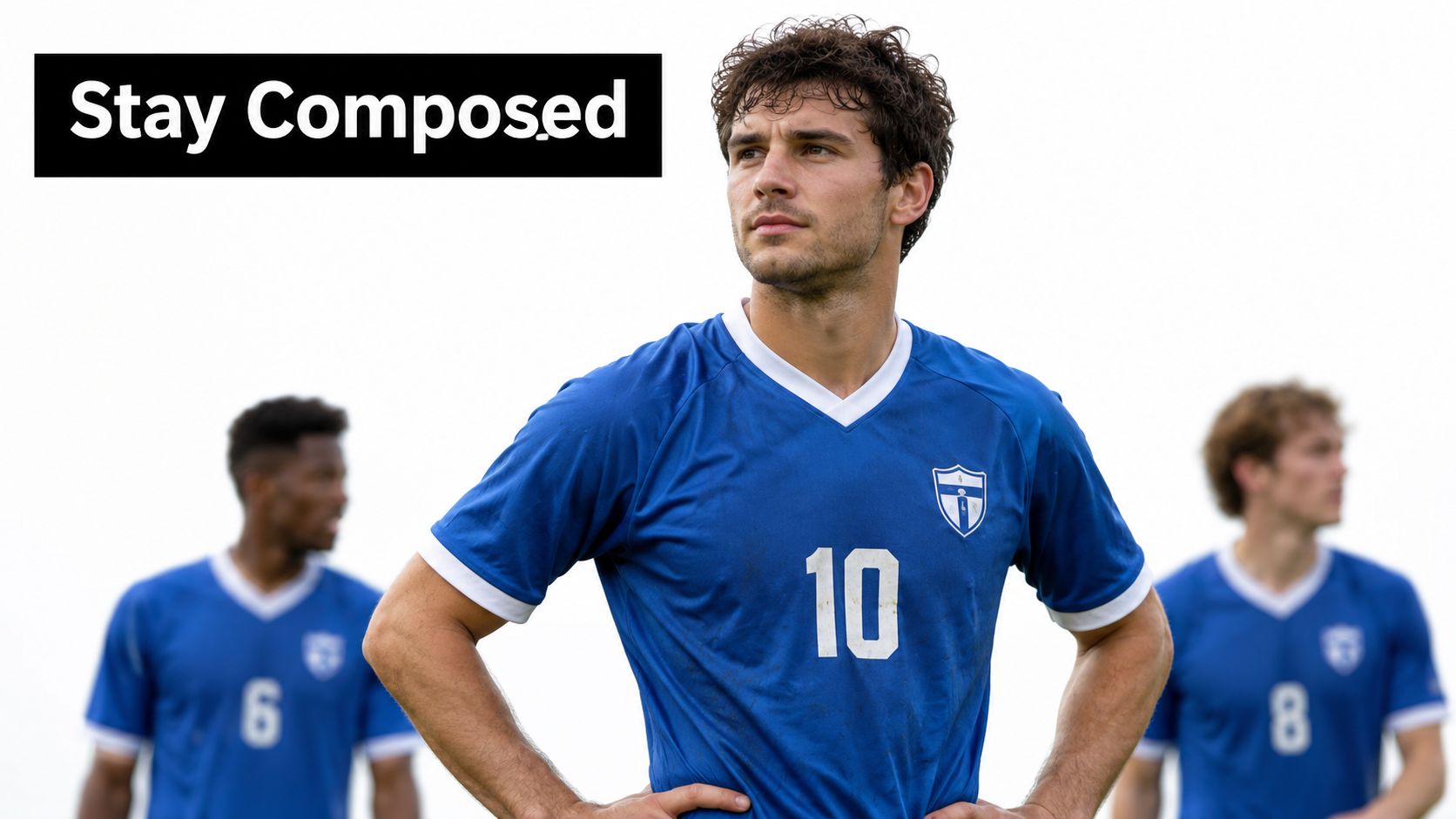
Make the next action visible
Coaches expect mistakes. They watch what follows. After a misplaced pass, recover your position, press with control, communicate, and offer for the ball again. Keep your body language engaged, keep moving, and choose the simple play if pressure has affected your confidence. Pressure should sharpen attention, not produce reckless tackles or unnecessary tricks.
One mistake should lead to a response, not a performance collapse. A player who reconnects with the game shows resilience and competitive maturity, even when nervous.
Parents can reinforce this process after the session. Ask what felt clear, what became difficult, and what the player learned about the level. Asking only whether the player made the team can turn a useful evaluation into a single verdict. Confidence does not require the absence of fear. It requires a repeatable response when fear appears.
Keep expectations realistic. One session can show current readiness, while long-term potential depends on continued training, feedback, and competitive experience. Use the day-of routine to stay present, accept pressure, and give coaches consistent effort and decision-making.
6. Prepare with Game Film Study and Self-Evaluation
Film gives players evidence instead of guesses. A training video can reveal that a player receives square to pressure, stops moving after passing, watches the ball instead of scanning, or contributes more defensively than they realized. Those details are difficult to track during a fast match.
Record games or training when the coach and facility rules allow it. Review one theme at a time rather than trying to judge everything at once. Start with decisions before criticizing execution. Ask whether you saw the pressure, chose the right option, supported the play, and reacted after possession changed.
Turn review into a short development brief
Before tryouts, prepare a clear description of your game. Identify several strengths and a few development priorities, but don't present a rehearsed sales pitch. A coach will respond better to a player who can say, “I'm comfortable receiving between lines, and I'm working on checking my shoulder earlier when pressure comes from behind.”
Use film to compare repeated situations across matches. Look for patterns in your first touch, defensive positioning, passing choices, communication, and reactions after losing the ball. Then ask a coach for specific feedback. “What should I improve?” is less useful than “Was my starting position too high when our fullback had the ball?”
“Film should change what you practice next, not just confirm that you played well.”
A self-evaluation also helps parents avoid vague criticism. Instead of saying a player needs to “work harder,” the family can identify a concrete behavior, such as recovering inside after losing the ball or opening the body before receiving. That makes the next training session more purposeful and gives the player a way to measure progress qualitatively.
7. Demonstrate Coachability, Respect, and Character
A tryout can turn on a player's response to one correction. Coaches evaluate how players listen, adjust, treat teammates, and compete under pressure because a roster requires reliable people, not isolated technical ability.
Show coachability in the next repetition. Listen until the instruction is complete, make eye contact when appropriate, and apply the change immediately. If the task is unclear, ask one concise question. An honest mistake followed by adjustment shows a different level of readiness than repeating an error after ignoring feedback.
Character is visible between major actions. Encourage a teammate who struggled, provide a passing option after a turnover, and avoid blaming others. Respect players competing for the same place. Help collect equipment when asked, arrive with the required gear, and follow the session's directions.
Use communication that helps the group: “turn,” “man on,” or “hold” gives useful information without insults. Compete firmly while keeping challenges controlled. These habits make effort easier for coaches to assess and help parents support the process without adding pressure.
Parents have a role too. Keep sideline comments supportive and avoid confronting coaches during evaluations. A player's attitude can be affected by what happens before and after the session, so agree on one or two practical goals rather than reviewing every mistake.
A coach may select a player with less polish who consistently learns, communicates, and supports teammates over a more talented player who disrupts the environment. That decision reflects the daily demands of team soccer. Technical quality earns attention, while coachability and character help sustain trust.
8. Train Regularly with Competitive Teams and Quality Opponents
A player who looks sharp in an unopposed drill may struggle when a defender closes space, a teammate makes an unexpected run, or the next decision must come quickly. Competitive matches expose those gaps and make tryout pressure more familiar.
Use league matches, camps, clinics, tournaments, or selected sessions with an older group when a coach considers the move appropriate. Choose the level carefully. The strongest available environment is not automatically the best one if the player rarely touches the ball or stops making decisions. The useful challenge is demanding enough to reveal weaknesses while still allowing meaningful involvement.
After each demanding session, review specific actions:
Did the player scan before receiving?
Could they protect the ball under pressure?
How quickly did they recover after losing possession?
Did technique and composure hold up during repeated high-intensity efforts?
Youth soccer participation creates broad evaluation pools. In 2024, 65% of U.S. youth ages 6 to 17 tried a team sport at least once, the highest level tracked since at least 2012, according to youth soccer participation data from FC National. Soccer remains a common entry point into organized competition, so families should prepare for consistency across several actions rather than rely on one spectacular play.
Build the training plan around four decisions:
Choose realistic challenges. Strong opponents should expose gaps without making every possession impossible.
Use game-realistic formats. Small-sided games and full matches test spacing, timing, and choices that isolated drills cannot.
Record one next action. After the session, identify one strength, one recurring problem, and one adjustment for the next practice.
Protect development. Extra competition loses value when recovery, enjoyment, or health deteriorates.
The right environment gives players a clear reference for speed, pressure, and responsibility before tryout day. Parents can support that process by asking what the player learned and what they will practice next, rather than judging every mistake.
8-Point Soccer Tryouts Comparison
Item | 🔄 Implementation Complexity | ⚡ Resource & Time | ⭐ Expected Outcome | 📊 Measurable Impact | 💡 Ideal Use Cases / Tips |
|---|---|---|---|---|---|
Master Technical Ball Control and First Touch | Moderate, repetitive skill drills and progressive pressure | High time commitment; minimal equipment | High, cleaner receptions, smoother play | Immediate on-ball improvement; fewer turnovers at tryouts | Practice both feet, cone grids, simulate defenders |
Demonstrate Tactical Awareness and Positional Intelligence | High, cognitive learning and pattern recognition | Moderate, match play and video study required | High, smarter decisions and better spacing | Subtle but decisive; increases playing time and coach trust | Watch matches, small-sided games, ask coach feedback |
Develop Physical Fitness and Game Conditioning | Moderate–High, structured periodization and strength work | High, regular conditioning sessions, possible gym/coaching | High, sustained intensity and reduced fatigue errors | Clear late-game advantage; better recovery and durability | Interval runs, strength work, practice skills while tired |
Showcase Versatility and Positional Flexibility | Moderate, learn multiple role responsibilities | Moderate, extra practice and varied game minutes | Medium–High, greater selection opportunities | Increases roster value; more playing opportunities | Master primary role first; train in 2–3 adjacent positions |
Build Mental Resilience and Embrace Pressure Situations | High, long-term psychological habit formation | Moderate, exposure to pressure, possible psychologist | High, composure, quicker recovery from mistakes | Strong differentiator in tryouts and clutch moments | Use routines, visualization, positive self-talk |
Prepare with Game Film Study and Self-Evaluation | Moderate, analytical skills and structured review | Moderate, camera access and weekly review time | High, targeted improvements and self-awareness | Reveals patterns and specific weaknesses to fix | Record regularly, review weekly, share with coaches |
Demonstrate Coachability, Respect, and Character | Low–Moderate, consistent behavioral practice | Low, no special equipment; ongoing effort | High, often decisive between similar players | Major influence on selection and long-term development | Listen, apply feedback immediately, be punctual/supportive |
Train Regularly with Competitive Teams and Quality Opponents | Moderate, arranging higher-level competition | High, travel, league fees, frequent matches | High, readiness for tryout intensity and pace | Best predictor of tryout performance and adaptation | Play up, attend showcases/tournaments, seek tougher leagues |
Make Preparation Visible on Tryout Day
Good preparation should be visible without becoming theatrical. The player arrives physically ready, knows the equipment is packed, understands the role they can offer, and has a response for mistakes. The parent creates calm around the event, handles logistics, and avoids turning every warm-up touch into a performance review.
In the final days, taper rather than cram. A light technical session, mobility work, and a few controlled sharp actions can preserve rhythm without creating heavy legs. Don't add unfamiliar conditioning, equipment, supplements, or complicated routines immediately before the evaluation. The safest preparation is familiar preparation performed with care.
A practical day-of plan
Pack the required kit in advance and confirm the program's instructions. A useful bag may include:
Playing equipment: Cleats suited to the surface, shin guards, training clothes, and an extra shirt.
Hydration and food: Water and familiar snacks that the player already tolerates well.
Documents: Any forms, registration information, or medical details the program requests.
Weather needs: Clothing and protection appropriate for the forecast and facility.
Mental routine: A few minutes for calm breathing, dynamic movement, and simple ball touches.
Arrive early enough to find the field, check in, and warm up without rushing. Listen carefully to the coach's instructions. Start with reliable decisions, compete positively, communicate, and keep moving after every action. If you make a mistake, recover quickly instead of trying to erase it with a risky play.
Parents should evaluate the environment as well as the result. A fair tryout usually communicates the schedule and expectations clearly, gives players meaningful opportunities to show different abilities, and considers more than size or one early physical advantage. Research on youth talent identification deserves that wider lens. A 2026 systematic review found that 91.4% of the reviewed literature examined male-only populations, while studies commonly focused on U10 to U16 players and assessed sprint speed, change of direction, jumping power, aerobic capacity, physical characteristics, and technical skill in the systematic review. Families should therefore ask how a program evaluates girls, late developers, decision-making, coachability, and continued development, not only athletic output.
Selection is one evaluation point, not a complete judgment of a player's future. Technical growth, tactical understanding, character, coachability, health, and enjoyment determine whether a young athlete can keep progressing. For families seeking structured programming in North Houston, Villarreal Houston Academy offers teams, camps, clinics, and tryouts within a pathway guided by Villarreal CF methodology.
Villarreal Houston Academy offers competitive and select youth soccer programming for boys and girls from age 4 upward, including teams, camps, clinics, and tryouts across the Greater Houston area. If your family wants a structured way to build technical quality, tactical intelligence, coachability, and character before the next evaluation, visit Villarreal Houston Academy to review available programs and get started.
Comments