


Soccer Team Acceptance Letter: What Families Should Check

In a 2022 selection process that tracked 365 adolescent players, 95 were approved for a place, or 26.2% of everyone who tried out, according to the Brazilian Journal of Physical Education and Sport study. Three out of four trialists went home without an offer.
That single ratio explains why the letter in your hand deserves a careful read. It represents a real achievement in a competitive pool. It also carries deadlines, costs and conditions that most families skim past on the way to the refrigerator door.
What a Soccer Team Acceptance Letter Is and Why It Matters
A soccer team acceptance letter is a formal, conditional offer. It confirms that a player met the evaluators' standards for a named team or age group, and it sets out the steps the family must complete to turn that offer into a roster spot. It isn't a trophy. It's a short contract dressed in congratulatory language.

The letter does three jobs at once. First, it confirms a place on a specific team, for a specific season, at a specific age group. Second, it sets the clock: the date you must respond, the documents you must return, the payment you must make. Third, it creates a written record that both the club and your family can point to months later if a question comes up about fees, status or expectations.
Wording matters more than families expect. When a club or academy is affiliated with an international professional organization, the letter is also a registration and safeguarding document, not just a courtesy note. The FIFA Article 19 guidance published by The FA treats academy paperwork for minors as a compliance matter with identifying details and child-protection duties attached.
The same study that produced the 26.2% figure also found that selection outcomes track measurable athletic characteristics such as relative age and physical fitness, not just soccer skill. That's worth knowing when your child is the youngest in the birth-year window.
Here's the part the letter rarely says out loud: acceptance is a milestone, not a pathway guarantee. As you'll see in the numbers below, most players who enter a competitive system never reach a senior professional contract. The letter marks the start of a development period, and your job as a parent is to know exactly what you're agreeing to before you sign it.
If your family is still learning how contracts and signatures work in sport, this explainer on player and sponsorship contract signing covers the mechanics of a signed sports document and why the returned copy matters.
Every Element a Complete Acceptance Letter Should Include
A complete acceptance letter works like a booking confirmation: it names exactly what was reserved, for whom, and what happens if nobody responds in time. Read it as a checklist. If one line is missing, the offer is incomplete, and you are entitled to ask for it in writing before the deadline passes.
Element | What it confirms | Example wording |
|---|---|---|
Player legal name and date of birth | Identity matches registration records | Full legal name and date of birth as on the birth certificate |
Team or age group | Exact roster placement | Under-13 Competitive Team, Blue group |
Participation status | Which status applies | Offered a roster place, subject to registration |
Training period | Dates the place runs | Fall season, September 1 to November 30 |
Acceptance deadline | Last day to respond | Signed reply due within 7 days of this letter |
Required registration documents | Paperwork to submit | Birth certificate, medical form, code of conduct signature |
Fees and payment deadline | Amount due and when | Itemized fee schedule with a written due date |
Parent or guardian consent | Adult authorizes participation | Signature line for parent or guardian |
Withdrawal and refund terms | What happens if the family leaves | Refund rules stated in writing |
Contact for questions | Who answers concerns | Named coordinator with email and phone number |
Read the identity block first. A misspelled legal name or a transposed birth date causes problems at registration, at insurance, and at any later transfer. Match it to the birth certificate rather than the name your child uses on the field.
Then check the status line. "Offered a roster place" and "accepted subject to registration" sound similar and mark different stages of the same conditional process. The first means the club is holding a spot pending your reply. The second means you replied, and the spot becomes final only when the documents and first payment clear. At many clubs, the financial obligation begins the moment a player accepts a roster position, so the status line tells you exactly when the meter starts running.
Deadlines are where families get caught. An acceptance window measured in days is common, and a letter that says "please respond soon" without a calendar date is defective on its face. Ask for the date in writing.
The paperwork list should be exhaustive rather than illustrative. Expect a birth certificate, a medical and emergency contact form, a signed code of conduct, proof of residency where the league requires it, and a parent or guardian signature line. Read the media consent line with the same care. At Villarreal Houston Academy, photographs, videos, and recordings of participants may be used for promotional, educational, marketing, and social media purposes without compensation unless a parent prohibits that use in writing, so know what your signature authorizes. For a minor at an academy connected to an international club, the required record goes further: full name, nationality, date of birth and prior country of domicile, alongside safeguarding measures the academy must apply.
Practical rule: If any element on this table is missing, request it in writing before the response deadline and keep the reply on file. A polite email asking for the refund terms is not a confrontation. It's documentation.
Whatever the letter requires, the club's forms, signatures, and consent records should be easy to locate and retain, so you can check each one against the table above. Organizations that work with children outside sport run comparable record-keeping: this overview of how to manage tutoring students and parents shows what a clean enrollment and consent workflow looks like from the organization's side, and a well-run club's paperwork should feel just as orderly.
A Sample Acceptance Letter Families Can Adapt
Below is a complete letter structured the way a family reads one. Placeholders sit in brackets; the filled-in example shows the level of specificity you should expect. Adapt it, or use it to compare against the letter your club sent.
Dear [Parent or Guardian Name],Congratulations. [Player legal name], date of birth [MM/DD/YYYY], has been offered a roster place on the [Under-13 Competitive Team, Blue group] for the [Fall 2026] season, running [September 1 to November 30].
The offer names the player, the team and the status. Without all three, you can't tell whether this is a place or an invitation to keep trying.
This offer remains open until [5:00 p.m. on March 14, 2026]. To accept, return the signed acceptance page to [name] by that date. After that time, the place may be offered to another player.
A calendar date with a time. "Soon" is not a deadline.
Please return the following with your signed acceptance: [copy of birth certificate; completed medical and emergency contact form; signed code of conduct; signed photo and media consent form].
Every document on its own line. Bundled requirements get forgotten.
The itemized fee schedule for the season is attached. Total season cost is [$X], with the first payment of [$Y] due [date] and the balance due [date]. Payment plans and hardship assistance are available by contacting [name] before [date].
The fee paragraph points to a schedule, not a single number. That's the difference between an honest letter and a surprising one.
Your child's place includes training access three evenings per week, all regular-season league matches, and the assigned team's winter indoor sessions. Weekly time commitment is approximately [X] hours, including travel to away matches.
"What the place includes" is the paragraph families quote back when they think something was promised.
This offer does not guarantee playing time, a starting position, match selection, promotion to a higher team, travel selection, college recruitment or a professional contract. Roster placement is reviewed at [mid-season date] and at the end of the season.
The exclusions paragraph is normal and should be read as a sign of a well-run program, not a warning.
A [mid-season review on October 15] will include a written development summary and a conversation with [coach name]. You may request feedback at any point by contacting [coordinator name].
Feedback with a date attached tells you the club plans to develop your child, not just roster them.
Withdrawal and refund terms are set out in the attached policy. In short, [refund rules as written]. Questions about fees go to [name, email, phone].
One named person, with a phone number. If the letter lists only a general office address, ask who owns the question.
Sincerely, [Club Name], [Title], [Signature]
A signature from the club matters as much as your signature back. It's the club committing, not just you.
Before you sign: replace every vague phrase in your version with a specific date, figure or name. "A modest fee" becomes a dollar amount. "Practices during the week" becomes three evenings, 6 to 7:30 p.m., at a named field. "Shortly after tryouts" becomes March 14.
Families also arrive at these letters carrying assumptions the document never corrects. Research indexed on PubMed notes that parents often interpret acceptance as a guaranteed competitive pathway or scholarship signal, even though misconceptions about specialization, injury risk and scholarship attainment persist. A letter that says plainly what isn't guaranteed does your family a favor.
For the drafting mechanics, the structure of a formal offer follows the same logic whether the subject is a house or a roster spot; these real estate proposal letter samples show how conditions, deadlines and acceptance terms are laid out so both sides know what they've agreed to.
One more paragraph belongs in every letter for younger players and girls: a line stating that acceptance is compatible with age-appropriate rest, school commitments and other sports. The same research points to communication among parents, athletes, coaches and health professionals as central to sustainable participation and injury management, and the emerging standard is a developmental letter that's celebratory and transparent at the same time.
Acceptance Status Levels and What Each One Requires
Five phrases show up in these letters, and they commit your family to very different things.
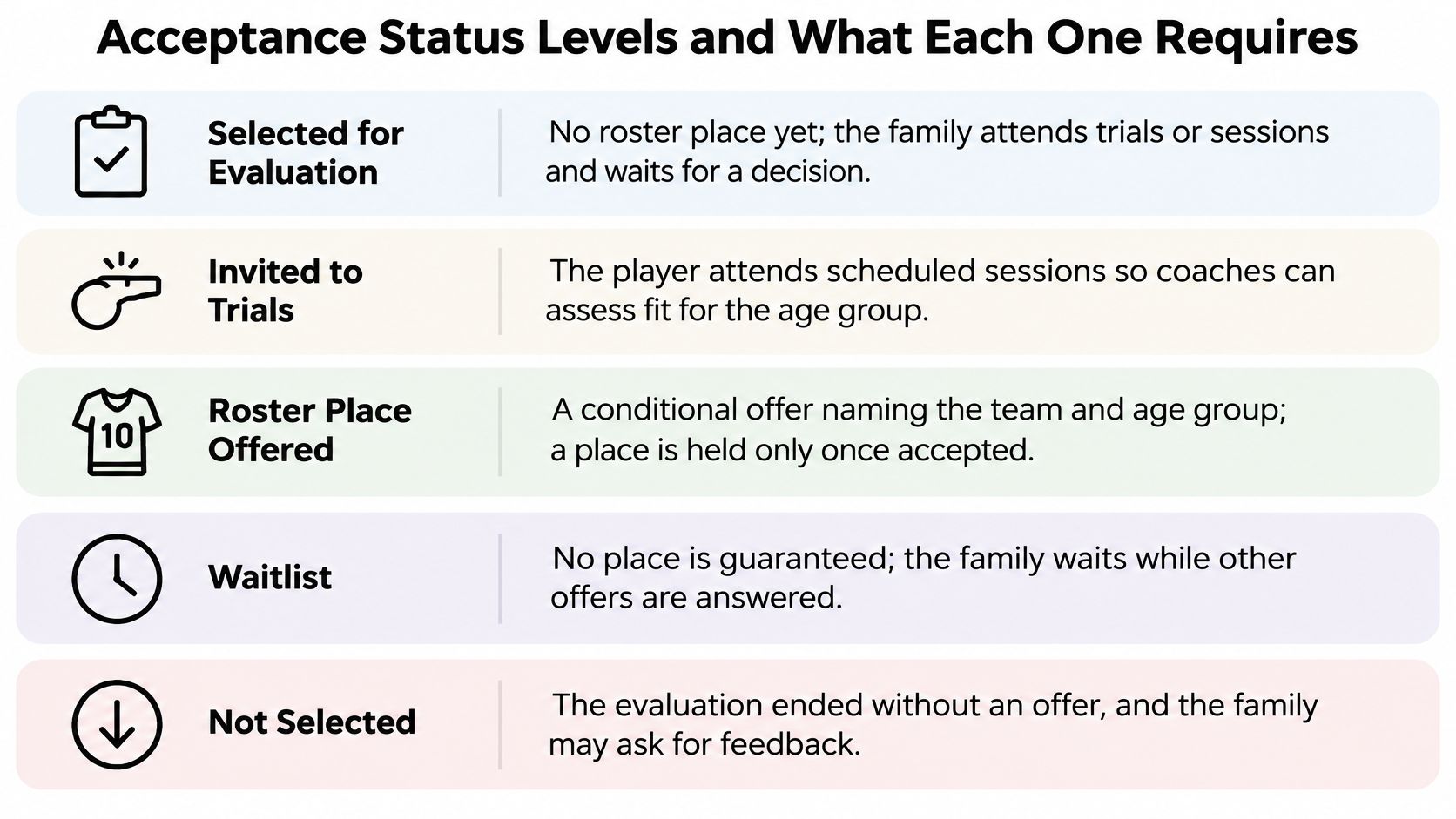
Selected for evaluation. No roster place exists yet. Your child attends the sessions, the coaches assess, and you wait. You commit to showing up and to nothing financial.
Invited to trials. Similar to an evaluation but usually scheduled and open to a larger group. Confirm the session dates and whether attendance at every session is expected, because missing one can end the process.
Offered a roster place. This is an offer, and it's conditional. It's held only if you respond by the deadline and complete registration. Read the fee and withdrawal terms before you reply, not after.
Wait-list. No place is guaranteed. Ask two questions: how does the club notify waiting families, and by what date should you assume the offer is dead? A wait-list with no notification date is a soft no.
Not selected. The evaluation ended without an offer. You can ask for feedback, and a well-run program will give it. Ask specifically which behaviors or skills the coaches wanted to see more of.
Research on youth selection indexed by the American Psychological Association found that A-, B- and C-team labels became the primary reference point through which boys judged themselves and their peers, with the top tier carrying substantially greater perceived value. That's a heavy weight to place on a line in a letter.
The same research supports behaviorally defined standards over prestige language: attendance, coachability, technical execution, tactical decision-making, respect, effort. Ask the club for the criteria behind the placement, the review dates, and a named contact for feedback. If you want a broader sense of how levels differ across the sport, this breakdown of soccer levels of competition explains where select, competitive and recreational tiers sit relative to each other.
A simple test before signing anything: if the letter does not name its status, ask which one applies.
What Acceptance Does Not Guarantee
Here's the figure that should reset your expectations. A study that followed 537 youth players over 12 years found that only 53 of them, or 10%, ultimately obtained a senior professional contract at the club, as reported in the Scandinavian Journal of Medicine and Science in Sports. Nine in ten players in that development system never reached a senior contract there.
The same study found that 68% of the players who did become professionals had been recruited at age 12 or older. Early selection isn't destiny. Late selection isn't failure.
So what should the letter say plainly? Roster status for this season only. No guarantee of playing time or a starting position. No guarantee of promotion to a higher team. No guarantee of travel selection, college recruitment or a professional opportunity. Participation does not guarantee playing time, starting positions, team selection, advancement opportunities, college recruitment opportunities, or professional opportunities, and submitting a registration doesn't guarantee acceptance into any program in the first place; the club may accept, deny, suspend or terminate participation at its discretion.
Read those exclusions as standard practice. A club that omits them isn't being generous. It's being vague, and vague language cuts against your family later.
What a strong letter does promise is concrete and near-term: training expectations, team standards, written development goals, conduct requirements, the fee schedule, the response deadline, and review dates when you'll get feedback.
The useful question: not "will this make my child a professional?" but "what will my child learn between September and November, and who will tell us how it's going?"
Costs, Payments and Withdrawal Terms to Check Before You Sign
The acceptance fee is almost never the season cost. Families discover the gap in October, when the tournament travel invoice arrives.
Cost Item | Ask Before Signing |
|---|---|
Acceptance or registration fee | Is it refundable if the family withdraws? |
Full season fee | What is the total cost for the whole season? |
Uniform and kit | Is kit provided, and is it due at signing? |
Tournament travel | Which trips are optional and which are required? |
Facility and training fees | Are facility costs included in the season fee? |
Goalkeeper equipment | Is specialist goalkeeper gear provided or extra? |
Payment plan or hardship help | Are installments, scholarships or sibling discounts available? |
Cost is not a side issue. A 2025 youth survey cited in an Aspen Institute report found that 47.9% of respondents said sports are too expensive, and a RAND review named finances, time and transportation as prominent barriers to participation. If your family is stretching to cover the fee, you're in a large group, not an unusual one.
Two financial rules deserve to be read twice.
The obligation survives the enthusiasm. Once a player accepts a roster position or completes registration, the financial obligation remains in effect regardless of participation status. If your child stops attending in October, the season fee doesn't stop with them.
And the refund line is usually narrower than families assume. No refunds are issued for voluntary withdrawal from the club, a transfer to another club, dissatisfaction with playing time, coaching decisions, team placement, or schedule conflicts. That's not unusual in competitive youth soccer, but it's the clause most families discover only when they need it.
Ask one more question that separates a developmental offer from a pay-to-play transaction: does this acceptance reflect demonstrated performance, a roster need, or enrollment capacity? A club that can't answer is selling a spot, not selecting a player.
Before you compare programs, it helps to understand what each fee buys. This explanation of soccer academy fees walks through the cost structure behind a competitive season.
Ask in writing: "What is the total cost of this season, including travel, kit and any optional items, and what are the refund terms if we withdraw in the first month?"
Confirm the Letter Before You Accept the Place

An acceptance letter reads like good news, and it is. It is also a conditional offer: paperwork has to clear and the first payment has to land before the place is fully yours. Read it once for the celebration, then a second time the way an administrator would, line by line, before you respond.
Name the status. Identify which of the five statuses the letter states, and check it against what the coach told you at the evaluation. If the two don't match, ask before you sign.
Run the elements checklist. Confirm the response deadline, the fee schedule, the required documents and the withdrawal terms are all present and specific. A missing refund clause changes what you can recover later.
Compare promises against exclusions. Note every question you have about playing time, review dates and development goals. Write them down and send them as one email.
Ask in writing and keep the reply. Anything promised verbally, from a starting position to a waived fee, should come back to you in writing before money changes hands.
Sign only when you can state three things. The total season cost, the response deadline, and the name of the coordinator who answers your questions.
Once you sign and complete registration, the financial obligation applies, and the written record becomes the thing you rely on if a disagreement arises later. Until that point, the conditions still belong to the club. That is why the deadline and the document list are the two lines to check first.
Check the packet for a media clause while you're at it. Some clubs state that unless a parent prohibits it in writing, photographs, videos and recordings of participants may be used for promotional, educational, marketing and social media purposes without compensation. If you'd rather your child not appear in club media, the time to say so is before you return the forms, in writing.
It also pays to know how disputes are handled. Under Villarreal Houston Academy's terms, disputes tied to membership, payments, participation or coaching decisions are resolved exclusively through binding arbitration before a single arbitrator in Harris County, Texas, and the parties have 30 days to attempt good-faith resolution through written notice before any legal claim begins. Your letter and your email thread are the record that process will look at.
Families often ask who to call with a registration question. The answer is the coordinator named in your own letter, not a general office line or a coach on the field. If your letter names no one, request a named contact before you respond. Registration steps and timing are usually explained in resources like this guide to youth soccer registration, which is a reasonable place to start when you're unsure what happens after the signature.
A clear, written acceptance protects the player and the family as much as it protects the club. Read it as an adult document, ask your questions in writing, and keep the whole thread on file.
Villarreal Houston Academy sends written offers after tryouts, and the letter you receive names the team, the season and the next steps rather than leaving you to guess. Our select and competitive programs for boys and girls from age 4 upward run on a clear development pathway, and our staff will walk you through fees, registration and what a place does and doesn't include before you commit. Visit Villarreal Houston Academy to learn about tryouts, programs and locations across North Houston, and bring your questions to the acceptance conversation.
Comments