


Soccer Kingwood TX: Youth Programs, Training and Pathways

Which soccer program in Kingwood should my child join? Most parents answer by opening the nearest club's registration page and signing up for whatever age group looks closest. That order costs families time and money, because the right fit is decided by three things a club page rarely puts side by side: the child's birth year, the drive to the training site at 5:30 on a weekday, and the full seasonal cost once uniforms and tournament fees are added in.
Reverse the order. Find the birth-year band first, then check the drive, then the money, and only then compare coaching. Parents searching for soccer Kingwood TX options usually get a list of clubs with no cost, no address and no drive time attached. This guide puts those three columns next to the program name so you can rule options out before you pay a registration fee.
One warning before the details. The Kingwood, Porter and New Caney corridor has grown fast enough that program listings change between seasons, and some start dates below are listed for Spring 2026 or February 2026. Confirm with the club before you plan around a date.
Youth Soccer Programs in Kingwood by Age Group
Age or birth year | Program | Location | Notes |
|---|---|---|---|
4-5 | Future Stars developmental program | United City Church, Humble | Entry level for first-time players |
5-9 | Villarreal Junior Academy | Fall Creek Sports Complex, United City Church | Fundamentals and play-based training |
5-9 | Junior Academy | Porter-Kingwood-New Caney location | Spring 2026 launch listed; confirm current status |
4-13 | Recreational Soccer with MLS Go | Fall Creek Sports Complex | Non-competitive entry point |
7-15 | Girls technical program with Coerver | Porter-Kingwood-New Caney location | Start listed as February 2026; confirm current season |
10-18 | Villarreal Competitive Teams | Fall Creek Sports Complex | Select and competitive play |
Birth years 2010-2013 | Boys competitive categories | Cypress-Tomball location | Competitive boys' teams |
Start with the youngest band. Future Stars takes four and five year olds at United City Church, and the goal at that age isn't tactics. It's comfort: stopping, turning, touching the ball with both feet, and staying in the group without a parent on the field. Sessions are short and playful, and a child who cries in week one often settles by week three.
Ages five through nine is the busiest band in Kingwood. The Villarreal Junior Academy runs at Fall Creek Sports Complex and at United City Church, and it sits between pure recreation and competitive teams. The same age band is listed at the Porter-Kingwood-New Caney location, which opened a Junior Academy for Spring 2026 with more age groups added in Fall 2026. Families in Porter and New Caney should check that site before committing to a Fall Creek commute.
From four to thirteen, recreational soccer at Fall Creek Sports Complex in partnership with MLS Go is the low-pressure entry point. It suits a child who wants weekly games with friends, and it's the right first step for most beginners.
Older and more driven players split two ways. Competitive Teams for ages 10-18 train at Fall Creek, while the boys' competitive categories for birth years 2010 through 2013 sit at the Cypress-Tomball location. For girls who want technical work rather than another team, a Coerver program for ages 7-15 is listed at Porter-Kingwood-New Caney with a February 2026 start.
Check the birth year cutoff before you register
Almost every club places players by birth year, not by the age they turn during the season. A child born in November 2019 and a classmate born in January 2020 may land in different bands. Before you register, read how youth soccer age groups work and match your child to the correct cutoff year.
Have these four things ready at registration:
Birth year, from the birth certificate, not from memory.
Current school grade, since some programs organize by grade instead.
Previous experience and positions played, including any rec league or camp.
Injury history the coach should know before the first session.
Where Kingwood Families Train and Play
Where can your child train without turning practice into an exhausting commute? Start with the location that matches the program, then check the route at the time you would drive it.
The three ZIP codes that anchor the Kingwood market, 77339, 77345 and 77346, have about 81,692 residents, a median household income of $77,527, and 53.63 percent of residents hold a college degree, according to Kingwood community population data.
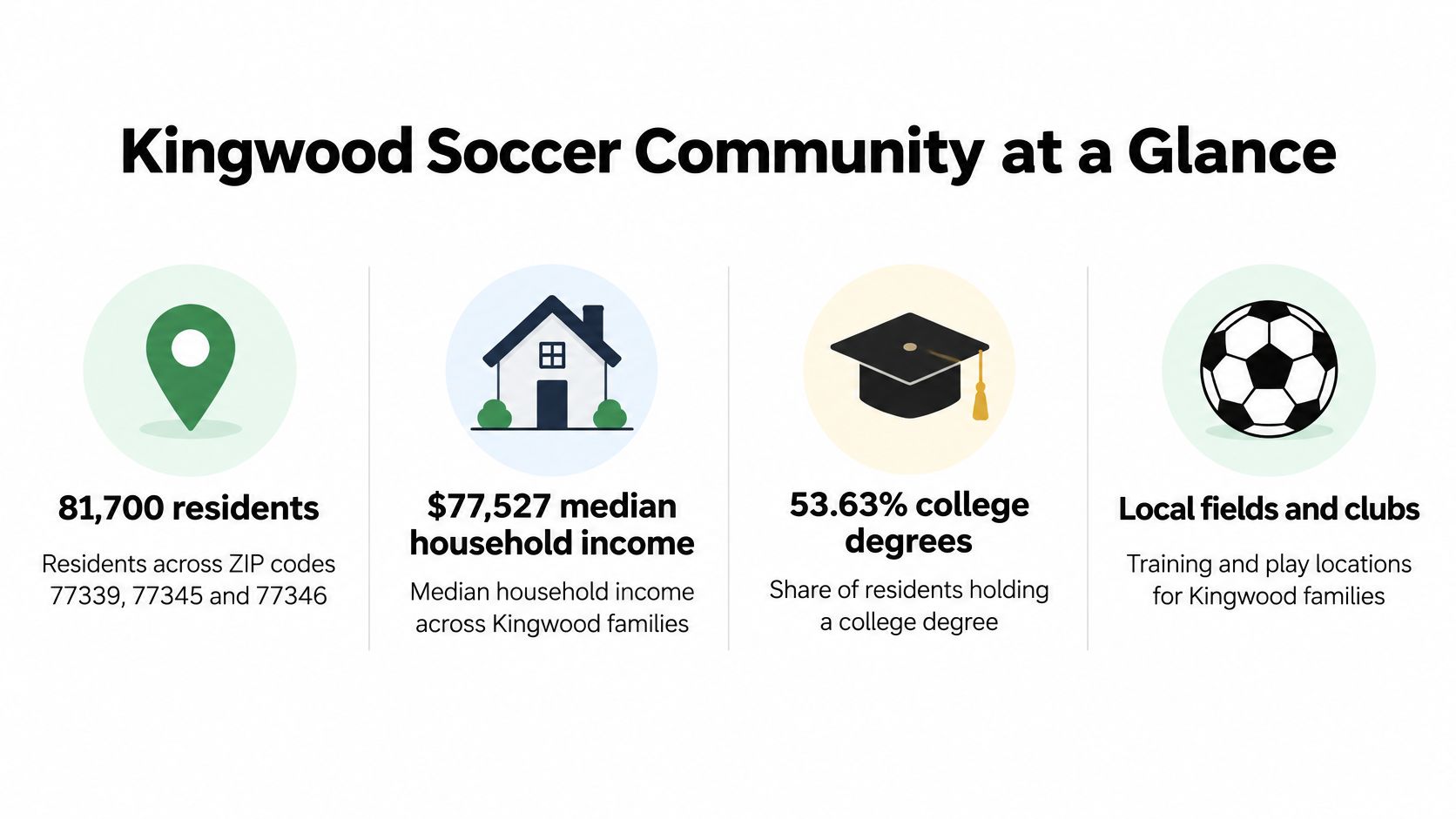
Kingwood families can also use public soccer fields at Northpark Recreation Area and River Grove. Some fields are shared with other sports, so availability may vary.
Villarreal Houston Academy's programs operate at several Humble addresses, while its Porter-Kingwood-New Caney turf fields serve families across those three communities. The academy's expansion into Kingwood, Porter and New Caney gives families another option to compare with the Humble sites.
Location | Address | Programs or uses |
|---|---|---|
Fall Creek Sports Complex (HKA South) | 9810 Wyatt Shores Dr, Humble, TX | Recreational, Junior Academy, competitive teams |
United City Church (HKA North) | 19901 Townsen Blvd, Humble, TX 77338 | Future Stars, Junior Academy |
JC Sports Indoor Center | 18610 Page Forest Dr, Humble, TX | Indoor Coerver technical training |
Porter-Kingwood-New Caney turf fields | Fields across the Porter, Kingwood and New Caney area | Serves Kingwood, Porter and New Caney |
Northpark Recreation Area | Public park in the Kingwood area | Public soccer fields, some shared with other sports |
River Grove | Public park in the Kingwood area | Public soccer fields, some shared with other sports |
Time the drive at practice hour
Check the drive before choosing a program. A route that takes 20 minutes at midday may take 45 minutes when practice starts, changing the weekly schedule substantially. Two weekday practices and a weekend game mean three round trips; at 45 minutes each way, that adds up to four and a half hours in the car each week.
Training Formats and How to Judge Quality
Format | Best for | Question to ask |
|---|---|---|
Recreational league | Beginners and fun-first players | How many coached sessions per week? |
Academy or Junior Academy | Players wanting a structured pathway | How is progress measured each season? |
Competitive or select teams | Players ready for tryouts and travel | How many practices and tournaments per season? |
Indoor technical training | Ball control and skill work in bad weather | What is the group size and session focus? |
Camps and clinics | Short, intensive skill blocks | What is the coach-to-player ratio? |
Now the assumption worth testing. More hours do not automatically build a better player. A systematic review of elite football development found that top players often accumulated roughly 3,000 to 8,000 hours of structured, coach-led practice between ages 15 and 18, but the same review of football development research is explicit that this is not a prescription for heavier weekly schedules or early specialization. Development comes from the mix: structured training, informal play, competition, and psychological growth.
So judge the session, not the calendar. Four checks work for any program in the area:
A stated objective. The coach can tell you what this session is teaching before it starts, not after.
Progressive difficulty. The drill gets harder as players succeed, and easier when they don't.
Decision repetitions. Small-sided games where players choose to pass, dribble or shoot, not lines waiting for a turn.
Individual correction. A coach who stops one player, shows the fix, and restarts the drill.
The question that separates programs. How does the club measure whether a player improved this season, and what evidence can it show you?
If the answer is goals, wins or attendance hours, you've learned something useful. Stronger answers name things you can watch: scanning before receiving the ball, successful actions under pressure, off-ball positioning, decision quality.
Ask two more questions before signing. How are the coaches trained, and does the club involve sports psychologists or offer any psychological support? A curriculum that stops at technical work leaves out the part of development that decides whether a player is still playing at seventeen.
Heat, Workload and Injury Risk in Kingwood
How can parents judge a soccer session in Kingwood's summer heat? Start by watching how players recover between drills, then ask how coaches adjust the workload when conditions are demanding.
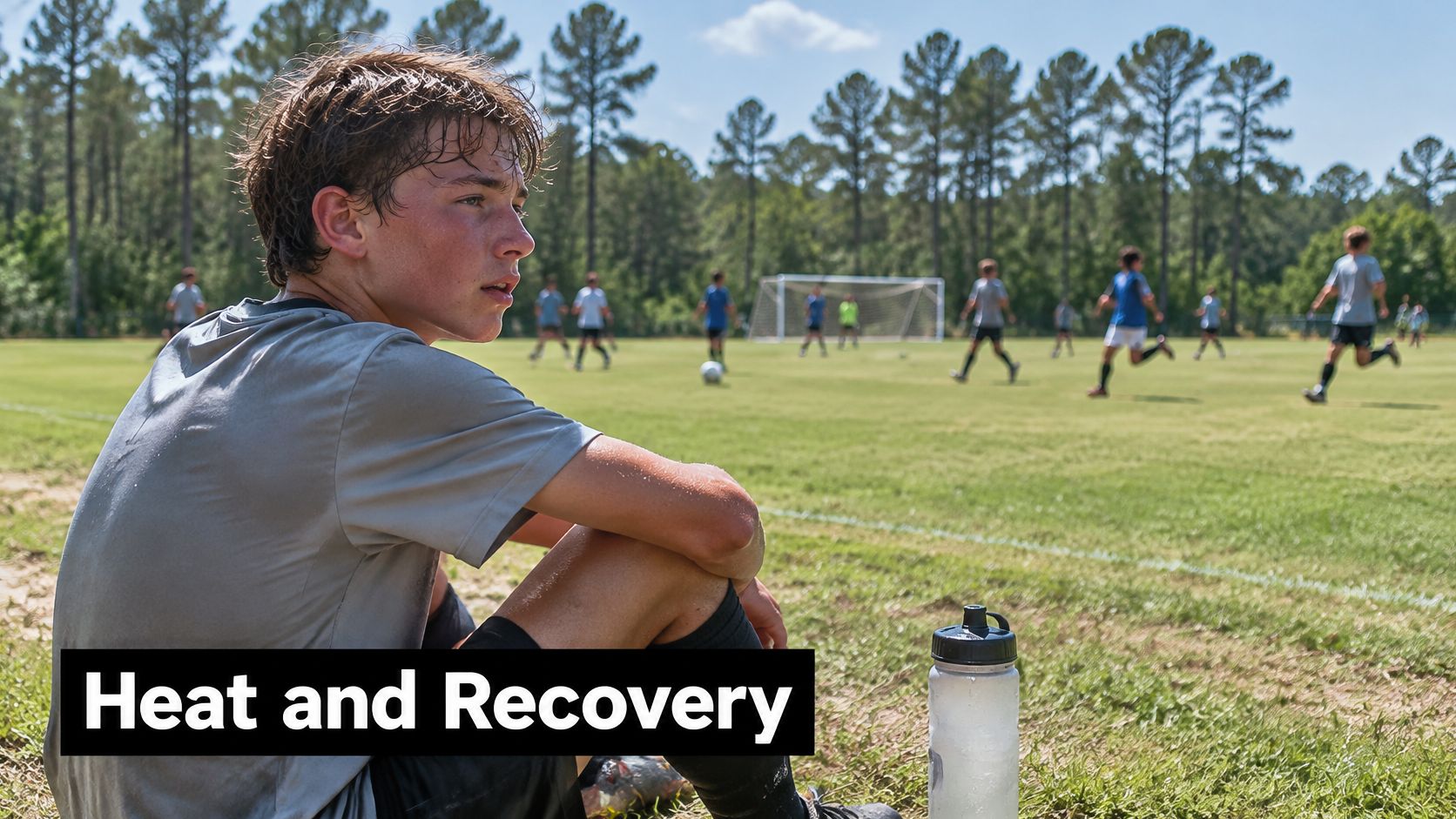
Typical July and August conditions in the Kingwood area reach about 93 to 94°F, with relative humidity near 70 to 71 percent and dew points around 74°F, according to Kingwood-area climate records. Humidity slows evaporative cooling, so a drill that feels manageable in a dry climate can put more strain on a young player here.
Use this checklist at any training site:
Ask when hard sessions are scheduled. Cooler morning or evening windows can be more suitable for intense technical work and small-sided games than a hot afternoon.
Check the shade and water-break plan. Ask where players can cool down and how often breaks happen. Then watch whether the coach follows the plan.
Ask how heat affects practice decisions. Coaches should be able to explain when they modify or cancel a session and who makes that call.
Check the field after rain. Standing water can delay practice. Saturated turf reduces traction and can increase slipping and awkward loading.
Younger players may not recognize or report heat symptoms promptly. Coaches should watch for warning signs, build workload gradually, and remove a child from play immediately if heat illness is suspected.
Overuse injuries are the slower risk in youth soccer. They tend to become more likely when workloads are heavy or young players specialize in one sport early. Soreness after a hard session can happen, but pain that changes a player's running is a reason to stop and seek appropriate guidance. For general background on muscle soreness, DOMS relief for busy lifters discusses recovery basics.
Before joining, ask about weekly workload, support for playing multiple sports, the concussion protocol, and the process for returning after an injury.
Costs, Access and Travel for Kingwood Families
Could your child's age group, program cost and weekly drive all fit your family's schedule? Start by matching the age band to a nearby option, then compare the full cost and travel commitment before registering.
Villarreal Houston Academy offers select and competitive youth soccer for boys and girls as young as 4. At Fall Creek Sports Complex, families can find recreational soccer for ages 4–13 through MLS Go, the Villarreal Junior Academy for ages 5–9, and competitive teams for ages 10–18. Fall Creek is at 9810 Wyatt Shores Dr in Humble. The Porter-Kingwood-New Caney location offers a Junior Academy for ages 5–9 for Spring 2026 and Coerver Just For Girls for ages 7–15 starting February 2026. Check with the academy about current schedules, costs and the field location for the program you're considering.
A five-step budget routine
List registration and uniform costs. Ask what the fee includes and whether families need to buy additional uniforms or gear.
Include tournament fees and travel. For select soccer, ask how many travel weekends to expect and what costs families pay beyond entry fees.
Account for siblings and transportation. Separate schedules can mean extra trips, while carpooling may reduce the number of drives.
Ask about payment options. Check directly with the program about payment plans or financial assistance, if available.
Compare cost with drive time. Put the seasonal expenses beside the weekly travel commitment. A lower fee may be harder to manage if the field is far from home.
Youth soccer costs and access to a ride vary by household. The useful comparison is the total commitment for your family, not a national average.
Practical rule. A program's listed fee is only one part of the commitment. Include the drive to and from training, repeated across the season, when deciding whether it fits.
Before registering, ask which teams are recreational and which are select, what the complete cost covers, whether carpooling is practical, and where the team trains. For Kingwood families, a nearby age-appropriate program may be easier to sustain than one that requires a long drive several times a week.
Pathways From Recreational Soccer to Competitive Play
Local players have several possible routes from first touches to high school soccer. Kingwood High School's recorded all-time boys' soccer results are 113 wins, 117 losses and 63 ties, with a playoff record of 10 wins and 8 losses, according to the MaxPreps all-time record for Kingwood High School.
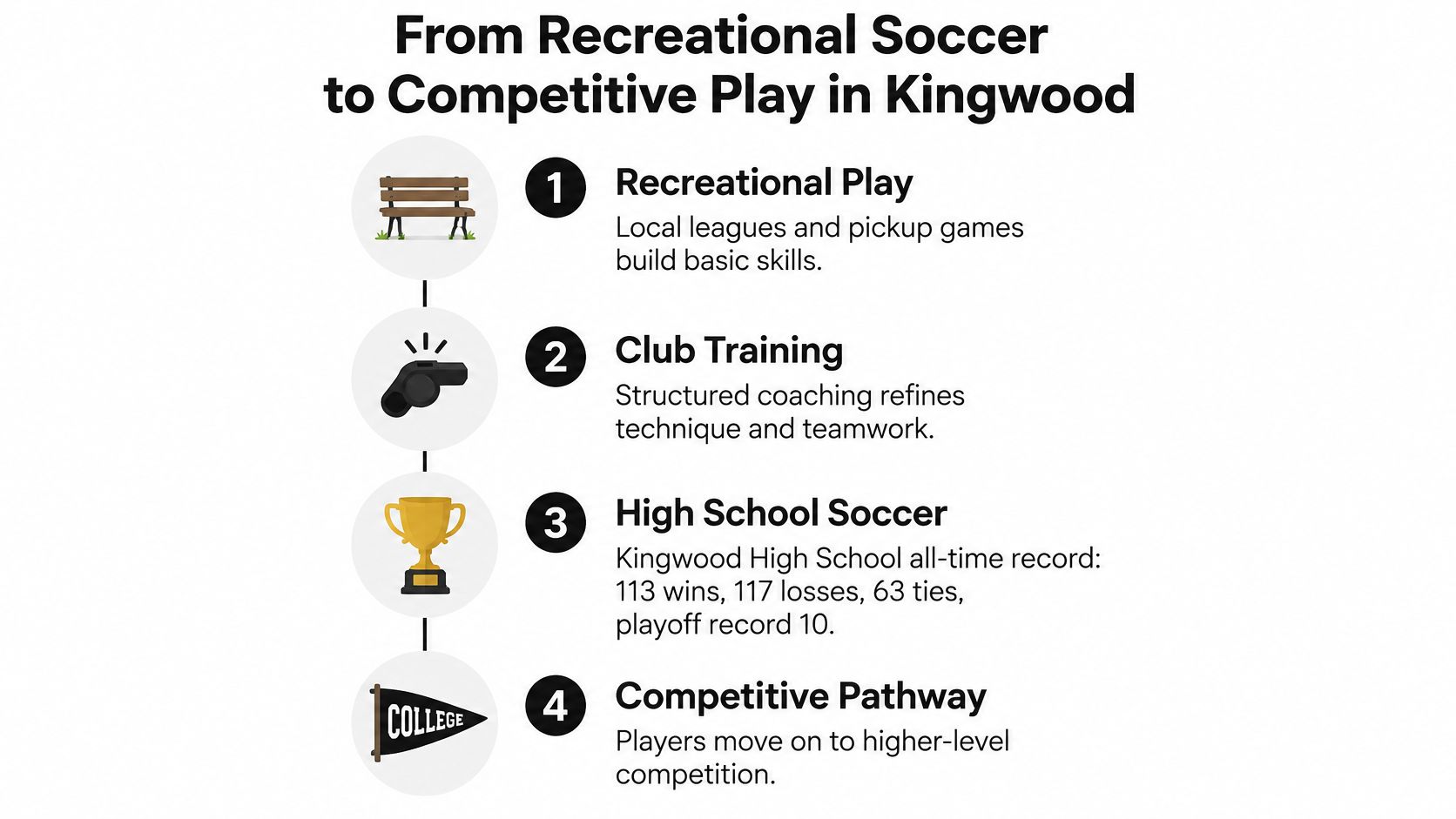
Kingwood, Kingwood Park and West Fork make this a multi-school soccer market. Kingwood High School also finished tied for 17th in Class 6A in the 2023-24 UIL Lone Star Cup with 58 points, according to Humble ISD's report on the standings.
A player's route often starts with recreational soccer, then moves through age-appropriate development and competitive play:
Recreational soccer, ages 4-13. Players learn to move with the ball, work with teammates and enjoy the game. At Fall Creek Sports Complex, recreational soccer is offered in partnership with MLS Go.
Junior Academy or Future Stars, ages 4-9. These programs focus on fundamentals through repeated touches and small-sided games. For example, a player practices receiving the ball and choosing what to do next. Villarreal Houston Academy offers a Junior Academy at Fall Creek Sports Complex, and United City Church offers both the Junior Academy and Future Stars.
Competitive teams, ages 10-18. Tryouts and a greater commitment to training and travel mark this step. At Fall Creek Sports Complex, Villarreal Houston Academy offers competitive teams for ages 10-18. Read how youth soccer competition levels differ to understand the options before considering a tryout.
The step back is part of the pathway
A player who feels overwhelmed at a higher level may develop better in a group where they can play with confidence. Regular minutes and chances to try new skills can help more than spending a season mostly on the bench.
Look at three signals when judging readiness: tryout feedback on skill and decision-making, coach comments on effort and decisions under pressure, and the player's motivation to attend practice. Taken together, they give a clearer picture than any one signal alone.
Choose Your First Step in Kingwood Soccer
You can finish this in a week. Work through it in order.
Pick the row that matches your child's birth year from the age table, not the row that looks about right.
Choose one training format that fits both your child's goals and your family's weekly time, using the format comparison as the filter.
Confirm the site is a drive you can sustain at practice hour, in traffic, on a school night.
Request a full seasonal cost sheet and work through the budget routine before you pay a deposit.
Watch one practice before committing. Then check whether the coach explained what each player should improve.
For registration questions, the local route is straightforward. Villarreal Houston Academy is the official partner academy of Villarreal CF and can be reached at 281-962-4920. Fabian Montenegro is the Academy Director for West Houston, and Jennifer Coronel is the Community Liaison for registration questions.
A player who moves down a level and plays with confidence often develops faster than one who stays where every touch feels like survival.
The best program is not the biggest name or the closest field. It's the one that fits your child's age, the drive your family can manage, the full cost your family can carry, and the coaching style your child responds to. Keep short notes on how your child handles coaching, workload and heat. Those observations tell you whether the next move is up, stay, or step back.
Villarreal Houston Academy runs the age-banded pathway described here, from Future Stars for ages 4-5 and the Junior Academy for ages 5-9 through competitive teams for ages 10-18, at sites in Humble, Fall Creek and the Kingwood, Porter and New Caney corridor. Coaches work within the Villarreal CF methodology alongside sports psychologists, so the development plan covers more than match results. Visit Villarreal Houston Academy to see current programs, locations and registration details for your child's birth year.
Comments