


Find Your Soccer Club in Houston TX: 2026 Guide

Two players can live in the same Houston neighborhood and still need very different soccer environments. One may want convenient training, a supportive coach, and steady technical progress. Another may be targeting ECNL, Girls Academy, college exposure, or a bridge for older players. The right soccer club in Houston, TX depends on that difference.
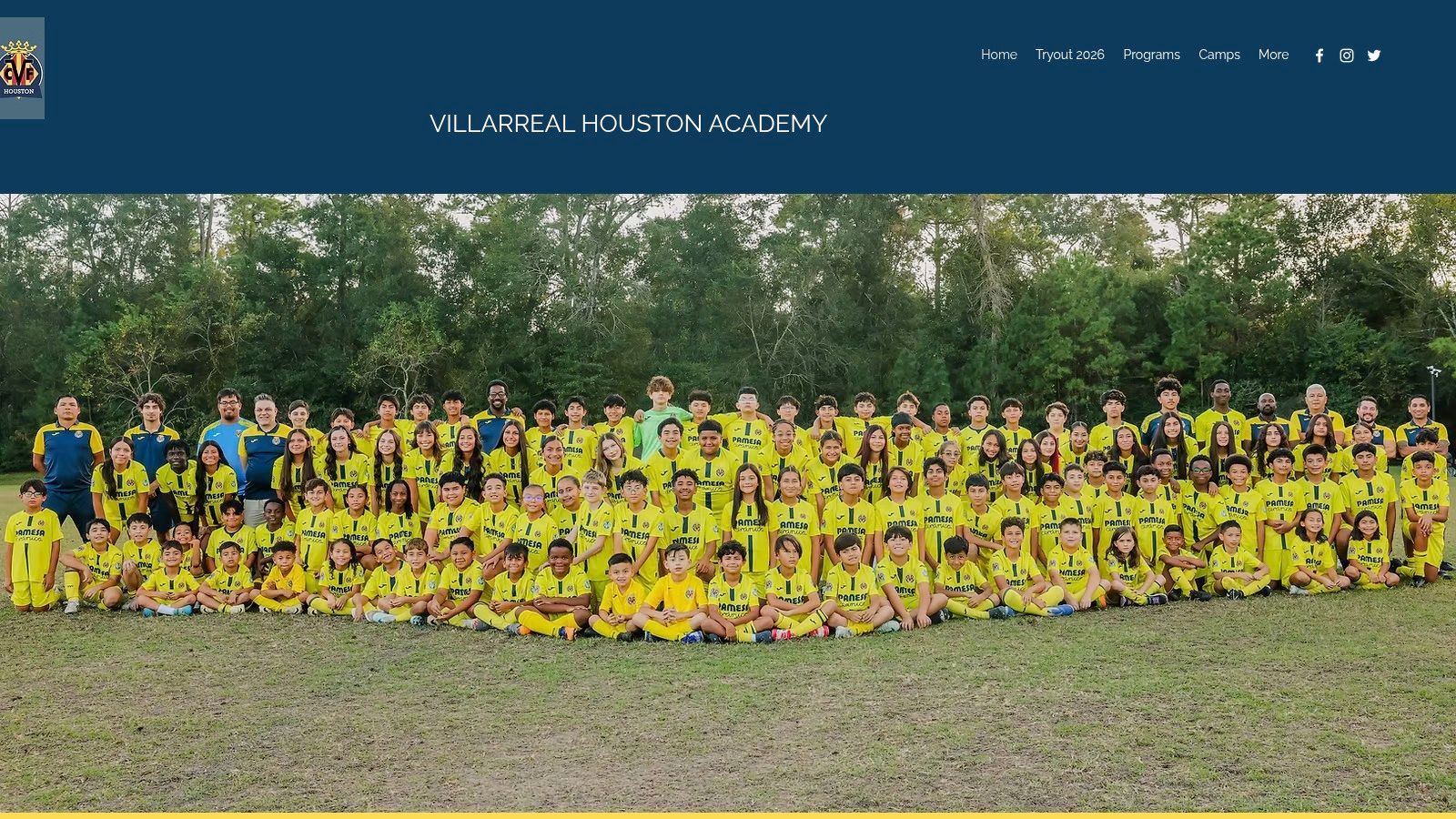
This guide compares seven clubs by program breadth, age groups, competitive platforms, coaching and development approach, facility access, tryouts or evaluations, geography, and publicly available cost information. It also includes Villarreal Houston Academy, the official Greater Houston partner of Spain's Villarreal CF. The Academy serves boys and girls from age 4 upward through teams, camps, clinics, and tryouts, with training locations across North Houston.
Houston already has a substantial player pipeline. HYSA traces formal youth-soccer governance in the area to 1968, while independent coverage describes more than 50,000 registered youth players across more than 500 clubs and academies. Houston Youth Soccer Association The city's professional demand is also established, with the Houston Dynamo drawing 25,462 fans for its first match in 2006. Houston Dynamo history and attendance
Use this framework before choosing:
Player fit: age, ambition, gender-specific needs, and readiness.
Pathway: recreational, competitive, ECNL, Girls Academy, college, or adult soccer.
Practical load: commute, training schedule, tournaments, travel, and total cost.
Practical rule: Evaluate the specific team, coach, campus, facility, and travel schedule, not only the club name.
1. Villarreal Houston Academy
For a family in North Houston, the decision may come down to commute, player ambition, and the type of development environment wanted. Villarreal Houston Academy offers a structured local option connected to Spain's Villarreal CF, with programming for boys and girls ages 4–18. Its offer includes year-round teams, competitive programs, camps, clinics, and tryouts.
The Academy's approach links technical training, tactical understanding, and character development. Younger players can work on foundational skills in an age-appropriate setting, while older athletes can enter more demanding competitive programs. The coaching model also includes sports-psychology support, with an emphasis on confidence, decision-making, respect, and personal responsibility.
Families can review the Academy's Villarreal CF youth academy pathway to see how its local programming relates to Villarreal CF's development identity. Standout players may have opportunities to travel to Spain for training and matches with the club's elite academy, including access to facilities such as Estadio de la Ceramica and Ciudad Deportiva.
Location may decide whether the program works in practice. Training sites serve families in Humble, Fall Creek, Cypress, Tomball, Kingwood, Porter, and New Caney. That spread can reduce the strain created by school schedules, siblings, work, and evening traffic. Families should confirm the assigned campus and team schedule before enrolling, since the nearest site may not offer every age group or level.
The Academy stands apart through local access, technical development, and a Villarreal CF connection. It can suit families seeking a more structured pathway while still valuing enjoyment and continued participation.
Best fit: Boys and girls seeking technical, character-centered competitive development.
Geographic advantage: Multiple North Houston-area training locations.
Development feature: Age-appropriate technical and tactical work linked to Villarreal CF methodology.
Decision point: Pricing, travel costs, and detailed parent or player testimonials are not publicly listed, so families need a direct conversation with the Academy.
Programs like Houston Parks and Recreation charge $250–$315 per season, while competitive club fees add uniforms, registration, tournament, and travel expenses. Houston youth soccer access and cost coverage A direct fee conversation is essential before comparing the Academy with other clubs.
2. HTX Soccer

HTX Soccer, formerly Houston Dynamo | Dash Youth, offers one of the widest program ranges in the Houston area. Its north, south, east, and west Houston sites let families weigh driving time alongside team level. Boys and girls can enter recreational, competitive, or elite programs, with year-round camps, identification events, goalkeeper training, and advanced team environments.
That breadth can matter as a player's age, goals, or weekly availability changes. A family may prefer staying within one organization as a player moves from recreational soccer to a more demanding competitive or showcase schedule. Older players pursuing college exposure can also evaluate elite platforms and showcase-focused opportunities within the club.
What scale changes
The relevant comparison is the specific campus and team, not the organization's overall size. A broad program menu may vary by location, age group, coach, and roster depth. Families should confirm where the player's team trains, how often it practices, and whether the local team provides the level of competition the player needs.
HTX includes Boys ECNL and ECNL-RL, as well as a girls elite pathway. These platforms may fit ambitious players seeking higher-level competition, while their schedules can require more travel and weekend availability than recreational or local competitive teams. A coed club structure also differs from a girls-only option, so families should compare the player's preferred environment as well as league access.
Best fit: Families seeking multiple levels and coverage across Houston.
Strong point: A possible progression from recreational soccer to elite programming within one organization.
Questions to ask: Which campus serves your zip code? Who coaches the player's age-group team? Where are home practices held? How many tournaments require overnight travel? Is the quoted fee separate from uniforms, showcases, and registration?
Cost consideration: Request a full seasonal estimate covering tournaments, showcases, uniforms, registration, and travel.
Families comparing HTX with other Houston options can also review Houston Dynamo tryouts and youth pathways. The practical decision is whether the nearby campus offers the right coach, roster level, pathway, and schedule for the player. HTX Soccer
3. RISE Soccer Club
A family in West University or Bellaire may reach RISE with less weekday driving than a North or Northwest Houston club. That geographic advantage matters most when practices occur several times a week and tournament travel already fills weekends. RISE serves boys and girls through recreational, competitive, and elite programs.
The first question is the player's target pathway. Girls can pursue the Girls Academy, while boys can enter ECNL or ECNL-RL environments. Families should compare league access, team culture, and the player's ambitions rather than treating those platforms as interchangeable.
RISE's current structure grew from the combination of Houston Express, Eclipse, and Texans SC. That history provides a broad base of teams, coaches, and alumni connections. It does not guarantee equal roster depth across every age group, so a family should examine the specific team, coach, and training site under consideration.
Year-round tryouts and evaluations offer more entry points than a single annual selection period. The label alone is not enough. Ask whether the evaluation concerns a named roster, a training pool, or general placement, and whether a player can move between groups as development changes.
Best fit: Central and southwest Houston families evaluating Girls Academy or boys ECNL options.
Girls-only or coed choice: RISE's league pathways differ by gender, so ask which environment and competition level apply to the player's age group.
Competitive trade-off: Elite platforms can bring stronger opponents and a larger commitment to events, travel, and family availability.
Cost question: Request a current outline that separates club fees from uniforms, tournaments, showcases, and travel.
For younger players, the development setting may matter more than immediate platform status. Older players should ask about showcase dates, roster expectations, playing opportunities, and the next competitive step. RISE is therefore a fit decision tied to age, location, ambition, and available family time, not just a search for the closest soccer club in Houston, TX.
4. Albion Hurricanes FC
Founded in 1989, Albion Hurricanes FC, or AHFC, has built one of Houston's longest-running soccer structures. Its programs span recreational, competitive, and elite levels, with options for younger players and older athletes pursuing higher competition. The AHFC Royals extend that pathway toward pre-professional soccer through USL League Two.
That history matters most for families comparing continuity with specialization. A player can enter through the Junior Hurricanes recreational programs, then consider select or elite teams without changing organizations immediately. The trade-off is that the club's broad system does not guarantee the same roster depth, coaching approach, or schedule at every age group. Evaluation details should be confirmed for the specific team under consideration.
Campus and facility fit
Location can determine whether the pathway works in practice. Campbell Road Sports Park is a recognizable AHFC facility, while households near Memorial and Spring Branch may value access to West Houston sites. Weekday driving, training frequency, and tournament travel can outweigh the appeal of a club's history, particularly for younger players with several family commitments.
Tryouts and event infrastructure support the competitive route, but placement may involve a named roster, a training group, or a wider age-group pool. Families should clarify which one applies, how movement between groups works, and whether the proposed schedule matches the player's ambition.
AHFC fits families seeking organizational continuity, multiple development levels, and a facility network with relevance in West Houston. It may fit less well when a highly localized schedule is required or when the family needs every fee, tournament expense, uniform cost, and travel expectation explained before evaluation. The right comparison depends on age, competitive goals, geography, and available time, rather than the club's established name alone.
5. Challenge Soccer Club
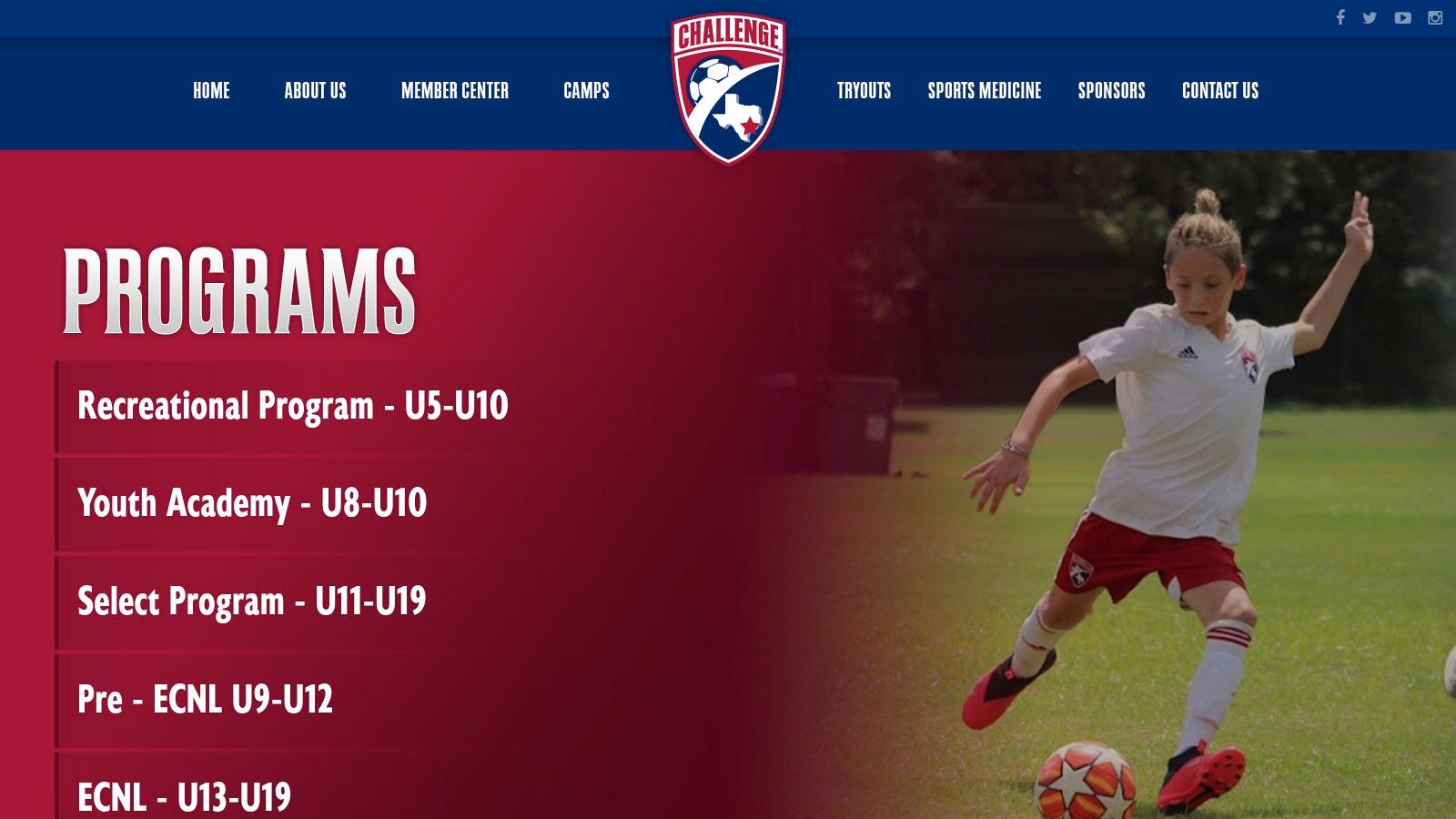
If your daughter plays soccer and you want a girls-only competitive environment, Challenge Soccer Club offers a direct fit within Houston's ECNL field. It is one of the longest-running all-girls organizations in the United States and the first Houston club invited to ECNL Girls. Those facts make its pathway especially relevant for families comparing girls-specific and coed options.
The program includes academy, ECNL, and ECNL-RL teams. Players can progress from foundational development into a demanding girls platform, while showcases and events may support families pursuing college-focused exposure. The Texas Shootout adds to that event profile by bringing competitive girls teams and recruiting attention together.
Challenge's specialization shapes the decision. A girls-only setting may align coaching, competition, team culture, and development around the needs of female players, while boys and families seeking a mixed program need a different club. That makes player eligibility and program preference the first screening questions, before location or competitive ambition.
Training sites across North and West Houston can suit some households, but families should confirm the campus, age-group schedule, and expected weekly travel for the specific team. ECNL and ECNL-RL commitments may also include substantial tournament and showcase travel.
Best fit: Girls pursuing a dedicated competitive and college-oriented pathway.
Distinctive feature: ECNL Girls history and girls-only programming.
Family commitment: Confirm showcase, tournament, training, and travel requirements.
Cost transparency: Request the full fee breakdown, including expenses beyond registration.
Families comparing a girls-specific route can use this guide to soccer for girls when assessing coaching style, competition, and long-term fit. Challenge may be a strong match for a girl with clear competitive goals, but its value depends on age, ambition, geography, and willingness to travel. Those factors should be weighed alongside North Houston alternatives such as Villarreal Houston Academy, rather than treating one pathway as suitable for every family.
6. Houston Surf Soccer Club
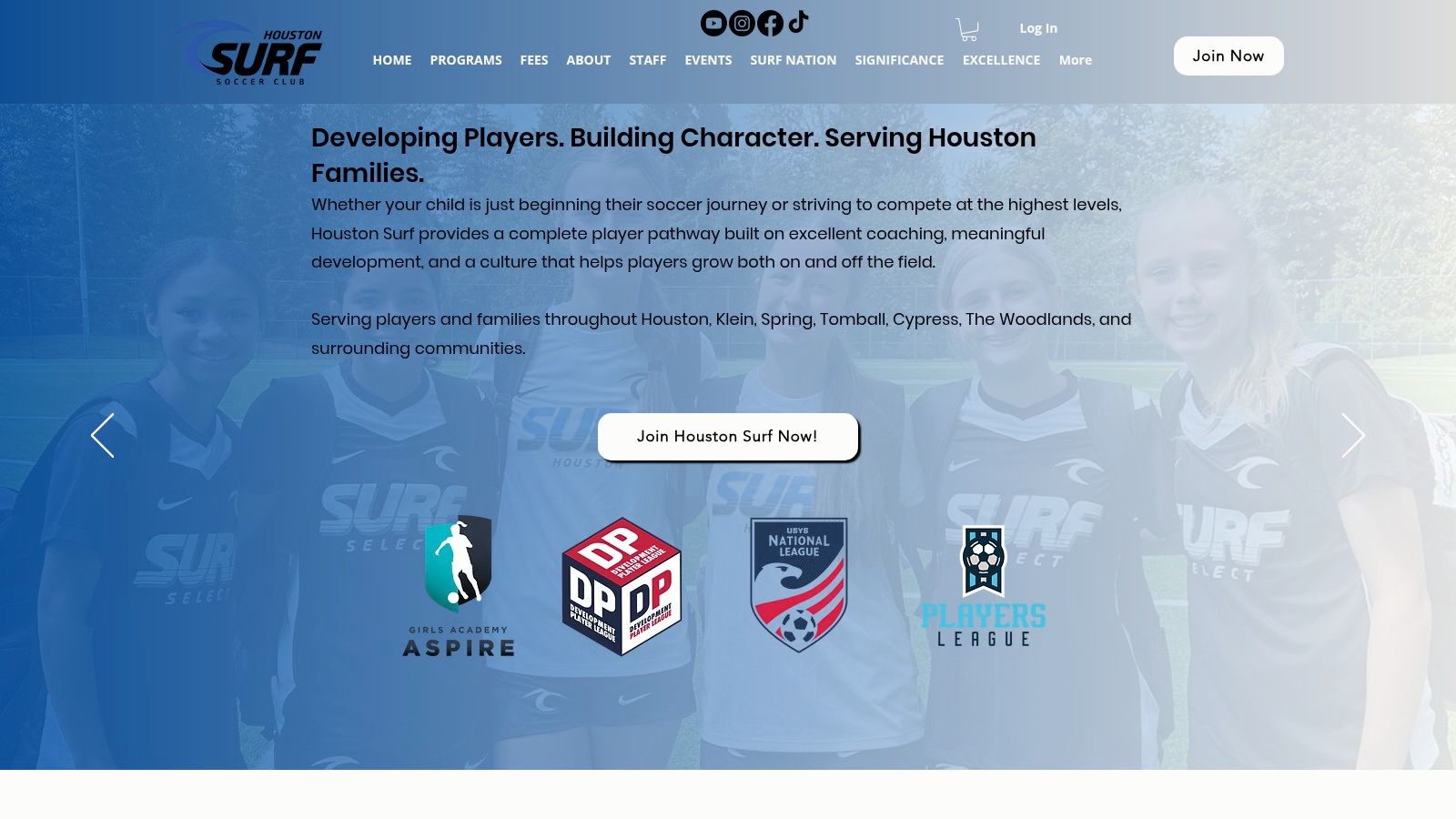
Houston Surf Soccer Club provides a useful comparison benchmark because its published fees show what cost transparency can look like in practice. Families can use that standard when comparing clubs, asking each one for a written list of included and excluded expenses rather than relying on a headline registration price.
The club is concentrated in Northwest Houston, including Klein, Spring, Tomball, and Cypress. That footprint may suit families seeking shorter routine drives in the northwest corridor, while households in South or Southeast Houston could face a substantial commute. The location should be evaluated alongside the player's training schedule and expected tournament travel.
Houston Surf offers Youth Academy, Competitive, and Elite teams, plus camps, clinics, goalkeeper training, and college guidance. Its connection to Surf Nation may provide broader identification and event opportunities, while the local organization focuses on player development and team culture in Houston.
Published annual fees and program inclusions make budgeting easier to assess. Parents should verify whether personal travel, hotels, optional training, tournament costs, and equipment are outside the listed package. The club's newer local affiliate status also creates a trade-off. A developing organization may offer a focused culture and expanding opportunities, but some age groups may have fewer internal teams than larger citywide programs.
For a family considering Houston Surf, the practical questions are whether the northwest location fits weekly routines, whether the player's age group has sufficient roster depth, and which competitive pathway matches the player's ambition. Families should also compare the full written cost with alternatives such as Villarreal Houston Academy, rather than treating transparency alone as proof of overall fit.
7. Imperial Soccer Club
Imperial Soccer Club's strongest distinction is its bridge from youth soccer into adult competition. The Sugar Land and Missouri City club offers Boys Pre-ECNL, senior programming, and a UPSL route for older players who want to continue in a structured, competitive setting after youth soccer. That pathway also gives families a practical comparison point against clubs focused mainly on youth teams.
Its specialist staff adds another layer. Imperial provides full-time goalkeeper training, strength and conditioning led by a physical therapist, and a college placement coordinator. For a player whose priorities include position-specific work, physical preparation, or recruiting support, bringing these services into one local program can simplify the decision. Families should still confirm which services are included in the program fee and which carry separate costs.
Imperial's base in Fort Bend and Southwest Houston supports families who value shorter routine drives and direct access to a smaller organization. Tryouts take place at Lost Creek Park, and the club hosts the Imperial Classic tournament. Competitive teams still require tournament and event travel, so a convenient weekly location does not eliminate broader soccer commitments.
The trade-off is roster depth. A smaller player pool can mean fewer internal team options at certain ages, particularly if a player's placement or competitive goals change. Ask how many teams exist in the relevant age group, how movement between levels works, and whether the club can support a player whose ambition increases over time.
Imperial fits families weighing geography, staff access, and a youth-to-UPSL route against the broader team inventory of a metro-wide organization. During evaluation, request current fees, inclusions, travel obligations, and the conditions for accessing goalkeeper, physical preparation, and college placement support. That comparison clarifies whether Imperial's specialized structure justifies choosing it over alternatives such as Villarreal Houston Academy.
7-Club Comparison: Houston, TX Soccer Clubs
Club | Structure / Complexity 🔄 | Resources & Facilities ⚡ | Expected Outcomes ⭐ | Results / Impact 📊 | Ideal Use Cases 💡 |
|---|---|---|---|---|---|
Villarreal Houston Academy | Structured academy model tied to Villarreal CF; selective pathways and international coordination | Multiple premium sites; qualified coaches and sports psychologists; international training opportunities | High technical/tactical development and character education | Strong development pathway with selective international exposure; fee details not public | Players seeking LaLiga methodology and potential Spain training |
HTX Soccer (formerly Dynamo | Dash Youth) | Large, multi‑campus organization with layered rec→elite progression | Extensive sites and staff; very large membership (~8.5–9k); ECNL platforms | Broad college‑placement pipeline; experience varies by campus | Families wanting one‑club progression and college exposure |
RISE Soccer Club | Consolidated legacy clubs with centralized south/inner‑loop operations | South‑area facilities; Girls Academy and Boys ECNL programs; year‑round evaluations | Strong girls pathway and national‑level boys exposure | Deep team inventory from mergers; established alumni network | South/central families seeking GA or ECNL platforms |
Albion Hurricanes FC (AHFC) | Longstanding multi‑campus club with rec→elite and pre‑pro bridge | Stable facilities (e.g., Campbell Rd); structured tryouts; pre‑pro (AHFC Royals, USL2) | Consistent pathway toward pre‑professional and collegiate opportunities | Recognized brand with steady program continuity | West Houston families wanting established club and pre‑pro options |
Challenge Soccer Club (girls‑only) | Girls‑only ECNL‑focused structure with academy and elite teams | ECNL pedigree; hosts major girls events (Texas Shootout); multiple hubs | High female‑specific development and strong college recruitment | Strong ECNL reputation and high showcase visibility | Female players seeking ECNL environment and college exposure |
Houston Surf Soccer Club | Affiliate model (Surf Nation) focused on NW Houston footprint | Concentrated field map; posted transparent annual fees; academy→elite pathway | Clear development roadmap with growing competitive results | Increasing elite presence with Surf national event pathways | NW families wanting transparent costs and national affiliation |
Imperial Soccer Club | Non‑profit local club with end‑to‑end pathway and adult bridge | Home base at Lost Creek Park; college coordinator; PT‑led S&C; full‑time GK coach | Structured development plus UPSL/senior pathway and strong staff support | Good local tournament infrastructure; strong staff value adds | Fort Bend / SW Houston families seeking staffed, local program |
Turn the Shortlist Into a Confident Choice
There isn't one universal best soccer club in Houston, TX. The strongest choice is the club that matches the player's current ability, development ambition, location, team environment, and family capacity for time and expense.
Villarreal Houston Academy is a natural shortlist choice for families seeking a technical, character-centered pathway connected to Villarreal CF. Its North Houston locations across Humble, Fall Creek, Cypress, Tomball, and the Kingwood, Porter, and New Caney area can help families reduce the practical burden of cross-city training. The international training opportunity is distinctive, but families should ask about selection, travel costs, and the exact evaluation route.
HTX Soccer fits families that want broad metro coverage and many team levels. RISE is especially relevant for central and southwest households seeking Girls Academy or boys ECNL pathways. AHFC offers established multi-level programming and a Royals bridge for players interested in a longer competitive progression.
For girls seeking a dedicated ECNL environment, Challenge Soccer Club deserves focused attention. Houston Surf is a strong northwest comparison for families that prioritize published fees and a Surf Nation connection. Imperial may suit Fort Bend and Southwest Houston families who value a smaller club, specialized support, and a UPSL pathway for older players.
Before accepting a roster place, verify the details that generic club lists rarely explain:
Exact campus and commute: Confirm every training and match location, not just the club's main address.
Age group and coach: Ask who leads the specific team and how the coach teaches players.
Team level: Confirm whether the offer is recreational, competitive, ECNL, GA, Pre-ECNL, or another platform.
Tryout details: Get the date, evaluation format, placement process, and next steps in writing.
Training frequency: Ask how often the team trains and whether sessions change by season.
Travel expectations: Clarify tournaments, showcases, hotels, transportation, and likely time away.
Total cost: Request registration, uniforms, tournaments, coaching, travel, and optional training costs separately.
Roster depth: Ask how many teams exist at the age group and what happens if placement changes.
Facility access: Check field quality, parking, weather policies, and realistic arrival time.
Withdrawal terms: Review refunds, cancellation deadlines, payment plans, and transfer policies.
Houston's youth soccer market is large and still attracting attention. Local coverage describes rising access and demand ahead of the projected 2026 World Cup, while Texas high-school participation was reported at more than 49,000 students in the 2024–2025 period, nearly 31% above the level cited from a decade earlier. Houston youth soccer and World Cup coverage Families therefore have more choices, but more choices make precise comparison even more important.
Contact each shortlisted club before enrolling, and compare the current team, campus, fee, and tryout information rather than relying on general reputation. For Villarreal Houston Academy prospects, ask directly about current fees, travel costs, enrollment steps, and the evaluation route best suited to the player's age and goals.
Villarreal Houston Academy offers boys and girls ages 4–18 a structured pathway built around Villarreal CF methodology, technical and tactical development, character, teams, camps, clinics, and tryouts across North Houston. To compare that approach with the other options in this guide, visit Villarreal Houston Academy and request the current program and evaluation details.
Comments