


Soccer for Girls Benefits, Pathways and How to Start

Maya has just turned eight, and her parent is standing beside a Houston practice field with two questions: Will she enjoy soccer, and how can the family choose a program that helps her grow without making the experience feel like another source of pressure? She may be excited to try the ball, nervous about joining unfamiliar players, or unsure whether she's “good enough” to begin.
Those concerns are normal. Soccer for girls can start as a playful introduction to movement and gradually become a structured pathway for technical skill, teamwork, confidence, and competitive development. The right environment changes as a player grows, so a program that suits a curious four-year-old won't necessarily fit a teenager preparing for higher-level competition.
This guide follows that progression. You'll learn why girls' soccer matters, what development can look like from ages four to eighteen, how training and competition work, how to compare Houston programs, and how to protect motivation and well-being through adolescence. If you're already booking sessions or managing a busy family calendar, a prepaid session login portal can also help keep access details organized in one place.
Introduction to Soccer for Girls Today
A family in Humble might begin with a simple decision: let their daughter attend a clinic, watch a practice, or join a beginner group before committing to a longer schedule. That first step should answer practical questions without turning soccer into a test. Does she look forward to returning? Does the coach explain activities clearly? Does she feel comfortable making mistakes in front of teammates?
Those observations matter more than an early focus on goals, positions, or tournament results. Young players need time to discover how the ball moves, how teammates communicate, and how their own bodies respond to running, stopping, turning, and kicking. A welcoming first experience gives a girl permission to learn at her own pace.
The opportunity is now much larger than it was for earlier generations. FIFA reported in 2023 that 16.6 million women and girls were playing organised football worldwide, nearly a quarter higher than in 2019. FIFA also reported that 3.9 million held federation licences and 19,064 were professional players. Those figures show a broad pathway from local participation to formal competition and elite soccer, not a small side category of the sport. FIFA's global women's football survey provides the wider context.
For Houston families, the decision is personal even though the movement is global. A girl might want a relaxed introduction, a technical clinic, a select team, or a route toward playing in college or abroad. The best choice depends on her age, interests, schedule, temperament, and current experience.
Start with curiosity, then evaluate the environment. By the end of this guide, you'll have a clearer way to identify healthy progress, compare program types, and choose next steps that support both enjoyment and ambition.
Why Soccer for Girls Matters and What It Builds
Soccer develops more than a player's ability to pass or shoot. A girl learns to coordinate movement while scanning the field, interpret pressure, communicate with teammates, and recover after an unsuccessful decision. Those lessons accumulate through ordinary practices, especially when coaches create activities that require players to think rather than repeat isolated movements.
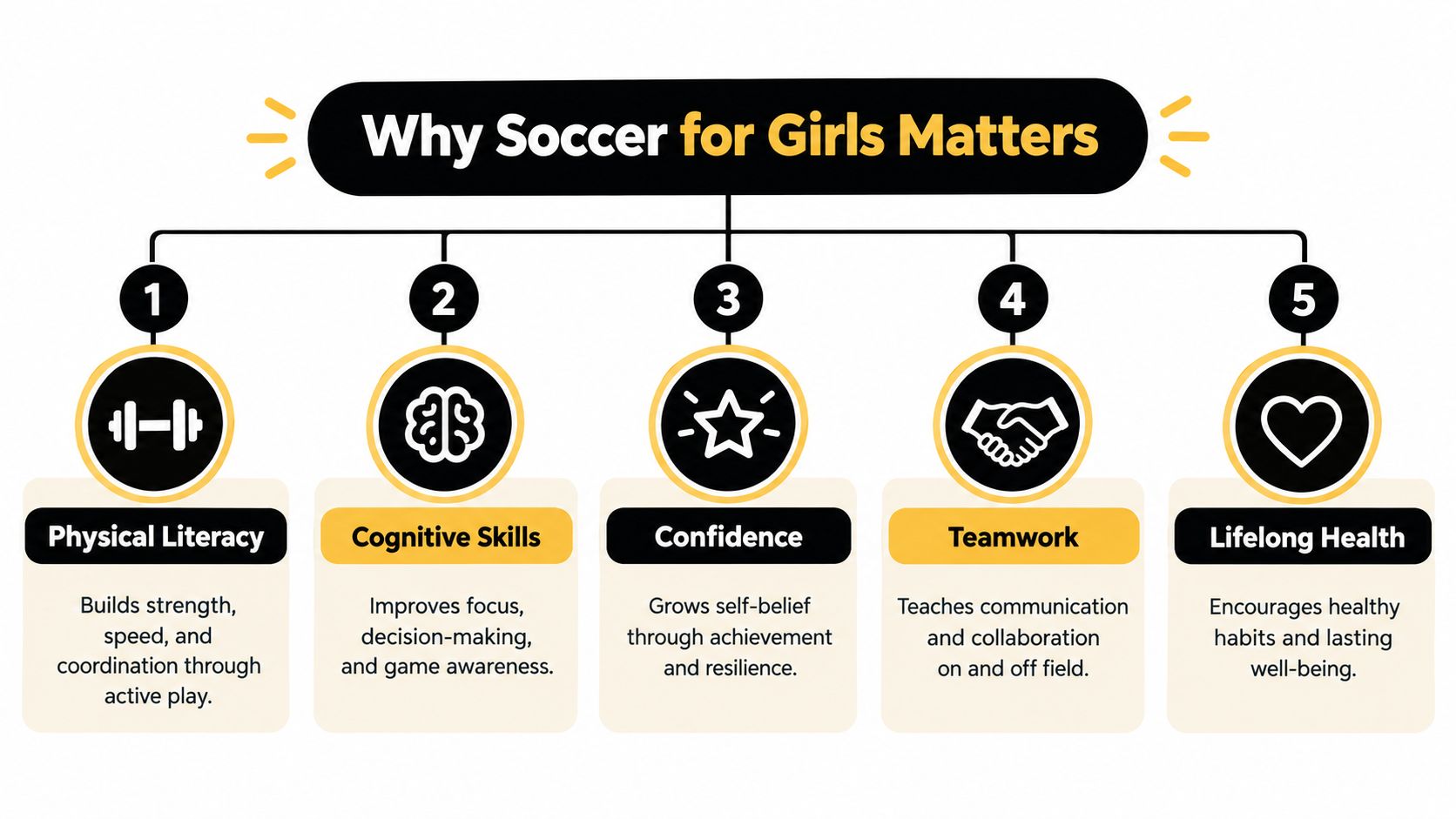
Five benefits that reach beyond the field
Physical literacy comes first. Running, balancing, changing direction, striking the ball, and controlling speed help a player understand what her body can do. That foundation supports participation in other activities and makes movement feel familiar instead of intimidating.
Cognitive skills grow because soccer presents changing problems. A player must decide whether to dribble, pass, protect the ball, move into space, or delay an opponent. The coach can guide those decisions, but the player eventually has to recognize the situation herself.
Confidence develops through earned progress. A girl who once avoided the ball may eventually ask for it under pressure. That shift doesn't require a perfect performance. It requires repeated opportunities to try, receive useful feedback, and see mistakes as part of learning.
Teamwork becomes concrete. Players have to share responsibility, listen, communicate, and adjust when a teammate needs support. Those habits can carry into classrooms, friendships, and family life.
Lifelong health is supported when girls associate activity with enjoyment and belonging. A positive soccer experience can help create a durable relationship with movement, rather than a short period of exercise driven only by adult expectations.
A useful parenting lens: Measure growth by what your daughter can understand, attempt, and enjoy, not only by the score.
The sport's expanding infrastructure gives those personal benefits a stronger setting. The organised-player figures reported by FIFA indicate that girls can find more formal teams, coaching, scouting opportunities, and competition pathways than previous generations could. That doesn't mean every player needs an elite goal. It means families can select an experience that matches the player, from informal participation to ambitious development.
Watch the accompanying video for another accessible way to discuss the game with a young player.
How Girls Develop in Soccer From Age 4 to 18
Development isn't a straight ladder where every player reaches the same step at the same time. It's closer to building a language. Young children learn sounds and simple words first, then combine them into ideas, and eventually use the language with more independence and nuance.
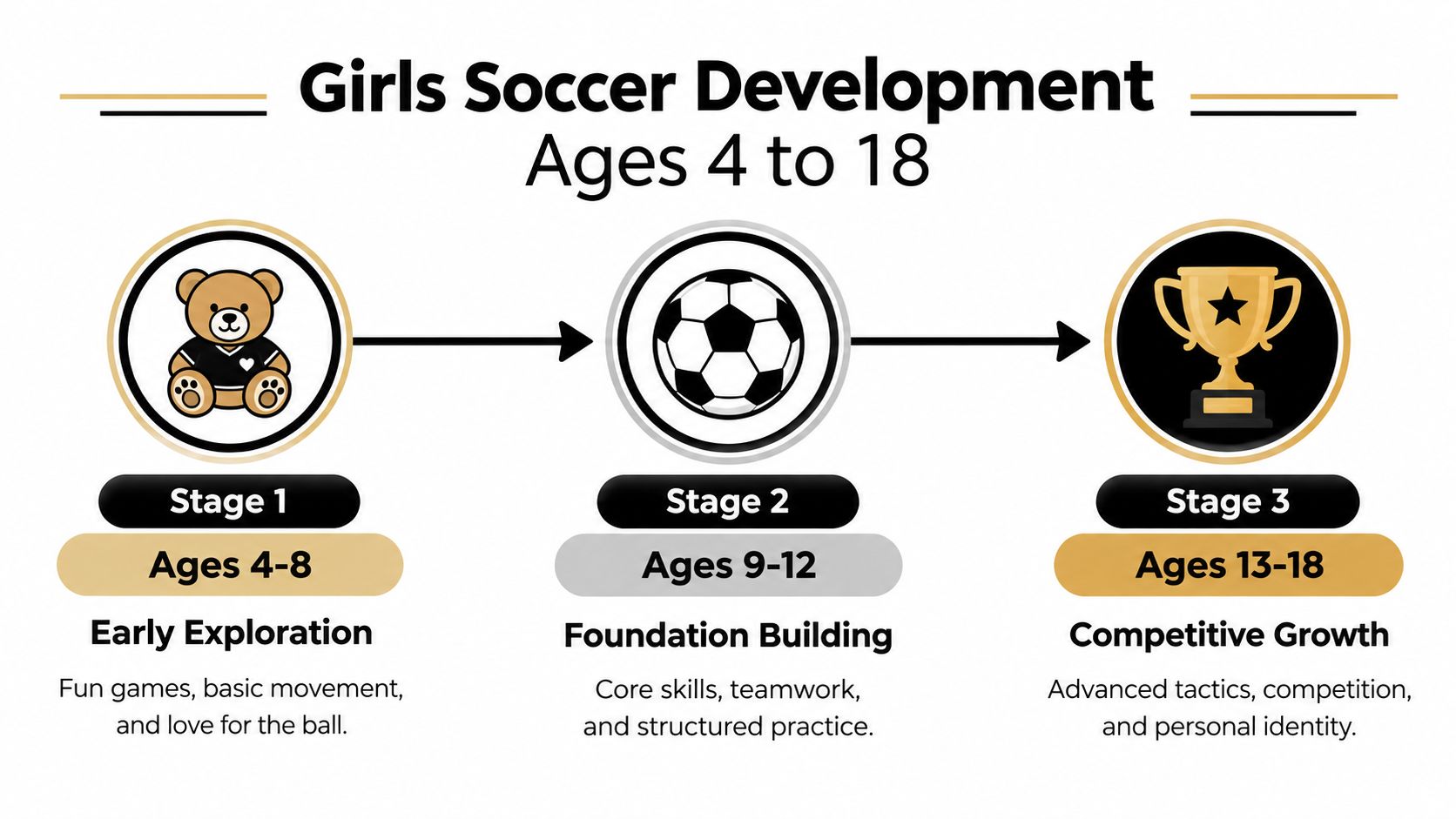
Ages 4 to 8, early exploration
At this stage, the priority is joyful movement and familiarity with the ball. Practices should include simple games, short activities, changes of direction, balance, and chances to use both feet. A young player may not understand team shape or tactical instructions yet, and that's fine.
Parents can look for signs of healthy development:
Comfort with movement: She runs, stops, turns, and tries new actions without fearing mistakes.
Interest in the ball: She wants repeated touches and begins to control the ball in simple situations.
Social confidence: She can participate with others, even if attention and engagement vary from practice to practice.
Ages 9 to 12, foundation building
Players can usually absorb more detailed technical instruction and begin connecting actions to teammates. Coaches can teach receiving, passing, dribbling under pressure, finishing, and basic principles such as creating space or helping the player with the ball.
The best benchmark isn't early specialization in one position. It's whether the player becomes more adaptable. A defender should still learn to pass and attack, while an attacking player should learn how to recover and defend.
Families exploring international examples may find a guide to watching Japan vs United States useful for showing how different teams solve similar game problems. For a more detailed local explanation, review soccer development by age.
Ages 13 to 18, competitive growth
Adolescents develop technical consistency, tactical awareness, physical capacity, and a clearer athletic identity. Training may include position-specific decisions, transition play, match analysis, recovery habits, and preparation for stronger opponents. Coaches should still adjust expectations for biological maturation, school demands, confidence, and injury history.
A player might be ready for select competition but not want an all-consuming schedule. Another may actively seek higher-level training. Healthy development respects both choices and keeps communication open between player, parent, and coach.
What Training and Competition Really Look Like
A good practice should feel purposeful without feeling like a lecture. Players might begin with movement preparation, then work through a ball-based activity that introduces a technical problem, and finish with a small-sided game where they have to apply the skill under pressure.
The coach's role is to shape the challenge. If the activity is too easy, players stop making decisions. If it's too difficult, they may withdraw or wait for someone else to solve the problem. A positively engaged coach adjusts space, rules, player numbers, and feedback so the group can keep learning.
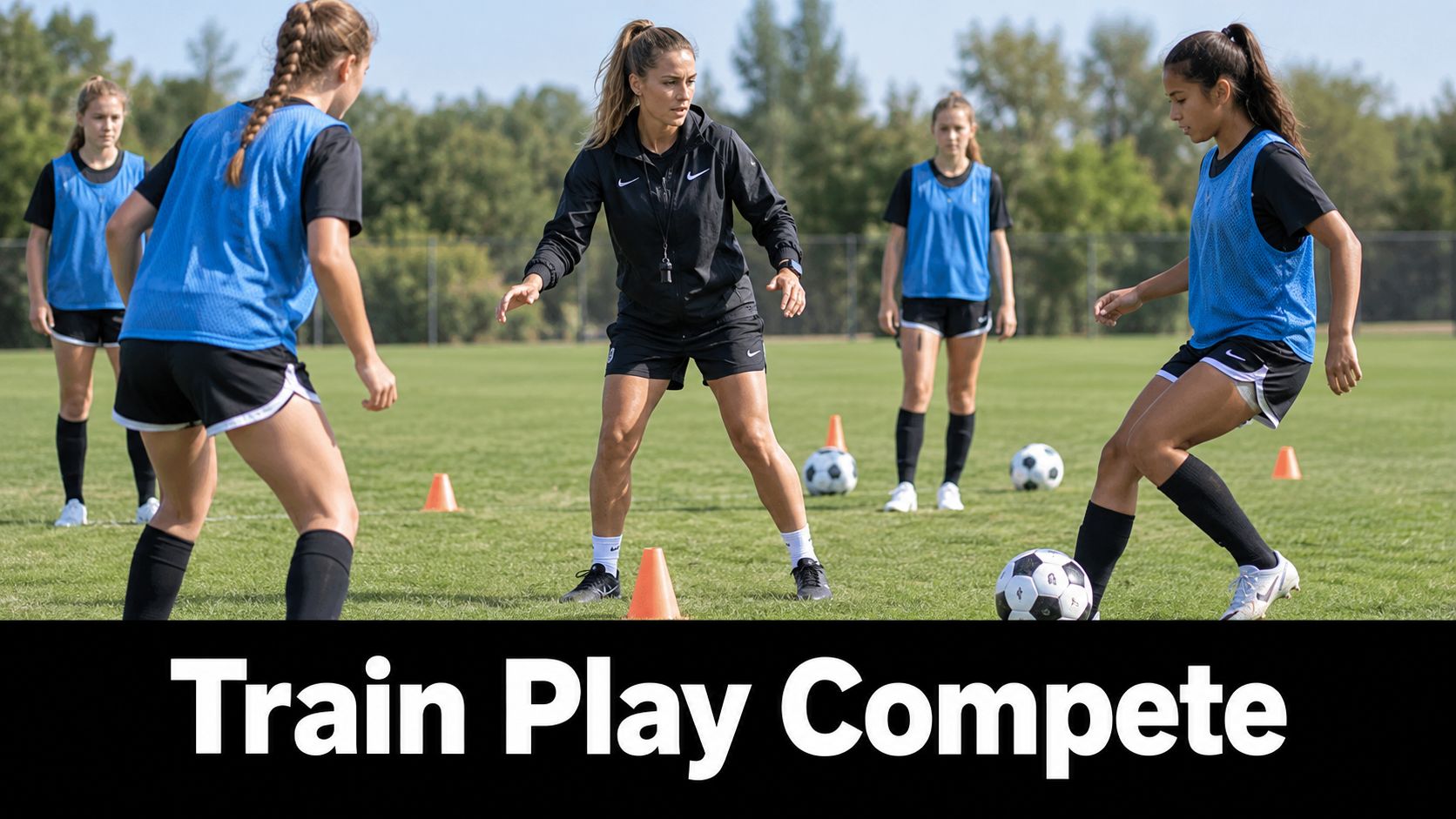
What players should experience
Technical work may involve first touch, passing angles, dribbling, finishing, or protecting the ball. The activity should connect to a game situation, so the player understands why the technique matters.
Tactical learning asks questions such as, “Where can you move after passing?” or “How can you help the defender nearest the ball?” This approach develops awareness rather than dependence on constant instructions.
Physical preparation should include acceleration, deceleration, balance, landing, and changes of direction that resemble soccer. A player needs to move efficiently, not accumulate tired running.
Psychological support appears in the language adults use. Coaches can praise brave decisions, focused effort, communication, and recovery after errors. Sports psychology support can help players handle competition anxiety, confidence dips, and the emotional swings that accompany adolescence.
Game day adds another layer. Players may need to arrive prepared, warm up, listen to a short plan, manage substitutions, and reflect afterward. Parents can help by asking what the player noticed, rather than reviewing every mistake from the sideline.
For families building a predictable routine, this weekly soccer training schedule offers a useful reference point. The right schedule leaves room for sleep, school, family life, and recovery.
How to Choose the Right Girls Soccer Program in Houston
Parents don't need to identify the most demanding program. They need to identify the program whose method, expectations, and culture fit their daughter right now.
Ask to observe a session when possible. Watch whether coaches speak respectfully, whether players receive meaningful touches, and whether mistakes lead to instruction or embarrassment. A program should explain how it groups players, how it handles absences and injuries, and how families can communicate concerns.
Houston families may also weigh access across Humble, Fall Creek, Cypress, Tomball, and the Kingwood, Porter, and New Caney area. A technically excellent program becomes difficult to sustain if the commute creates constant family stress. Convenience isn't a soft factor. It affects attendance, recovery, homework, and the player's emotional energy.
Compare the program types
Evaluation Criteria | Recreational Program | Select and Competitive Academy |
|---|---|---|
Primary emphasis | Enjoyment, participation, and basic game experience | Structured development, advanced competition, and progression |
Coaching approach | Broad introduction to skills and team play | Detailed technical, tactical, physical, and psychological development |
Player commitment | Usually more flexible | Usually requires more consistent attendance and preparation |
Competition | Local and introductory | More demanding matches, evaluations, and advancement opportunities |
Best fit | A beginner or player prioritizing low-pressure participation | A player seeking deeper training and a clearer competitive pathway |
Parent questions | Is she having fun and learning basic skills? | Is the workload appropriate, and does the pathway match her goals? |
The modern international pathway grew from visible milestones. The first FIFA Women's World Cup took place in China in 1991 with 12 teams, and the tournament expanded to 16 teams in 1999, as described in this historical overview of women's soccer. That history helps explain why today's families can consider more formal routes, but it shouldn't pressure every girl toward elite competition.
Compare clubs carefully, including how they present themselves online. If you operate or manage a local sports facility, resources on how to rank my gym on Google Maps can clarify how families discover nearby programs. For a local overview of options, see soccer academies in Houston Texas.
Keeping Girls in the Game Through Challenges and Growth
Getting a girl onto a field is only the beginning. Keeping her involved through adolescence requires adults to understand that motivation can change when friendships shift, school demands increase, bodies develop at different rates, and competition feels more exposing.
Recent reporting connected to youth-sports participation data says girls are roughly twice as likely as boys to drop out by age 14, and soccer is included in that broader retention concern. The same summary cites nearly one in four youth players leaving the sport each year, with sharper declines for girls and a visible drop beginning around U14 to U16. See the SFIA summary on soccer participation and retention for that reporting.
Make psychological safety practical
Psychological safety doesn't mean removing challenge. It means a player can ask questions, admit confusion, make a mistake, and discuss discomfort without expecting ridicule or retaliation.
Parents can support that environment by using specific questions:
Ask about belonging: “Who did you enjoy training with today?”
Ask about learning: “What decision did you try to make?”
Ask about pressure: “What part of competition felt difficult?”
Ask about the body: “Does anything hurt, feel unstable, or feel unusually tired?”
A coach should notice changes in mood, attendance, movement, and confidence. The player should also have a clear way to report pain, bullying, unsafe contact, or overwhelming pressure.
Treat injury prevention as development
In adolescent and youth female soccer, a systematic review reported 12.7 injuries per 1,000 hours in games versus 2.3 per 1,000 hours in training, with lower-limb injuries most common and ankle and knee injuries prominent. The review also identified ligament and muscle injuries among the leading tissue types. These findings support practical preparation focused on neuromuscular control, landing mechanics, deceleration, and ankle and knee stability, as detailed in the systematic review of youth female soccer injuries.
A separate surveillance study found injury rates were higher in college than high school, 6.60 versus 2.33 injuries per 1,000 athlete-exposures, while competition carried greater risk than practice in both settings. Lower-extremity sprains and strains dominated, and concussions were especially prominent in high school competition, according to the high school and collegiate women's soccer surveillance study.
The goal isn't to frighten girls away from soccer. It's to match workload and prevention habits to age, competition level, recovery, and medical guidance.
Your Next Steps With Villarreal Houston Academy
A practical starting point is to write down your daughter's current situation before contacting any program. Note her age, experience, preferred locations, school and family commitments, comfort with competition, and what she wants from soccer. That list will make conversations with coaches more useful and will help you separate a genuine fit from an exciting but unsuitable schedule.
Villarreal Houston Academy is the official partner academy of Spain's Villarreal CF in the Greater Houston area. Its programming serves boys and girls from age four upward, with an emphasis on intelligence, skill, and character through age-appropriate training, qualified positively engaged coaches, and sports psychology support.
Families can explore several entry points:
Teams: Select and competitive development for players seeking structured progression.
Camps and clinics: Shorter experiences that let a player build skills and understand the environment.
Tryouts: An evaluation route for families considering a more competitive team setting.
International opportunities: Players may have opportunities to travel to Spain to train and play alongside Villarreal CF's elite academy.
North Houston access: Training locations include Humble, Fall Creek, Cypress, Tomball, and the Kingwood, Porter, and New Caney area.
The methodology should remain age-appropriate. A young player needs playful repetition and confidence, while an older player may need tactical detail, position-specific development, workload conversations, and support through selection pressure. Respect, integrity, and personal responsibility belong in every stage because a soccer pathway should develop the person as well as the player.
Parents should ask clear questions before enrolling. Who coaches the group? How does the academy manage injuries? What does a typical week involve? How are players supported when confidence drops? What happens if a player's goals change? Answers to those questions reveal whether the environment can support long-term participation.
Villarreal Houston Academy offers girls' soccer teams, camps, clinics, tryouts, and age-appropriate development across convenient North Houston locations, with a pathway built around intelligence, skill, character, and safe participation. Visit Villarreal Houston Academy to explore current programs and choose a first step that fits your daughter's age, goals, and readiness.
Comments