


Long Term Development Model for Youth Soccer Players

Your child hasn't moved up this season, and nobody can explain why in plain language. You're told to trust the process, but you can't see the process. A good long term development model should make that process visible, so you can judge progress, fairness, and fit for your family.
Why Youth Soccer Needs a Long Term Development Model
Say a nine-year-old dominates every game. At ten she's still ahead. At fourteen, teammates who grew later outpace her, and her parents ask whether the talent is gone.
It usually isn't gone. The early advantage has faded, and other skills now matter more. Without a plan that expects that shift, families read a normal growth change as failure.
A long term development model is a planned sequence, not a single program or season. It sets age-appropriate training, tracks growth, measures progress across several seasons, and defines more than one successful outcome.
Think of school. A curriculum runs from reading readiness to university, and each grade builds on the one before it. You wouldn't judge a seven-year-old by a high school exam, and you wouldn't repeat the same worksheet for ten years.
Soccer needs the same logic, especially as more families enter the system. In 2023, 594,000 more U.S. adolescents ages 13–17 regularly played sports than in 2022, according to the Aspen Institute Project Play analysis of Sports & Fitness Industry Association data.
A model earns trust when a parent can point to a stage, see what comes next, and understand what progress looks like inside that stage.
That clarity changes the conversation. Instead of asking only whether your child made a team, you can ask what she's learning, how her body is changing, and what evidence shows she's moving forward.
Age Stages From Age 4 to 18
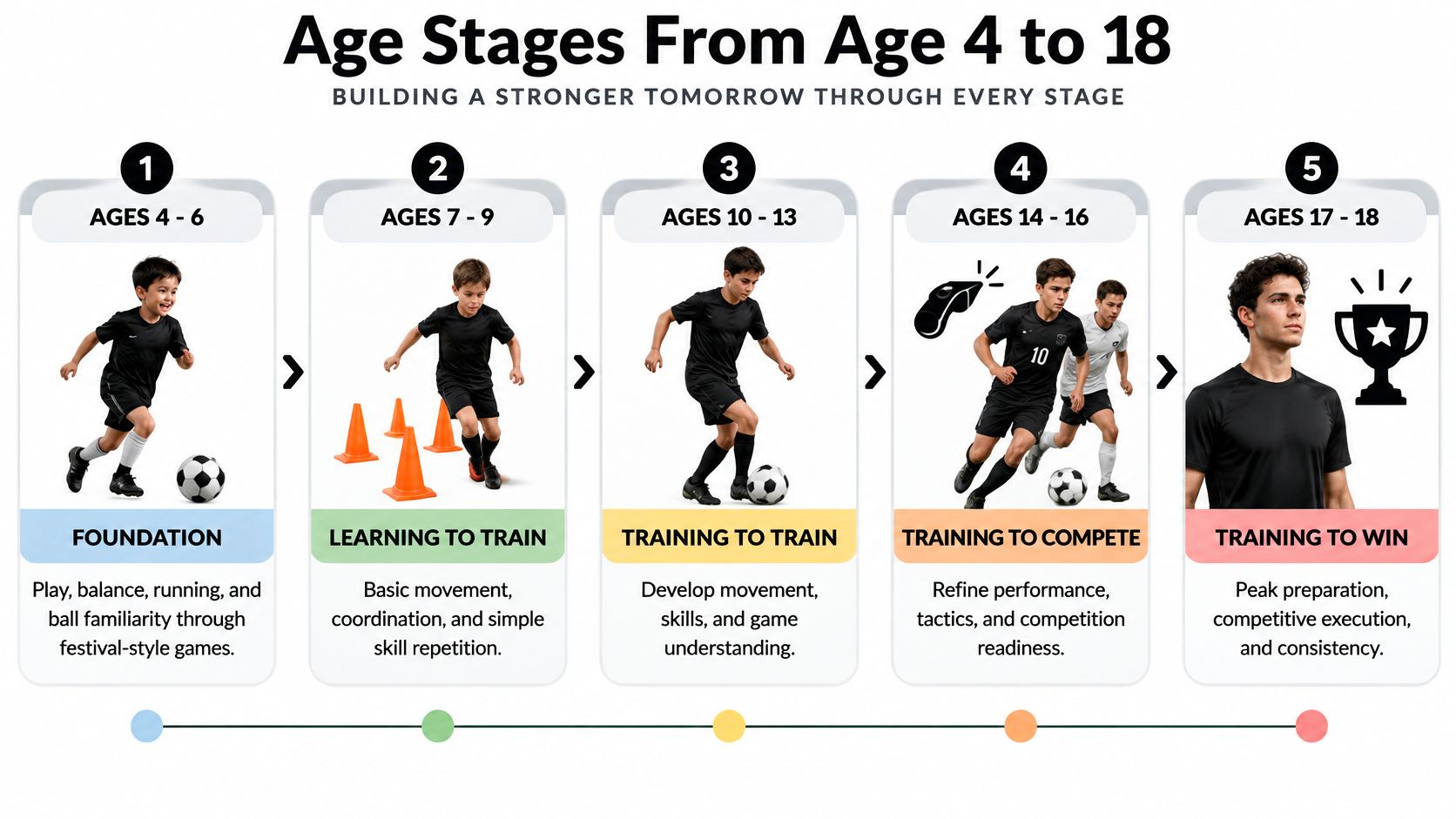
Start with the whole map. The table below shows five stages, what training emphasizes, how players compete, and how often they train.
Stage | Ages | Training Focus | Competition Format | Sessions per Week |
|---|---|---|---|---|
Foundation | 4–6 | Play, balance, running and ball familiarity | Festival-style games with no league tables | 1–2 short sessions |
Learning to Train | 7–9 | First touch, dribbling and two-footed work | 4v4 to 6v6 small-sided games | 1–2 |
Training to Train | 10–12 | Technique under pressure and basic tactical principles | 7v7 to 9v9 | 2–3 |
Training to Compete | 13–15 | Position-specific skill and strength base | 11v11 with rotations | 3–4 |
Training to Win | 16–18 | Tactical complexity and match performance | Competitive league play | 4–5 |
Reading Each Stage
Foundation keeps soccer playful. Children run, balance, chase, and touch the ball often, without league tables pushing adults to chase wins.
Learning to Train adds repeatable skill. A player practices first touch and dribbling with both feet in small games where everyone gets touches.
Training to Train adds pressure and simple team principles, such as when to pass, move, or protect space. Training to Compete then narrows toward positions and a strength base, while rotations prevent early labels from becoming permanent.
Training to Win is the most demanding stage. Tactical detail, consistency, and match performance matter more, and training frequency rises.
How to Use the Timeline
Read the stages left to right, but treat ages as guides, not gates. A player who's early or late for a stage should move on readiness, coordination, understanding, and health.
Each stage also keeps earlier skills alive. Ball mastery doesn't disappear at 13, and play doesn't become pointless at 16. The work layers up, it doesn't get discarded.
The Biology Behind the Model
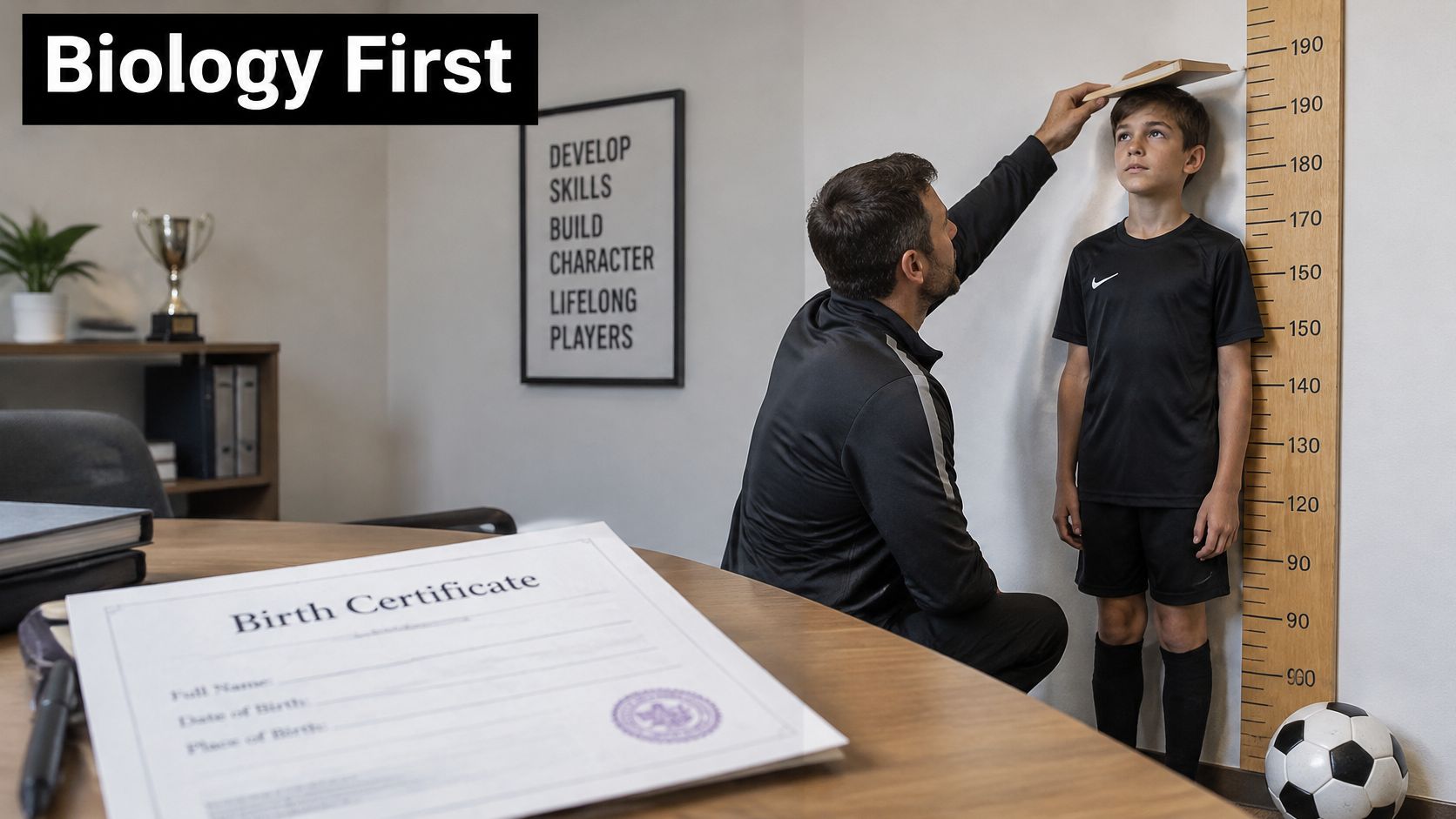
A birth certificate tells you a player's age. A growth chart tells you where that player is on the journey. Coaches need both, because two 13-year-olds can live in very different bodies.
Height checks are one simple part of that picture.
What Peak Height Velocity Means
Peak height velocity, or PHV, is the period of fastest adolescent growth. A major review of long-term athlete development explains that LTAD uses PHV to help determine readiness for different stages of training, and around PHV, changes include increases in muscle mass, aerobic capacity, energy utilization, and neuromuscular adaptation.
The same source reports that players of the same chronological age can differ by approximately 5–6 years in biological maturity, while academy players may grow as quickly as 7.5–9.7 centimeters per year during the pubertal growth spurt, between approximately ages 10.7 and 15.2.
During rapid growth, coordination can look clumsy, tissues tolerate load differently, and fatigue hits harder. That's why sensible load management matters, and families dealing with persistent soreness or stalled energy should understand how to recover from overtraining before adding more sessions.
This short video helps make growth and readiness easier to picture.
Three Principles That Follow
Skills develop at different rates. Technical, tactical, physical, and psychological growth don't move in lockstep, so a player can be tactically sharp while still physically immature.
Training load follows maturity. Coaches adjust volume, intensity, and recovery by growth status, not only by team age group, which supports sound injury prevention in soccer.
Early size is temporary information. Height and strength today aren't proof of adult talent.
The model also recognizes a "podium pathway" for elite performance and an "active for life" pathway for lifelong physical activity. A club should say which one it serves, or how it serves both.
Bio-banding is one practical tool. Coaches group players by maturity or percentage of predicted adult height for some activities, so late developers face fair challenges and early developers must solve problems without relying only on size.
Maturity Bias and Access
Ask a harder question. Who does a development model keep?
Selection often favors timing. A 2025 study of 1,011 players across 12 Scottish professional academy programs found that relatively older and biologically more mature players were more likely to be represented, even though later-maturing players may have greater eventual adult potential.
That pattern is easy to miss if you only watch match results. A player born early in the selection year may be older, taller, and stronger than a teammate born months later. Coaches can mistake that head start for better decision-making or higher potential.
Three Checks Families Can Apply
Plot birth quarters. Ask how squad birth dates spread across the year, and ask why if one quarter dominates.
Match some challenges by maturity. Bio-banded or maturity-matched groups let coaches judge touch, scanning, and choices without size deciding every duel.
Track minutes with a plan. If a late-maturing player loses minutes, ask what's written down for earning them back, which skills matter, and when coaches will review it.
Fairness test: Can the club show how a smaller, later-born player stays in meaningful training while his body catches up?
Access is the second filter. A player cannot develop in a program she cannot regularly attend due to transport, caregiving, work schedules, or household demands. Attendance gaps then appear as low commitment, even when the underlying problem is logistics.
A fair model counts who can attend, not only who is selected. Coaches should review attendance alongside performance and ask what barrier sits underneath repeated absences.
How the Yellow Submarine Curriculum Runs Locally
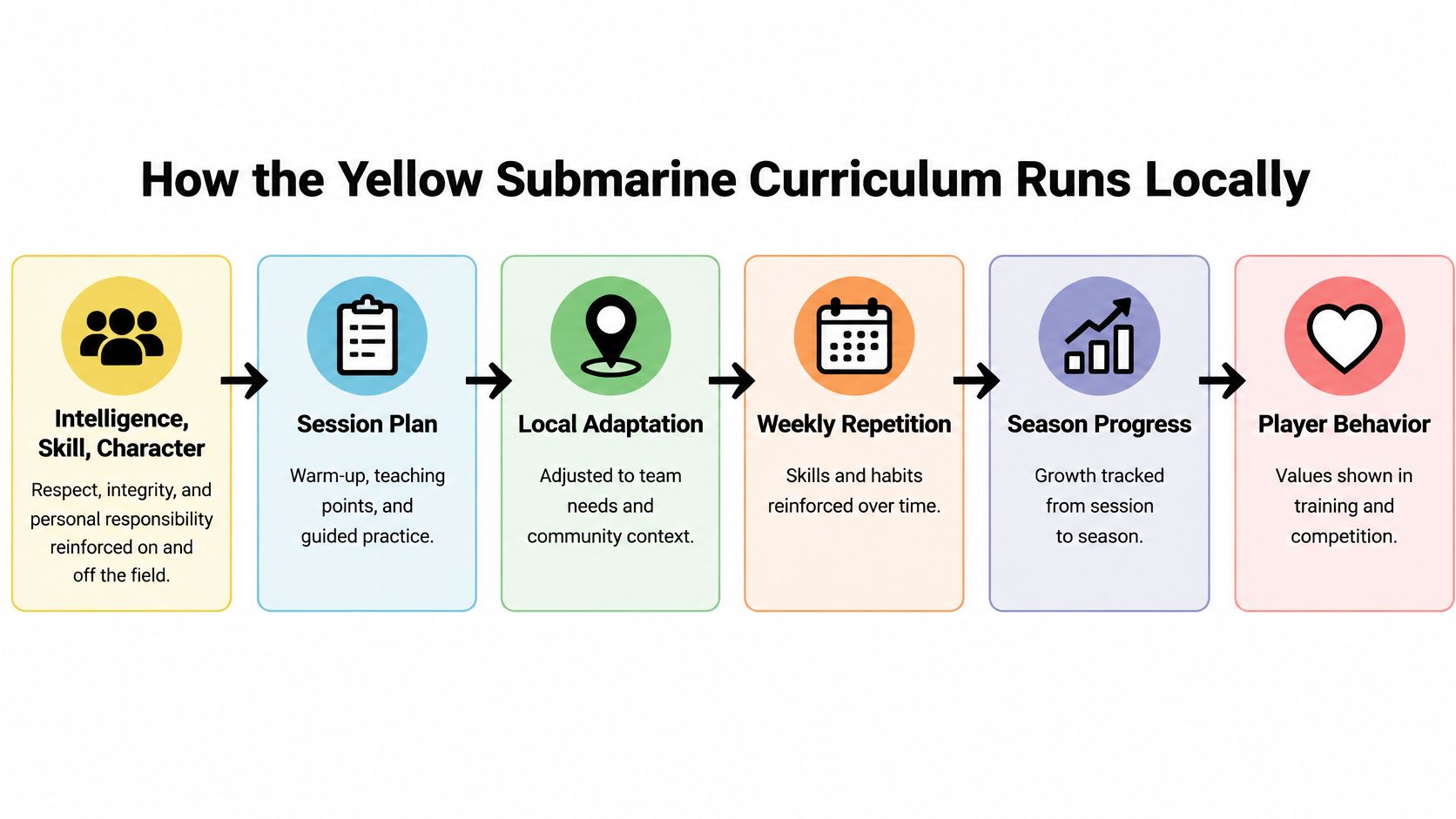
A curriculum should be visible inside a single session and across a season. Locally, the frame is intelligence, skill and character, with respect, integrity, and personal responsibility reinforced on and off the field.
Inside One Session
Warm-up and ball mastery, about 15 minutes. Players move, change direction, and get many touches while fresh. Control comes before speed, so technique isn't learned under exhaustion.
Technical games with constraints, about 20 minutes. A coach might limit touches, require the weaker foot, or shrink the space. The constraint forces a specific habit without long lectures.
Tactical principles in small-sided games, about 25 minutes. Players learn pressing, support angles, or switching play in game-like situations. Decisions stay central.
Position-specific or full-sided work, about 20 minutes. Older players connect their role to the team shape. Younger players rotate more, because narrow specialization can wait.
Cool-down and reflection, about 10 minutes. Players slow down, note soreness, and name one thing they practiced. That short pause builds awareness and personal responsibility.
Unstructured play still belongs in the week. Children need time to try moves, invent games, and enjoy the ball without every action being corrected.
Across a Season
Physical preparation progresses with maturity and coaching. A review of youth-athlete evidence and elite football pathways describes twice-weekly, high-velocity resistance training in Spanish academy players with relatively low squat volumes at approximately 45–59% of one-repetition maximum, combined with jumps and sprints, and after six months, under-16 and under-18 groups matched or exceeded an under-21 control group in squat strength, countermovement jump, and 20-m sprint outcomes.
Don't copy that as a home program. Use it as a principle, coached strength work starts with movement quality, modest load, and gradual progression.
Match volume shouldn't be maximized early. Volume and intensity rise step by step, with recovery protected, because more games don't automatically produce better decisions or healthier players.
As a parent, watch for coaches who explain why each drill exists. You should also see attendance, effort, and recovery noticed, not only goals. Our mission is to provide age appropriate training with qualified coaches so local youth talent can play at their fullest potential.
Evaluation Metrics That Track Real Progress
One tryout is a snapshot. Development is a trend.
A four-season mixed-longitudinal study of 94 players from a professional Spanish La Liga club compared 15 players entering the program, 54 progressing to the next age category, and 25 deselected players, and among under-13 players, improved physical performance during the season was one of the main factors associated with remaining in the club. Among under-15 players, those who progressed also demonstrated significantly greater improvement during the season.
In plain terms, learning rate matters. A player who starts behind but improves steadily may be a better long-term prospect than a player who starts ahead and stalls.
Metric | What It Shows | Review Frequency | Warning Sign |
|---|---|---|---|
Stature and maturity status | Growth rate and maturity offset | Every 2–3 months | Rapid growth alongside falling movement quality |
Countermovement jump | Lower-body power | Every 8–12 weeks | Two consecutive drops |
20-meter sprint | Acceleration | Every 8–12 weeks | Slowdown that persists after the growth spurt |
Session RPE and soreness | Load tolerance | Weekly | Soreness rising for three sessions in a row |
Decision-making score | Game understanding independent of size | Each season | Flat across two seasons |
Attendance and availability | Continuity of training | Monthly | Repeated missed sessions from schedule or cost |
How to Read the Numbers
Periodic stature checks help coaches spot rapid growth early. They can then adjust load before soreness, poor coordination, or missed sessions pile up, which is the same habit behind tracking simple daily health metrics to track such as sleep, energy, and soreness rather than guessing.
A structured soccer player evaluation should separate game understanding from body size. Did the player scan before receiving, choose the right pass, and react after losing the ball? Those answers shouldn't depend on who is tallest.
Minutes need special caution. In youth soccer, playing time can track maturity, so a late developer may play less for physical reasons that won't last. If minutes drop, ask for the skill targets and review date that give that player a route back.
One poor test is noise. Declines across three results in a row are a signal to adjust training, recovery, or support.
Pathways From Grassroots to International Play
There's more than one good outcome. The right route depends on a player's goals, readiness, school life, and what your family can sustain.
Route | Best Fit | Typical Commitment | Main Trade-off |
|---|---|---|---|
Active for life | Players who want lifelong fitness and enjoyment | 1–2 sessions a week | Lower competition load and fewer elite opportunities |
Competitive club or select | Players seeking regular league play | 2–4 sessions a week plus matches | Higher travel and fee load |
Academy pathway | Players with clear talent who want structured development | 3–5 sessions a week plus tournaments | Strong selection pressure and early specialization risk |
Elite and international trials | Players already showing advanced skill and maturity | Near full-time commitment | Few places, so many players need a second route |
What International Opportunity Usually Means
International travel is one route, not a requirement for being a serious player. Invitation events, camps, and tournaments where coaches can evaluate players in person are common entry points, including through a structured Villarreal CF youth academy pathway.
Selection at that level should rest on technical ability, tactical understanding, work ethic, and professionalism, not only physical size. A small player with fast decisions and clean technique has qualities worth seeing up close.
Protect School, Sleep, and Rest
Ambition has a cost that families should name early. A 2025 systematic review in Frontiers in Sports and Active Living synthesized evidence from 21 studies and found that school-based talent-development programs supported physical performance, social networks, and short-term academic success, while four studies reported increased psychological stress.
That doesn't mean avoid challenge. It means build the pathway around school, sleep, friendships, and rest, then watch for stress instead of treating exhaustion as proof of commitment.
Transitions are where players get lost. Moving from foundation play to competitive teams, or from an academy squad toward elite trials, can change minutes, friends, and confidence all at once.
Every route should keep a documented path back in. A player who steps down, gets injured, or matures later needs a realistic re-entry option, not a closed door.
Choose a Pathway Your Family Can Sustain
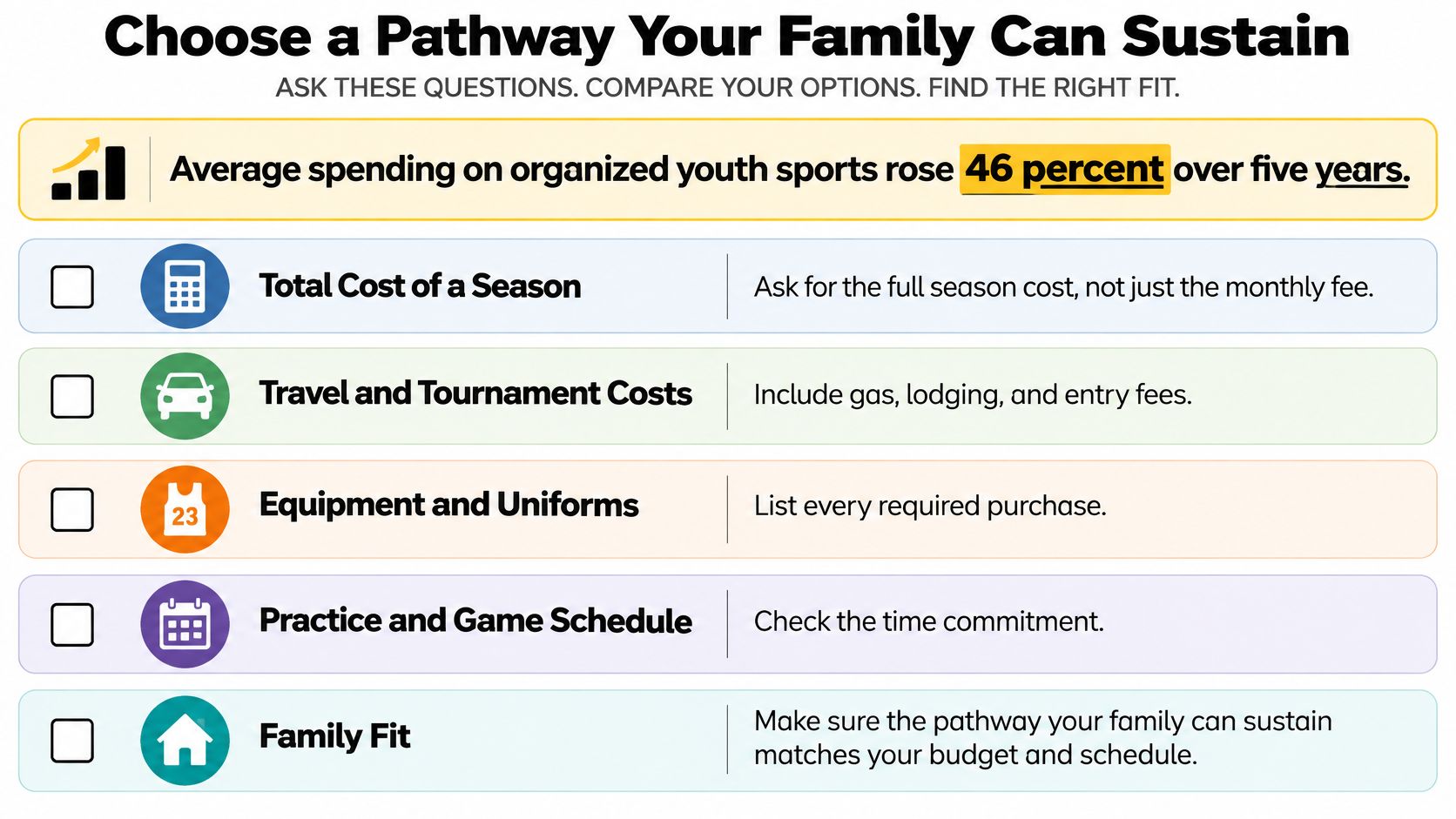
Start with cost, because it decides whether a plan can last. Families' average spending on organized youth sports increased by 46% over five years, according to the Aspen Institute's 2025 Project Play survey.
Six Questions for the First Meeting
Bring these questions and compare answers in writing.
What's the total seasonal cost? Include tournaments, travel, equipment, uniforms, and fees, not only the monthly payment.
Which pathway do you serve? Ask the club to publish its stage table and state whether it serves the podium pathway, active for life, or both.
How often do you measure growth and load? Ask what method coaches use and what changes when a player grows quickly.
What happens when a late-maturing player loses minutes? Look for a written plan, skill targets, and a review date.
Is there a re-entry route? A player who leaves, gets injured, or steps down should know how to return.
How do you adapt for families who can't attend every session? Ask about schedule options, communication, and what progress can look like with fewer sessions.
Read the commitment before you sign. Enrolling in any program is a financial commitment for the full seasonal year, term, program, or service period selected, so ask for cancellation and refund terms in writing.
Location matters for sustainability too. The Porter-Kingwood-New Caney location is expanding to additional ages in Fall 2026, which may shorten travel for some North Houston families.
A club that answers all six questions clearly fits the model in this guide. One that deflects on cost, minutes, or re-entry doesn't, however strong its facilities look.
If you're weighing stages, costs, and whether a late bloomer will get a fair chance, visit Villarreal Houston Academy to see our age-appropriate pathway for players from age 4 upward. Bring the six questions above to a tryout, camp, or first meeting, and we'll walk through total cost, training load, and next steps for your child in plain language.
Comments