


Indoor Soccer vs Outdoor Soccer: A Parent's Guide

You're standing on the sideline of a February futsal match in Houston. Your nine-year-old is darting through a crowded court, receiving the ball, turning, passing, and defending again before you've finished asking another parent how long the game lasts. You watch the touches pile up and wonder whether this compressed version is really preparing your child for outdoor soccer.
Yes, but not by replacing outdoor soccer.
Indoor soccer and outdoor soccer develop different parts of the same player. Indoor play compresses space, speeds up decisions, and gives young players frequent involvement. Outdoor play teaches distance, spacing, endurance, and the larger tactical picture. Parents make better decisions when they treat the formats as training partners instead of competing identities.
That matters in Houston. Families can often play outside through much of the year, but summer heat and humidity can make the timing of outdoor sessions difficult, while winter rain and shorter days create a natural opening for indoor work. The right question isn't “Which format is real soccer?” It's “What does my child need to learn next, and which environment teaches it most efficiently?”
Two Sides of the Same Beautiful Game
A young player rarely experiences the difference as a rulebook exercise. They feel it in their feet.
On a small indoor court, a loose touch immediately attracts pressure. A pass that arrives behind the player may become a turnover. A successful reception usually requires the child to check a shoulder, adjust the body, protect the ball, and find the next option in a short window. Outdoors, the same player may have more room to receive and turn, but they must recognize where that room is, how teammates are spaced, and when a long pass or diagonal run can change the attack.
Those are separate problems. Both deserve coaching time.
Indoor play creates involvement
Indoor soccer emerged as a modified, small-sided alternative to the outdoor 11-a-side game. In formal futsal, teams play with five players per side, use 20-minute halves, allow unlimited flying substitutions, and restart play under a stopped-clock structure with a four-second rule, as outlined in the SFIA overview of soccer participation and futsal's development. The first FIFA Futsal World Championship took place in 1989, giving the format an organized international pathway rather than leaving it as a casual variation.
For a child, the practical result is simple. The ball comes near them more often, and mistakes have consequences immediately. That repetition can build confidence, provided the coach also teaches patience and defensive responsibility instead of encouraging frantic dribbling.
Outdoor play supplies the larger picture
Outdoor soccer gives children the space that indoor soccer can't reproduce. They learn to recognize a switch of play, judge a longer pass, time a run into open space, and manage effort across a larger pitch. Wind, sun, grass, artificial turf, and changing field conditions also require constant adjustment.
A child who only plays outdoors may develop a useful sense of space while avoiding enough tight pressure. A child who only plays indoors may become comfortable in crowded areas but struggle when teammates are spread across a full field. Neither blind spot fixes itself automatically.
The useful choice isn't indoor or outdoor. It's deciding which format solves the development problem in front of your child.
Rules, Field, and Equipment at a Glance
“Indoor soccer” doesn't describe one universal game. Houston families may encounter futsal on a hard court, arena soccer on artificial turf surrounded by boards, or other small-sided formats set by a facility or league. Futsal has the clearest formal structure, while arena rules can vary, so ask for the competition rules before buying equipment or judging a program.
Element | Outdoor Soccer | Indoor / Futsal |
|---|---|---|
Players | The traditional adult format uses 11 players per side | Formal futsal uses five players per side; arena formats may use different small-sided numbers |
Playing surface | Grass or outdoor artificial turf on a large open pitch | Futsal uses a hard court; arena soccer commonly uses smaller artificial turf and may use boards |
Ball | Typically a larger, more responsive ball suited to open-field passing | UEFA describes futsal as using a smaller, harder, less bouncy size-4 ball |
Clock | Usually runs continuously, with stoppage time added by the referee | Futsal uses a stopped clock, 20-minute halves, and a four-second restart rule |
Substitutions | Competition rules determine the number and timing, with youth formats often varying | Futsal permits unlimited flying substitutions, and official FIFA competitions allow a maximum of nine substitutes |
The formal futsal playing area is also far smaller than an outdoor pitch. FIFA futsal laws set non-international areas at 25–42 metres by 15–25 metres, and international areas at 38–42 metres by 20–25 metres, with unlimited substitutions during play and up to nine substitutes in official FIFA competitions, according to the published futsal law table.
The substitution rule changes the parent's view of effort. A player can enter, press, recover, and rotate repeatedly. That keeps intensity high, but it doesn't mean every indoor match is automatically better conditioning.
Parents should also confirm field dimensions and goal sizes for the age group rather than assuming that every “indoor” facility uses the same setup. Villarreal Houston's guide to youth soccer field dimensions is a practical reference when you're comparing a small-sided environment with an outdoor league.
Surface care affects more than appearance. Safe traction, consistent bounce, and a well-maintained playing area support better technical work, so facility managers and clubs can use this playbook for field maintenance when evaluating outdoor or artificial-turf conditions.
What Each Format Teaches a Young Player
Indoor soccer teaches a child to solve problems in a crowded room. Outdoor soccer teaches the same child to recognize possibilities across a much larger field.
That distinction starts with spatial density. A smaller court puts teammates, opponents, and the ball within immediate reach. The player has less time to admire a pass or carry the ball without scanning. On a full-size outdoor field, the child must scan farther, understand depth, and judge whether space exists behind, beside, or in front of the next defender.
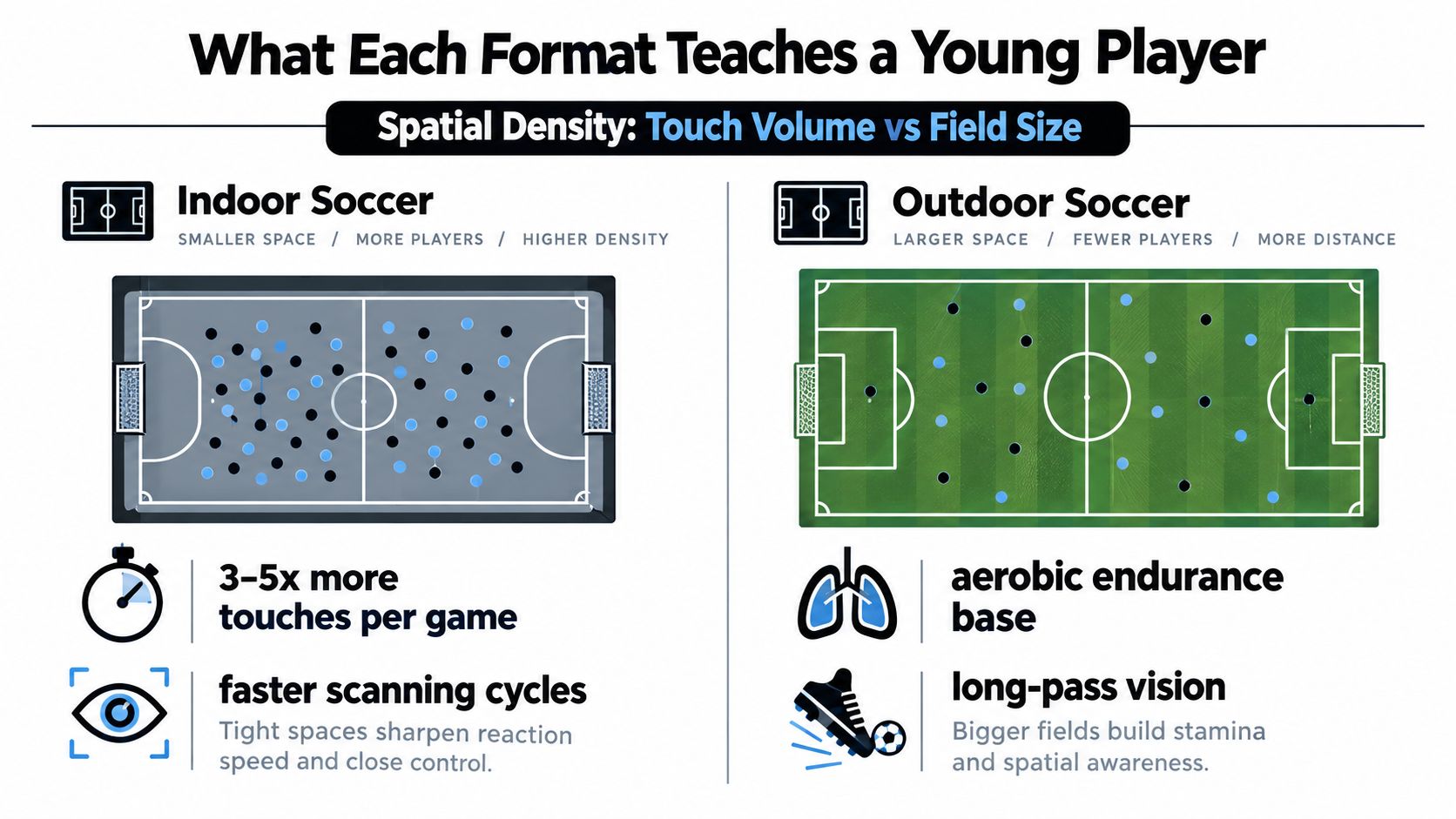
Indoor rewards clean actions
The indoor environment is especially useful for:
First touch: A poor reception can close the only available lane, so players learn to cushion, redirect, and protect the ball.
Close control: Short distances force the child to manipulate the ball with small touches rather than relying on open grass.
Fast scanning: Players must check pressure before receiving and identify the next pass almost immediately.
Transition habits: The moment possession changes, the child has a defensive or attacking job close by.
Formal futsal's smaller area and lower-bounce ball reinforce those demands. UEFA describes the ball as size 4, harder, and less bouncy, which favors close-control passing accuracy, quick reorientation, and reception mechanics near the ground.
Outdoor develops distance and timing
Outdoor soccer asks different questions:
Can the player recognize when to switch the ball?
Can they judge a pass over distance?
Can they time a run behind a defender?
Can they hold a useful position when the ball is far away?
Can they manage effort while contributing late in the game?
A Houston parent can observe the difference without technical vocabulary. Indoors, watch whether your child checks the shoulder before receiving and escapes pressure with the first touch. Outdoors, watch whether they move before the pass, create width, and notice space away from the ball.
Surface can influence movement, but it shouldn't become a simplistic argument for one format. A peer-reviewed study found faster movement time on artificial turf than natural grass, 45.1 ± 1.3 seconds versus 46.2 ± 1.8 seconds, with a reported p value of 0.045. The same study found no significant difference in the Loughborough Soccer Passing Test, 54.0 ± 4.7 seconds versus 54.1 ± 4.2 seconds, with a reported p value of 0.92, as shown in the peer-reviewed comparison of playing surfaces.
The conclusion is practical. Use indoor work to sharpen the first action and outdoor play to teach the child where that action belongs.
Fitness, Injury Risk, and Houston's Year-Round Calendar
Indoor soccer isn't easier, and outdoor soccer isn't automatically more dangerous. They load the body differently.
Indoor play usually involves repeated accelerations, short recoveries, stops, turns, and defensive reactions. Outdoor play spreads movement across a larger pitch and asks for longer runs, sustained effort, and more space between actions. A child may leave an indoor match feeling locally exhausted from constant changes of direction, while an outdoor match places a different demand on endurance and repeated running.
Factor | Indoor Soccer | Outdoor Soccer |
|---|---|---|
Movement pattern | Short bursts, frequent turns, repeated transitions | Longer runs, wider coverage, more open-field acceleration |
Technical pressure | Immediate pressure after many receptions | More time to receive, but greater demands on distance and positioning |
Main physical concern | Accumulated change-of-direction load and contact in tight areas | Fatigue across larger spaces, sprinting, and variable weather |
Houston scheduling value | Useful during rain, heat, or calendar gaps | Best for outdoor tactics, open-field fitness, and competition |
Parent priority | Manage total match and training volume | Monitor heat, hydration, sun exposure, and field conditions |
Injury questions need better questions
A classic adolescent cohort found no significant overall difference in indoor and outdoor injury rates, reporting 4.45 versus 5.59 injuries per 1,000 player hours. The same research found that risk was higher in the most elite outdoor division than in its indoor equivalent, while injury patterns differed by body part. Ankles were common in both settings, groin injuries appeared more often indoors, and knee injuries appeared more often outdoors, according to the adolescent soccer injury study.
Those findings don't justify telling every parent that indoor is safer. Age, competition level, surface, previous injury, growth, and total workload matter. For younger players, the biggest mistake is often stacking indoor games, outdoor practices, tournaments, and extra training without a recovery plan.
Parents who want a plain-language resource for recognizing common athletic pain can review sports injury guidance from Aspen Falls Wellness. For soccer-specific prevention habits, Villarreal Houston's injury prevention guidance can help families discuss warmups, recovery, and warning signs with coaches.
Build around Houston weather
Use the calendar instead of fighting it.
Fall: Make outdoor soccer the primary environment for league play and tactical development.
Winter: Add indoor soccer or futsal when rain, field closures, and shorter days interrupt outdoor rhythm.
Spring: Return to outdoor competition and full-field decision-making, while keeping occasional indoor technical work.
Summer: Schedule indoor sessions around the hottest part of the day, and protect outdoor work with hydration, shade, and sensible timing.
Any season: Keep genuine rest days. Pain that changes movement deserves attention, not a tougher schedule.
The indoor and outdoor split can reduce weather-related disruption, but it doesn't reduce injury risk by itself. The benefit comes from planning total load, rotating competition demands, and refusing to treat every available court or field as an invitation to add another match.
How Much Indoor or Outdoor at Each Age
The correct mix changes as the player grows. A four-year-old needs freedom, enjoyment, and frequent contact with the ball. A high school player needs outdoor competition, positional demands, and a schedule that supports school, recovery, and future opportunities.
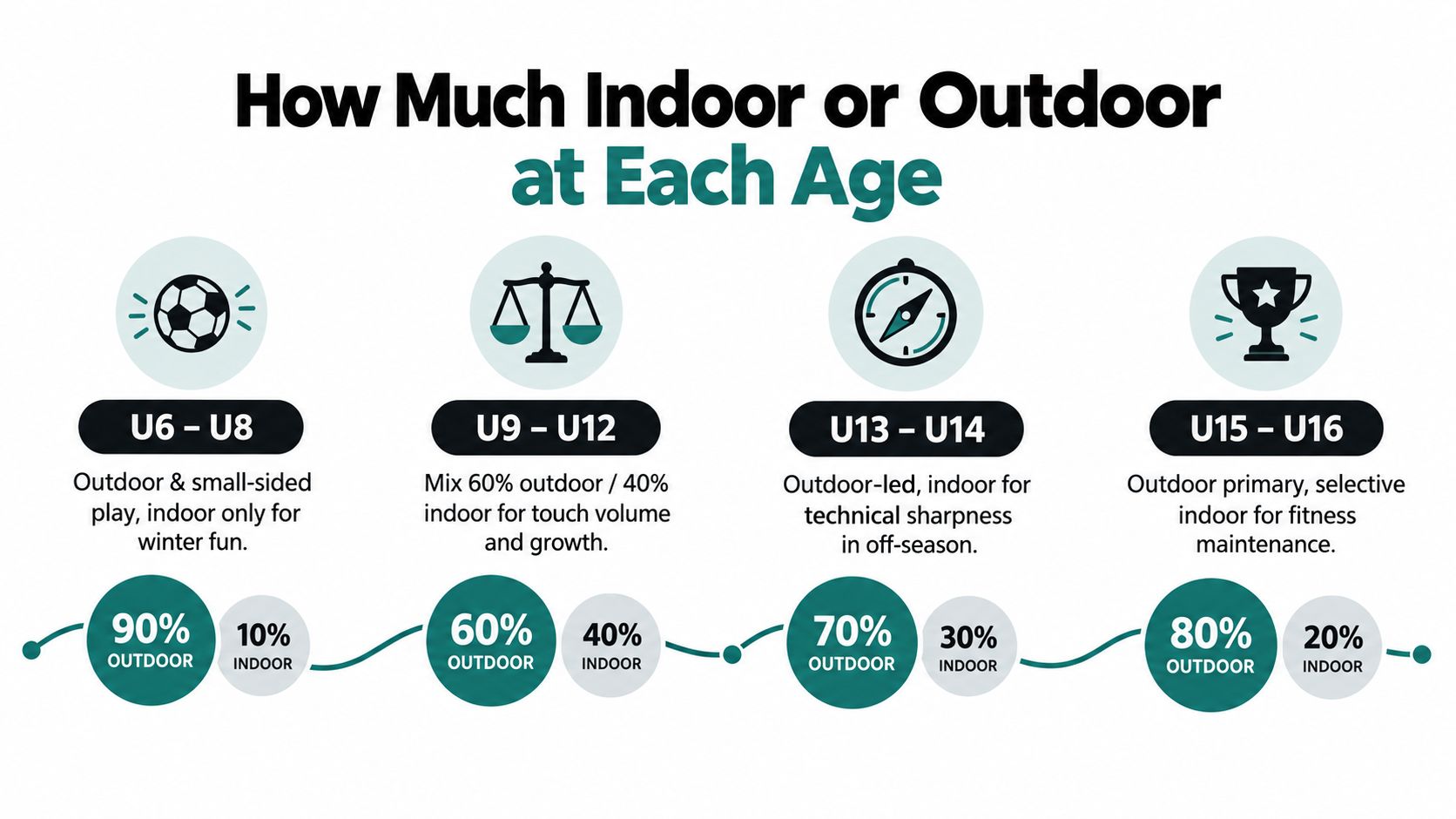
U6 to U8
Prioritize outdoor and small-sided play. At this age, children need freedom to dribble, chase, stop, turn, and solve simple problems without excessive tactical instruction. Indoor soccer can be excellent winter fun, especially when it keeps a child engaged, but it shouldn't become a second competitive calendar.
A sensible week might include:
One organized outdoor session.
One small-sided game or informal play session.
One optional indoor activity during poor weather.
At least two days without organized soccer.
Keep tournaments limited and short. The parent's job is to protect enjoyment and movement quality, not to maximize the number of team events.
U9 to U12
This is the strongest age band for using indoor or futsal as a technical bridge. During spring and fall, let outdoor soccer carry the larger share of the schedule. Use indoor work in winter or during selected summer blocks to challenge first touch, scanning, and quick decisions.
A practical seasonal target is a 60-to-40 outdoor-to-indoor balance, not as a rigid weekly quota but as a planning guide for the year. It aligns with the need for outdoor spacing while giving the child regular exposure to tight pressure.
A sample week could look like this:
Outdoor team training.
Rest or unstructured play.
Indoor technical session.
Outdoor match.
Full rest day.
Optional light ball work.
Family day or recovery.
Don't place an indoor tournament immediately beside a demanding outdoor tournament weekend.
U13 to U15
Shift toward a more balanced blend as players face stronger outdoor competition. Indoor and futsal can sharpen close control and pressure decisions, while outdoor play teaches positional responsibilities, longer passing, and tactical patience.
For a U14 player, a week might contain two outdoor team sessions, one indoor technical session, one outdoor match, and two recovery days. During an indoor block, reduce extra outdoor intensity rather than adding the block on top of everything else.
High school
Outdoor soccer becomes the priority because college visibility, outdoor tactical evaluation, and outdoor-specific fitness all matter. Indoor soccer remains useful as a five-a-side supplement, a technical reset, or a summer futsal program, but it shouldn't crowd out the outdoor environment a high school player must master.
Don't double the schedule during transition months. Replace a session before you add one.
Why Elite Academies Use Both Formats Together
The indoor-versus-outdoor argument is the wrong frame for serious development. A thoughtful academy uses each environment for a defined purpose, then checks whether the player can transfer the learning.
Indoor or futsal gives a young player fewer escape routes. There isn't always time to take a safe extra touch or wait for a teammate to arrive from across the field. The player must receive with an open body, scan before the pass arrives, and recognize simple combinations under immediate pressure. Small-sided situations also make numerical problems visible. A child repeatedly faces moments such as two attackers against one defender, or a quick transition after losing the ball.
Outdoor soccer tests whether those habits survive in a larger setting. The player must decide when to keep the ball, when to switch play, how far to support a teammate, and how to defend space that may be several passes away. A technically sharp indoor player still needs to learn the timing and geography of the outdoor game.
Villarreal CF's method is complementary
Villarreal CF's methodology is best understood as a development framework rather than a preference for one surface. Positional play principles can transfer between formats, but the constraints change the lesson. Indoor work can emphasize receiving under pressure, rapid scanning, and solving tight numerical situations. Outdoor work can emphasize spacing, progression, width, depth, and longer tactical relationships.
That sequence makes sense across a Houston calendar. Coaches can use futsal or small-sided indoor blocks during technical periods, then ask players to apply those habits during outdoor competition and larger-field training. The point isn't to declare that indoor creates better players on its own. The point is to make every format answer a different coaching question.
Villarreal Houston Academy's indoor soccer academy program reflects that kind of complementary planning by giving families an indoor training option alongside outdoor development. Parents should ask how any academy connects indoor sessions to outdoor objectives, rather than accepting a vague promise that “more soccer” automatically means better development.
One-format players carry predictable blind spots
Outdoor-only players may look comfortable with space but hesitate when an opponent closes quickly. They may receive facing forward because the field gives them room, then struggle to protect the ball in a crowded midfield.
Indoor-only players may become excellent at short combinations while missing the larger picture. They may not recognize when to switch play, how to manage a long defensive recovery, or where to stand when the ball travels away from them.
The solution is not equal exposure every week. It's purposeful exposure over the year, matched to age, competition, and the next skill the player needs.
Choosing the Right Path for Your Family
Your child may enjoy both formats but need a clearer plan. Start with four questions: age, development goal, family schedule, and access. The facility name and sideline opinions come later.
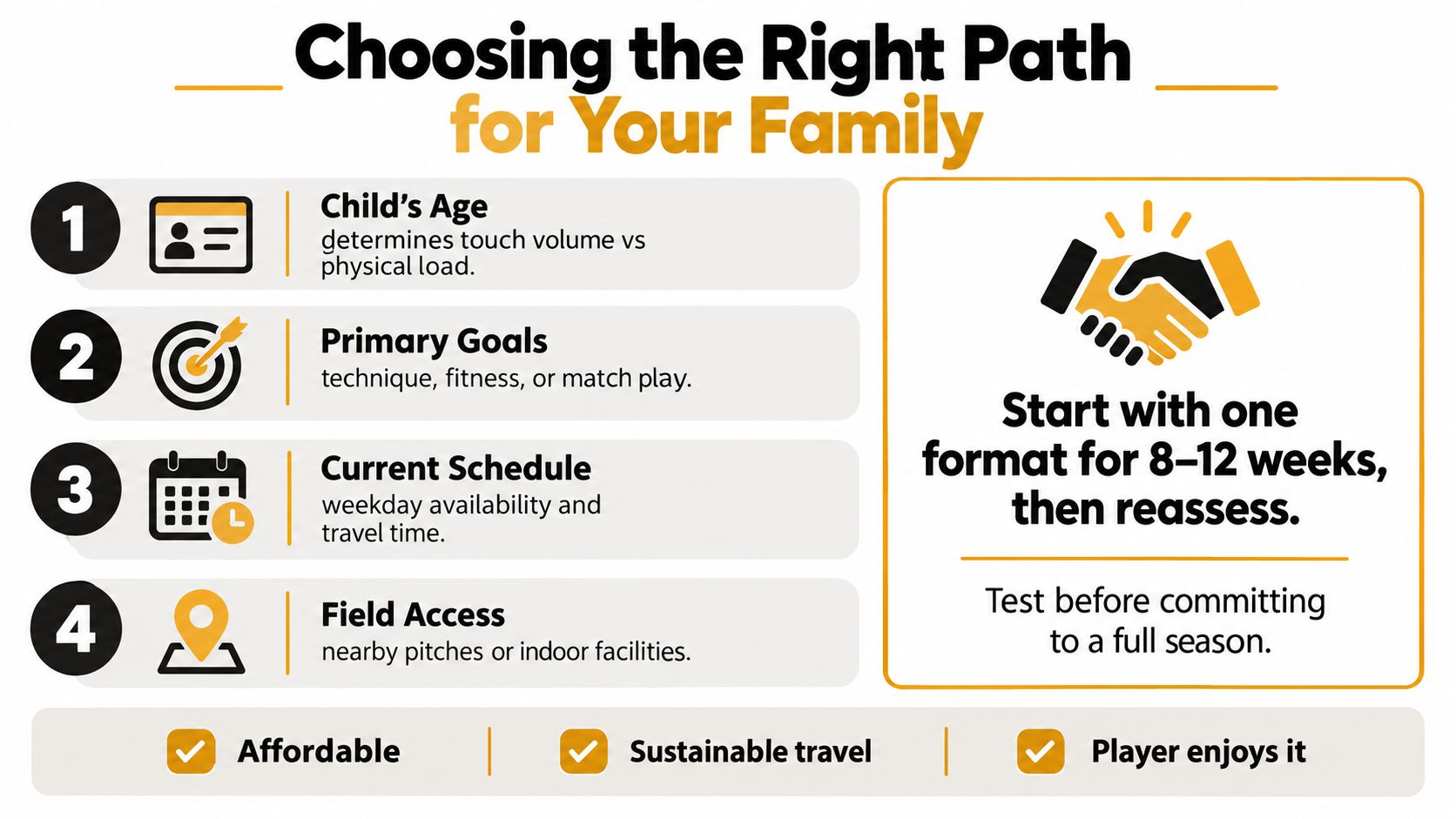
Ask what your child needs now
Age comes first. Younger players need freedom, varied movement, and small-sided outdoor play. U10 to U14 players often gain from futsal's repeated close-control decisions and quick pressure. Older players should keep outdoor competition central, using indoor soccer to sharpen specific skills.
Choose the format around the goal. Indoor work suits a player who needs confidence receiving under pressure. Outdoor training deserves priority when the need is endurance, open-field positioning, or longer passing. If they love playing, choose the format that keeps them engaged without overloading the family calendar.
Protect consistency. A technically strong program fails if travel, school, and recovery make attendance unreliable. Pick a routine your family can sustain through a full training block, then reassess. More sessions are not automatically better sessions.
Account for Houston conditions and access. Outdoor fields may be convenient, while a quality indoor facility requires more travel, or the reverse. Houston's year-round climate allows outdoor play across much of the calendar, but heat and weather still make indoor training useful during the hottest summer periods and for controlled technical work.
A practical plan uses outdoor soccer in fall and spring, with indoor sessions added during winter and intense summer heat. For U10 to U14 players, prioritize futsal or a well-coached indoor technical block when they need more touches and faster decisions. For high school players, keep the outdoor pathway primary and use indoor work to maintain sharpness without adding another heavy competition schedule.
Before registering, ask three direct questions:
How does the indoor curriculum transfer to outdoor play?
How does the coach manage total workload across both formats?
What should my child improve during the next training block?
Villarreal Houston Academy offers competitive youth teams, camps, clinics, tryouts, and an indoor training option alongside its outdoor pathway for players from age 4 upward. A free evaluation can help your family match the two formats to the player's current needs, schedule, and longer-term development plan. Visit villarrealhouston.com for evaluation and tryout information, then ask how the academy combines indoor and outdoor work.
Comments