


Elite Soccer Youth Development Academy Explained

Your child has outgrown recreational soccer, but the next choice feels less obvious than the brochures suggest. One program promises competition, another highlights college exposure, and a third uses the word “academy” so often that it becomes difficult to tell what the player will experience at training.
For a Houston family, the right question isn't whether a child can join an elite soccer youth development academy. The better question is whether the environment develops the whole player, explains its decisions clearly, manages training responsibly, and protects the child's long-term relationship with the game. Elite development should provide challenge without turning every practice into a judgment about future professional potential.
A genuine academy combines purposeful coaching, progressive competition, individual feedback, recovery planning, and personal growth. It also accepts an uncomfortable truth: the professional pathway is narrow. In the English academy system, roughly 12,000 boys aged 8 to 21 are contracted to professional academies at any one time, while around 1,000 players aged 9 to 16 receive academy contracts each year. Yet fewer than 1% of academy footballers ultimately play professionally as adults, according to research on the youth-to-professional pathway.
That reality shouldn't make ambitious families give up. It should help them choose more wisely. The sections ahead explain what “elite” should mean, how the methodology works, what parents should ask before committing, how academies compare with other soccer options, and how Villarreal Houston's Yellow Submarine model brings these principles into a local development pathway.
Introduction to Elite Youth Soccer Development
At a first serious tryout, a young player may focus on proving they belong. Parents often watch for something different: whether the program can stretch their child without overwhelming them. A few impressive drills cannot answer that question. Development shows itself across training, matches, feedback, and the way a player responds to difficulty.
An elite academy is a structured learning environment. Coaches assess how players receive information, solve problems, respond to mistakes, cooperate with teammates, and apply skills when the game becomes faster and more demanding. Those qualities should grow over time through purposeful coaching, rather than being judged from one strong performance.
Elite does not mean professional certainty
The word elite can sound like a promise about a player's destination. In practice, it describes the quality and organization of the development environment. A player may receive excellent coaching, make meaningful progress, and build confidence even if professional soccer does not become their adult career.
Research from the UK found that academy experiences supported transferable life skills and educational or vocational opportunities for both contracted and non-contracted players. The majority who left the system became better prepared for life beyond soccer, according to the Leeds Beckett University study. That finding changes how families should judge an academy. The pathway should prepare a player for opportunities on the field and for responsibilities away from it.
A healthy academy asks, “Who is this player becoming?” not only, “How far can this player go?”
A child-centered decision
A child may be ready for a greater challenge without being ready for every feature of an intensive program. Sleep, school, other interests, family travel, and simple enjoyment all belong in the decision. Training load works like a budget: spending more time and energy in one area leaves less available elsewhere. A strong academy considers the whole week, not only the practice schedule.
Parents should expect direct answers. How are players evaluated? What does feedback look like? How are growth and maturity considered? What happens when a player is not retained? Clear answers reveal the quality of the environment more reliably than a polished facility or a famous badge. Villarreal Houston's Yellow Submarine model offers a useful local example of an academy pathway that can be examined through those practical questions, including player development, education, and life beyond soccer.
What Makes an Academy Truly Elite
A parent watches a tryout and sees one impressive sprint, a confident dribble, or a powerful shot. The academy director must look further. What happens when the player faces pressure, receives unfamiliar feedback, or needs to manage school and training in the same week? Elite development depends on the quality of those decisions over time.
An academy earns that description through structure, coaching, and consistent attention to player development. Fees, travel schedules, and a “premier” label reveal little by themselves. The stronger test is whether the academy can explain how players learn, how progress is reviewed, and how the program adjusts when a child's needs change.
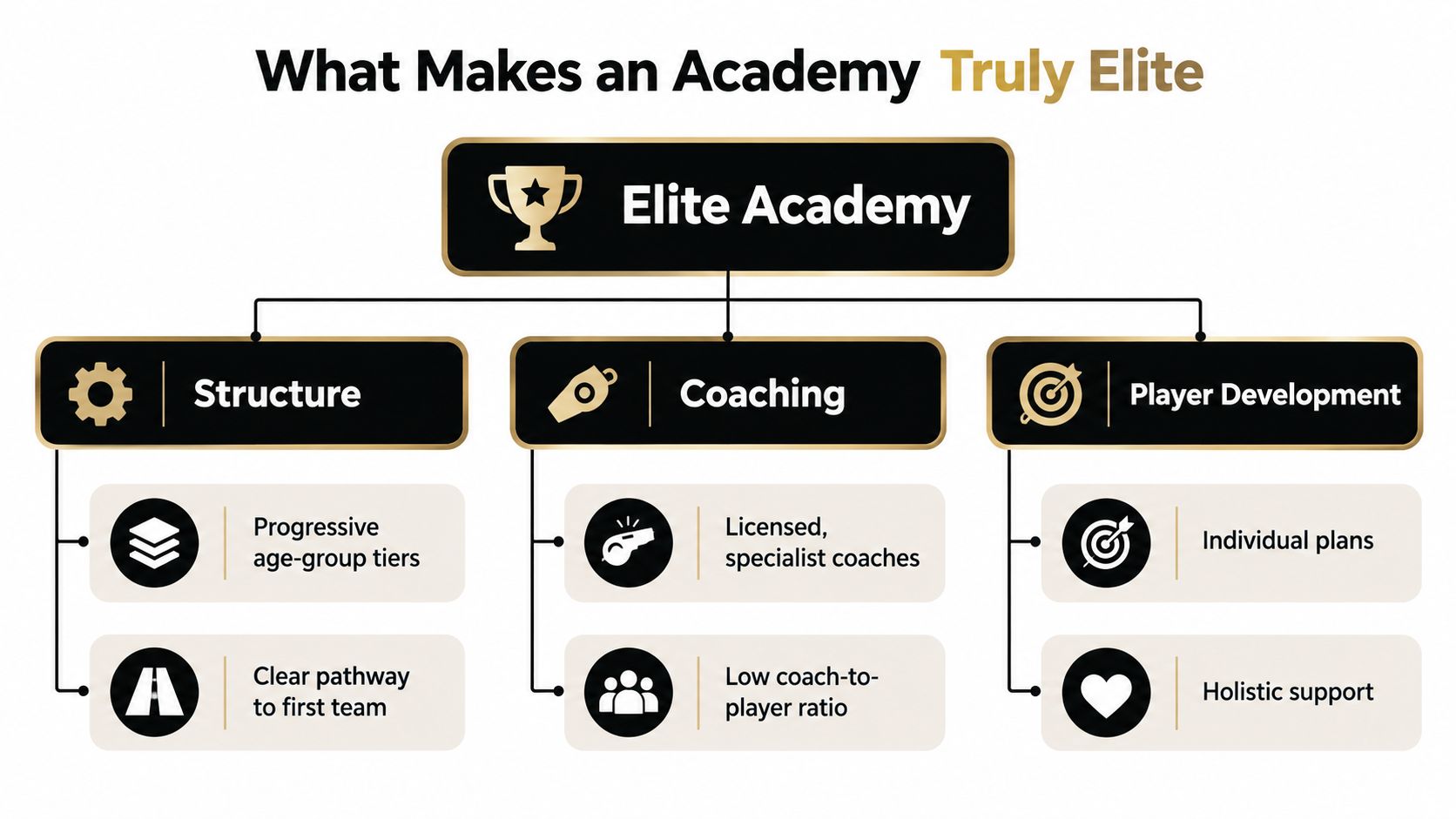
Structure creates a learning sequence
Start with progressive age-group tiers. Younger players need activities suited to their physical, cognitive, and emotional development. As their ability and readiness grow, the challenges can become more demanding. A smaller copy of an adult program rarely provides that progression.
A useful structure includes:
A planned curriculum: Sessions connect, with each practice developing ideas introduced earlier.
Age-appropriate progression: Coaches adjust the difficulty as players mature and gain experience.
Meaningful game application: Training themes appear in small-sided games and full-match situations.
A visible pathway: Families can understand how players move between teams, levels, and opportunities.
The English academy system shows why early selection requires careful explanation. Academies recruit players as young as five, while the pathway contains a large and highly selective group of young athletes. Reaching professional soccer remains a narrow outcome for players who enter an academy, as documented in this peer-reviewed pathway analysis. Early selection should therefore mark the start of a learning process. It should never define a child's ceiling.
Coaching turns opportunity into progress
Qualified coaches do more than demonstrate technique. They observe, ask questions, adjust the task, and explain the decision behind an action. After a pass reaches a teammate, for example, a coach may ask whether the player scanned first, recognized pressure, and selected the best option.
Players need enough individual attention to know what to improve. They also need space to solve problems without constant correction. Strong coaches choose when to intervene and when a short cue will help the player discover the answer.
Development includes the person
An elite environment develops character, communication, responsibility, and self-management alongside soccer ability. Players learn to prepare equipment, respond respectfully, handle disappointment, and contribute to a group. These habits can support a future in professional soccer, college soccer, another sport, or a different field entirely.
Parents can judge this standard through difficult moments. Observe how the academy responds when a match becomes tense, a player makes a mistake, or a selection decision disappoints a family. Villarreal Houston Academy's Yellow Submarine model provides a local example to examine through those practical questions. Its value should be judged by visible processes and player experience, rather than pathway hype alone.
Core Principles Behind Elite Development
A player who looks excellent in an isolated technical drill may still struggle in a match. The game adds time pressure, opponents, teammates, fatigue, changing space, and consequences. For that reason, modern academy development uses a talent model rather than selecting only for current performance.
Research on elite academy soccer identifies several relevant categories, including anthropometric and physiological factors, psychological characteristics, technical skills, and training history. The practical lesson is straightforward: coaches need a broad picture of the player, not a snapshot of what the player can do on one afternoon. The research on holistic talent development explains why balanced development helps reduce the risk of confusing early physical maturity with long-term potential.
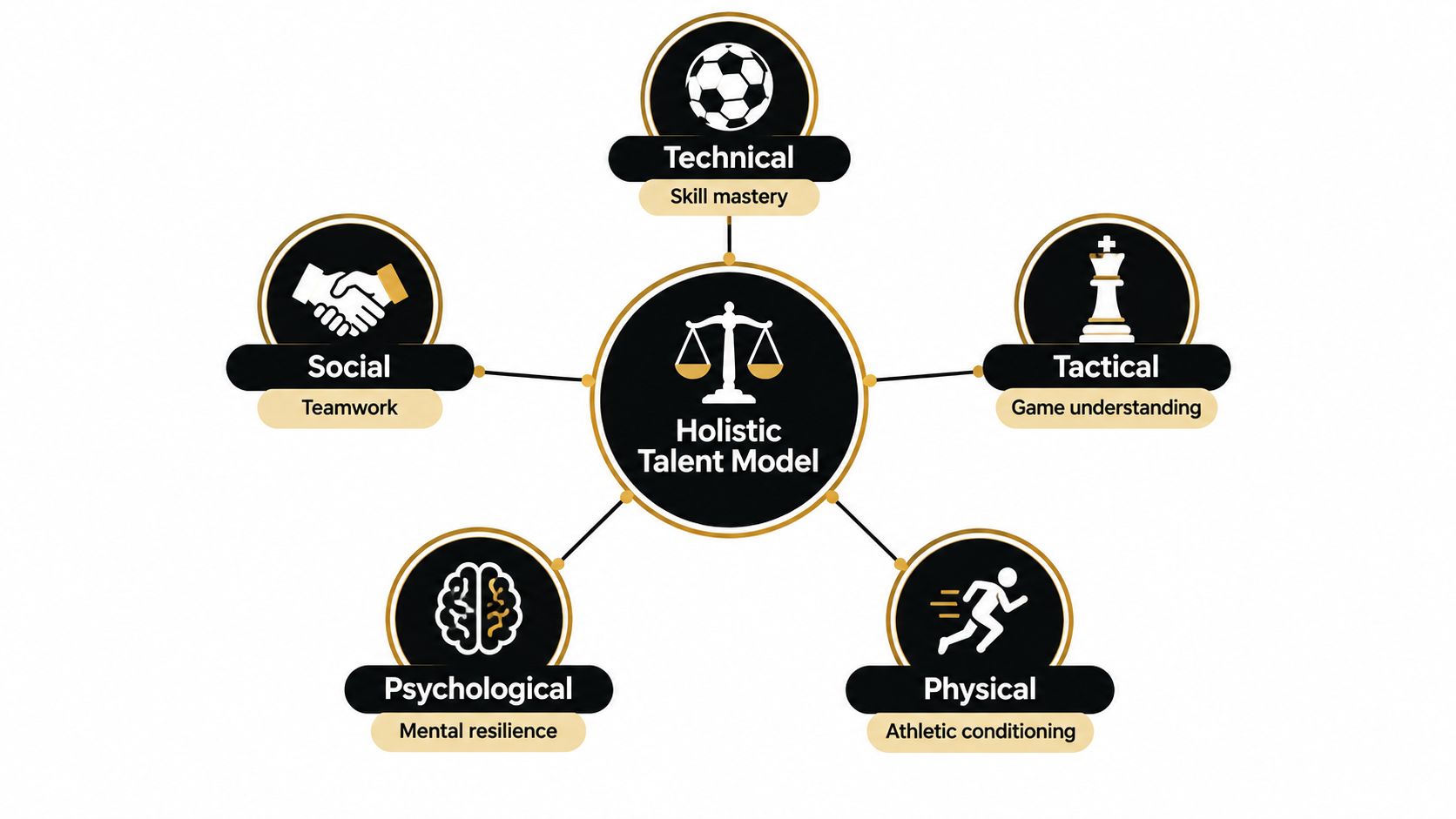
Five connected areas of development
Technical ability includes receiving, passing, turning, dribbling, finishing, and defending actions. Coaches should ask whether the player can execute those skills with the appropriate foot, speed, and direction.
Tactical understanding concerns decisions. Can the player recognize space, support a teammate, adjust positioning, and understand what the team needs in that moment? A technically gifted player who doesn't perceive the game may struggle against organized opposition.
Physical preparation includes movement quality, coordination, strength development, speed, and the ability to repeat actions safely. Coaches must account for differences in growth and maturation rather than treating every player in an age group as physically identical.
Psychological development covers concentration, emotional control, resilience, confidence, and willingness to accept coaching. A mistake should become information, not a reason for humiliation.
Social development includes communication, teamwork, respect, leadership, and belonging. Players learn faster when they feel safe enough to take responsible risks.
These areas overlap. A player may need technical confidence to make a tactical decision, psychological composure to execute it, and social awareness to understand a teammate's movement.
Load management is part of coaching
Training load works like a bank account. A player can make deposits through appropriate practice and recovery, but a sudden withdrawal can leave the account overdrawn. Elite adolescent soccer programs commonly use GPS, session RPE, wellness checks, and individualized benchmarks to understand how much work a player is completing.
A major review recommends age-, maturity-, and position-specific thresholds, while comparing a player's accumulated load and “time on feet” with their own baseline. The point isn't to chase the highest workload. It is to identify harmful spikes, chronic underload, and the appropriate balance of technical repetitions, tactical practice, strength preparation, and recovery, as outlined in this review of youth soccer training-load management.
The right question isn't “How many hours can my child train?” It's “What training dose can this child absorb, adapt to, and recover from?”
A practical academy plan might reduce intensity after a demanding match, adjust a player's activities during a growth period, or add recovery rather than automatically adding work. Coaches should communicate these decisions in language parents can understand.
For families who want to examine how curriculum design supports this integrated approach, the soccer academy curriculum provides a useful example of how training themes can connect across development.
How to Evaluate an Elite Academy as a Parent
Your child may leave a trial session excited, tired, or unsure what to make of it. Use that reaction as one clue, not the whole evaluation. Look beyond busy drills and attractive facilities. Notice what coaches observe, how they explain decisions, and whether players understand the purpose of each activity.
Bring these questions to a visit, call, or tryout.
Questions about coaching
Ask who leads your child's group, which qualifications they hold, and how they continue learning. A license does not by itself create a good environment. A coach who can explain the academy's methodology gives your family a clearer basis for trust.
Watch the coach-player relationship closely. Do coaches correct behavior without embarrassing players? Do they welcome questions? Do they give precise feedback, such as asking a player to scan before receiving, rather than repeating “work harder”?
Questions about methodology and welfare
Request the development plan for your child's age group. It should address more than formations and tournament schedules. Ask how coaches teach decision-making, track progress, account for maturation, and respond to fatigue or discomfort.
Parents should also ask:
Feedback timing: How often will families receive progress updates?
Evaluation criteria: Which technical, tactical, physical, psychological, and social qualities matter?
Injury response: Who handles concerns, and how does the player return to training?
Recovery education: How does the academy discuss sleep, nutrition, and rest?
Player voice: Can children ask questions or help shape development goals?
Research on academy selection found that parents and players often encounter subjective criteria, unclear decisions, and communication gaps during selection and release periods. Uncertainty can create emotional strain and perceptions of unfairness, according to research on fairness and transparency in academy evaluations.
Watch for the culture behind the results
A win-now culture may favor physically advanced players, keep feedback vague, or use fear to gain compliance. A development culture explains decisions, treats mistakes as part of learning, and shows players how they can improve.
If an academy can't explain how it evaluates players, it can't give your family a reliable picture of progress.
Ask for the same clarity about cost and scheduling. Confirm what tuition includes, which activities are optional, and whether travel or equipment creates additional responsibilities. Reviewing soccer academy fees can help your family compare the full commitment, not just the advertised price. The strongest choice is an academy whose evaluation process, training expectations, and life-skills goals are understandable before your child joins.
Elite Academy Compared to Other Soccer Options
No single soccer environment suits every player. A young athlete may need a gentle introduction, a competitive challenge, or a flexible schedule that leaves room for other sports and family commitments. The right choice depends on the player's current needs and the family's capacity to support the program.
Environment | Best For | Development Focus | Typical Commitment |
|---|---|---|---|
Recreational league | Players building confidence and enjoying a first team experience | Basic skills, participation, and game familiarity | Flexible and seasonal |
Competitive select club | Players seeking stronger opposition and regular team training | Technical growth, tactical habits, and competitive play | Regular practices and matches |
Elite academy | Players ready for a structured, progressive development environment | Integrated technical, tactical, physical, psychological, and social growth | Sustained training, evaluation, and competition |
Camps and clinics | Players wanting focused exposure or supplemental practice | Specific skills, new experiences, and short-term learning | Short-term or occasional |
Match the environment to the player
A recreational league may be the best fit for a child who is still discovering whether soccer feels enjoyable. It can also work well for a multi-sport athlete who needs flexibility. There's no developmental failure in choosing a lower-pressure setting when that setting supports participation and confidence.
A select club may suit a player who wants regular competition but isn't ready for a tightly managed academy schedule. Families should compare coaching consistency, player rotation, communication, and the quality of training rather than relying only on league labels.
An elite academy becomes more appropriate when the player wants purposeful challenge and the family can support the associated routine. The player should still have room for recovery, school, friendships, and interests outside soccer.
Use camps with intention
Camps and clinics can help a player test a new environment without an immediate long-term commitment. They can also address a particular need, such as finishing, ball mastery, or confidence in small-sided games. They shouldn't be treated as a complete replacement for consistent coaching and game application.
The badge on a jersey matters less than the daily experience. A less intensive program with thoughtful coaches may produce more useful learning than an elite label attached to chaotic scheduling or unclear expectations.
Inside Villarreal Houston Academy and Its Pathway
A family in North Houston may first encounter Villarreal Houston through a camp, clinic, tryout, or introductory training session. That entry point can lead to a more structured pathway, with age-appropriate programming for boys and girls from age 4 upward and progression from junior academy experiences toward competitive teams.
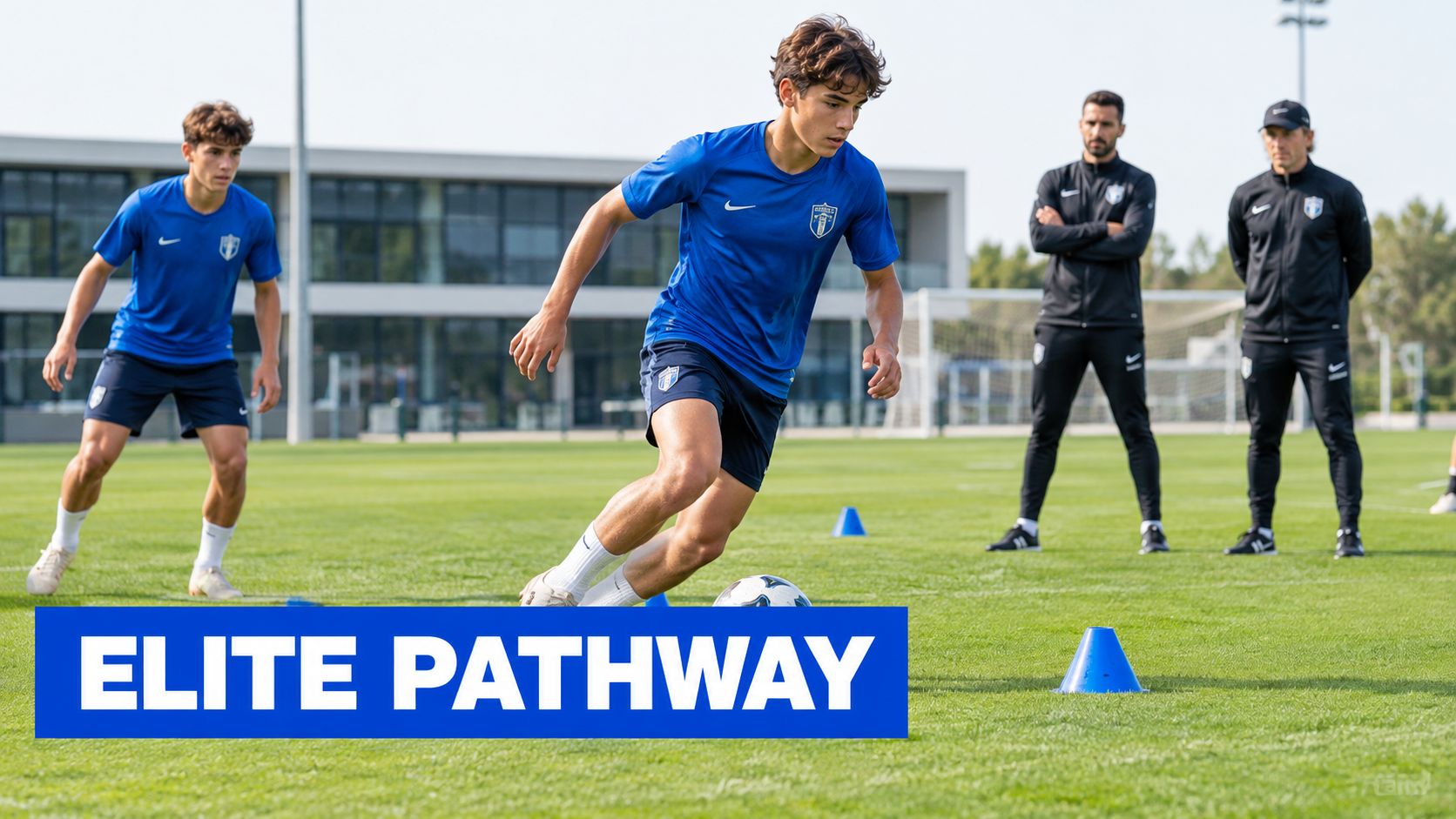
The academy is the official partner academy of Spain's Villarreal CF in the Greater Houston area. Its Yellow Submarine methodology places emphasis on intelligence, skill, and character, which fits the broader definition of elite development described earlier. Coaches use age-appropriate training to help players connect technical actions with tactical understanding, decision-making, and personal responsibility.
The pathway is designed to serve different stages rather than force every child into the same model. Younger players need engaging foundations and lots of contact with the ball. Older competitive players need more demanding game problems, stronger opposition, individual feedback, and preparation for the expectations of advanced soccer.
A local pathway with international connection
Villarreal Houston provides access across Humble, Fall Creek, Cypress, Tomball, and the Kingwood, Porter, and New Caney area. That geographic reach matters because a development plan only works when a family can maintain it without turning travel into a constant source of stress.
Players can pursue academy teams, competitive programming, camps, clinics, and tryouts. The pathway also includes opportunities to travel to Spain to train and play alongside Villarreal CF's elite academy, giving motivated players a direct experience of a different soccer culture and training setting.
Sports psychologists support the academy environment, alongside qualified coaches who are expected to engage players positively. That combination reflects a welfare-aware model in which mental skills, confidence, behavior, and performance belong in the same conversation.
A family considering the program can learn more about its partnership and pathway through the Villarreal CF youth academy overview.
The following video offers another way to see the academy's training environment and development approach.
Choosing the Right Development Path for Your Player
Choosing an academy is a decision about fit, not status. Start with your child's goals. Does the player want more challenge, or are adults creating the urgency? Does the schedule leave enough room for sleep, school, recovery, and enjoyment? Can the academy explain how it evaluates development and communicates difficult decisions?
Use four tests:
Purpose: The program should have a clear reason for each age-group activity.
Balance: Coaches should connect technical, tactical, physical, psychological, and social development.
Protection: Training demands should progress according to age, maturity, individual response, and recovery.
Transparency: Families should understand feedback, selection, release, costs, and next steps.
Youth burnout rarely comes from one influence alone. Recent evidence links psychological exhaustion with training fatigue and delayed-onset muscle soreness, while sleep quality can be protective and emotional intelligence can change how players respond to those pressures, according to this 2025 Frontiers study. That makes recovery and communication central parts of an elite program, not optional extras.
Visit training, speak with coaches, and watch how players are treated after mistakes. Then choose the environment that gives your child a challenging next step while preserving the curiosity and love that brought them to soccer in the first place.
Villarreal Houston Academy offers age-appropriate select and competitive soccer programs, camps, clinics, tryouts, sports-psychology support, and a pathway connected to Villarreal CF in Spain across North Houston communities. Visit Villarreal Houston Academy to explore programs and find a development experience built around intelligent play, skill, character, and long-term player welfare.

Comments