


Youth Soccer Drills U8: 8 Game-Ready Ideas

An energetic U8 group rarely needs more instructions. They need more involvement. If players spend too long waiting in lines, listening to complicated explanations, or repeating movements without a decision, their attention fades and the session loses its purpose. The best youth soccer drills for U8 players give every child frequent touches, simple challenges, and a chance to solve a problem.
This collection moves from individual control to passing, combination play, pressure, possession, and small-sided games. Each activity includes a practical setup, coaching cues, a progression, and a connection to match play. Coaches can adjust the challenge according to the group's confidence, available space, and player numbers while keeping the environment safe, encouraging, and enjoyable.
U.S. Soccer guidance for U7 and U8 players emphasizes small-sided formats such as 1v1, 2v2, 3v3, and 4v4, along with short passing, receiving, defending, and using both feet. The U.S. Soccer U7 and U8 coaching guidance supports a development-first approach that values touches, decisions, confidence, and game-like learning over rigid formations or long training blocks. Those principles also fit Villarreal-inspired coaching, where technical quality, intelligent play, positive engagement, safety, and character develop together.
1. Rondo Possession Circle
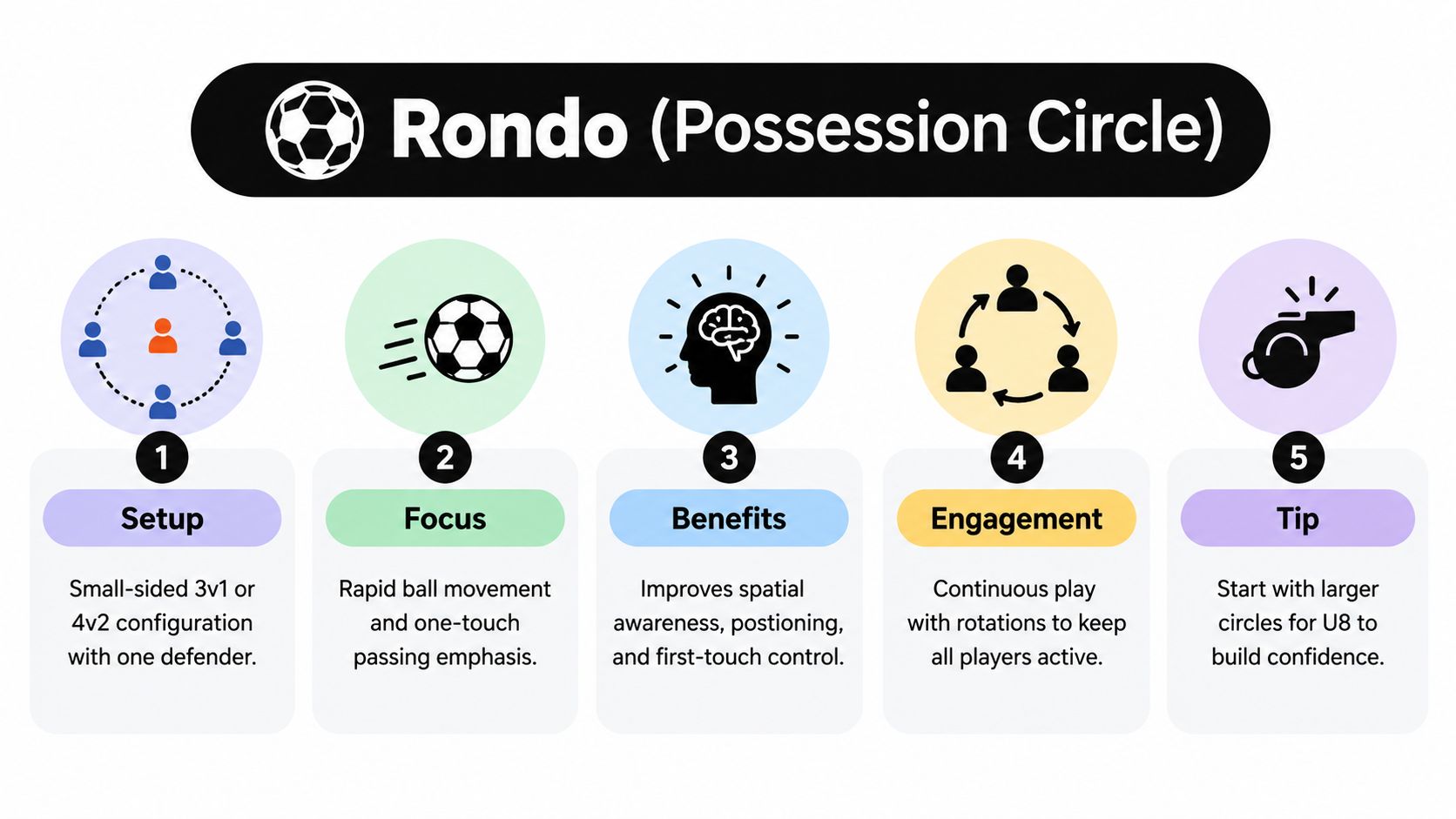
A rondo gives players a simple problem. Teammates on the outside pass and move to keep the ball, while a defender in the middle tries to win it. For U8 players, begin with a small group of five or six players, including one defender, then make the circle larger if the group needs more time and space.
Give each outside player a clear passing lane. The receiver should check away from the ball, move into a helpful position, and prepare the first touch before the pass arrives. Start with more freedom, then introduce a two-touch limit when players are comfortable. The objective isn't passing as fast as possible. It's making a clean pass, receiving with control, and recognizing where the next option is.
Rotate the defender after a brief round so everyone experiences pressure. Encourage players to communicate with simple words such as “turn,” “man on,” or a teammate's name. A defender who wins the ball should also receive praise for reading the pass and applying controlled pressure.
Setup and coaching cues
Use a circle large enough for players to succeed, then gradually reduce the space as their awareness improves. Keep spare balls nearby so the coach can restart play quickly instead of allowing the group to stand idle.
Body shape: Receive side-on when possible, with the first touch away from pressure.
Passing quality: Pass to the teammate's safe foot and keep the ball on the ground.
Movement: Move after passing instead of watching the ball.
Defending: Close down under control and avoid lunging.
Practical rule: Quality passes matter more than rushed passes. A calm decision that keeps possession teaches more than a hurried ball that goes out.
A rondo can open a session because it introduces technical repetition and decision-making without separating the skill from the game. The format also reflects the small-group logic recommended in the Official U.S. Youth Soccer Coaching Manual, which places U8 activities in compact spaces with frequent interactions.
2. Four-Goal Possession Game
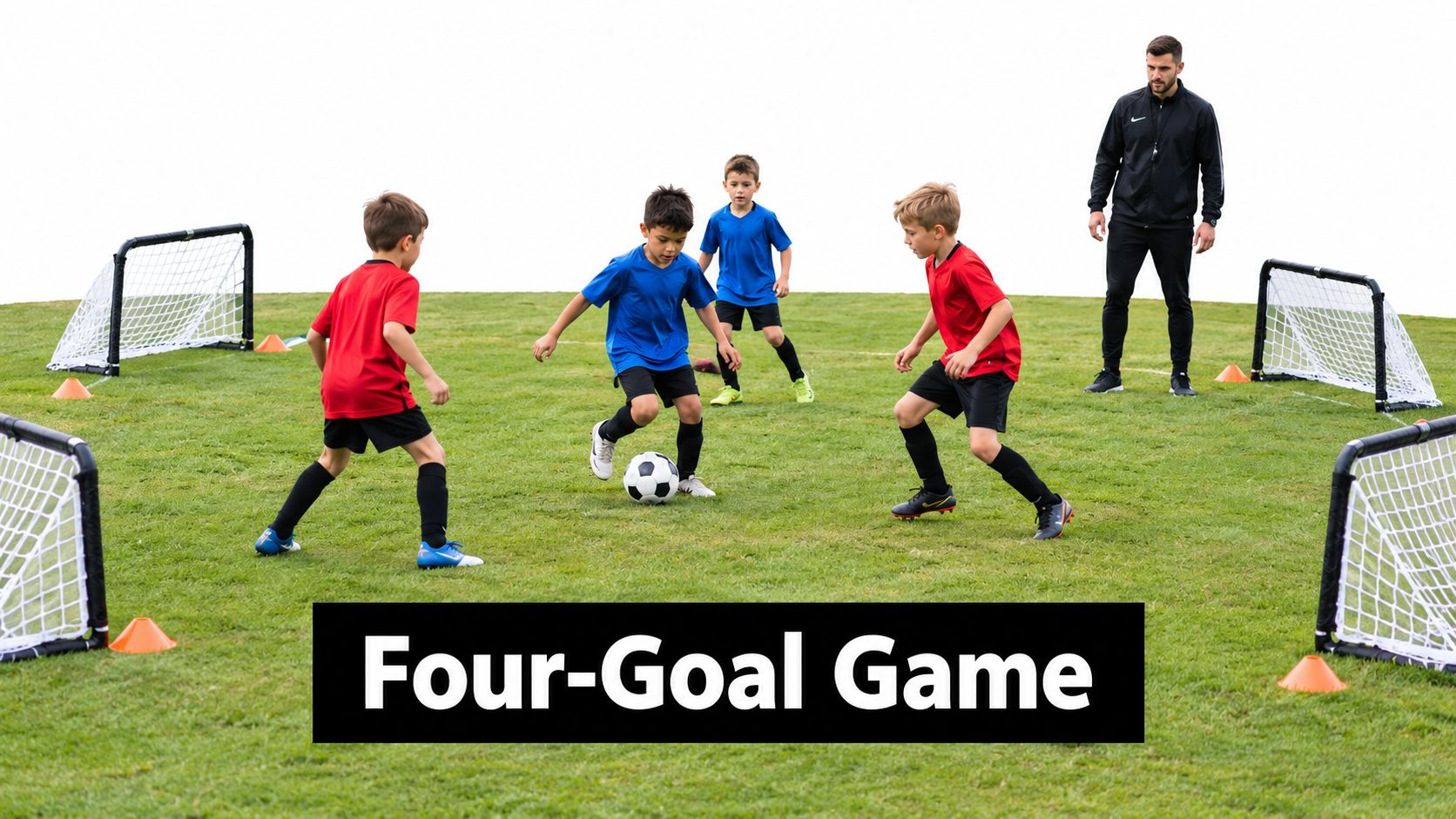
A defender closes one goal, and a teammate spots space by another. That quick change is the heart of the four-goal game. Mark a compact playing area and place a small cone goal on each side. Two teams keep the ball while attacking any goal, encouraging players to scan beyond the immediate pressure and recognize space in several directions.
Begin with clear, simple rules. Players may take several touches, pass to any teammate, and score through an open goal. As the game becomes smoother, ask the team to connect passes before trying to finish. The ball then works like a question for the defenders: move it one way, observe their response, and choose the opening that appears. Players learn to spread out, support the ball, and select a useful option rather than forcing the first one.
Use short questions during play. “Where's the open goal?” “Can you make the field bigger?” “Who can support behind the ball?” Give children time to solve the picture themselves. Positive coaching keeps the activity safe, active, and enjoyable while building responsibility and communication.
Progressions for intelligent play
Set lightweight cones on clear boundaries, and explain which goals count and where restarts happen. If the game feels difficult, allow unlimited touches and make the area more generous. If possession becomes easy, add a touch restriction or ask every teammate to be involved before a score.
Attacking cue: Look away from the ball before receiving, then check the next goal.
Supporting cue: Offer the player with the ball a forward option and a safe option.
Defending cue: Protect the nearest goal first, then recover toward the ball.
Teamwork cue: Move the ball to move the defenders and create a new passing lane.
Run several short games when space and players allow. Rotate teams often so children stay active and experience different roles. Praise communication, brave decisions, clean technique, and respectful challenges, not only goals. These habits reflect Villarreal-inspired principles of intelligent play, technical quality, positive coaching, and character. The purpose is to connect technical execution with intelligent choices while helping young players enjoy working together.
3. Cone Weaving and Ball Control
Cone weaving works when players control the ball with purpose, rather than racing through a pattern. Set up a straight line, zigzag, square, diamond, or gentle figure eight on a clear surface. Use one ball per player when possible, with enough space between routes for safe movement. For a group of eight, two lanes of four players keep everyone active. Players start on your signal, leave space before the next player begins, and return along the outside.
Start with small inside-foot touches. Once players can keep the ball close, add outside-foot touches and sole rolls. Invite both feet from the beginning, while treating the weaker foot as another tool, not a punishment. It helps a player turn away from pressure or carry the ball into a new space.
Build each repetition in three parts: weave with close touches, look up after each change of direction, then push the ball beyond the final cone into open space. The final touch gives the drill a match purpose. Close control helps near opponents, while a longer touch allows faster travel when space opens.
Coach the detail, then add a challenge
Use a calm rhythm for the first few attempts. A repetition can last about 30 seconds, followed by a brief recovery and a new start. Increase speed only when players still change direction cleanly. Challenge the group to complete a clean route, use both feet, or improve a personal attempt. This keeps enjoyment and persistence ahead of simple racing.
Close control: Keep the ball within easy reach near each cone.
Posture: Bend the knees and stay balanced through every turn.
Scanning: Glance up between touches to find the next space.
Character: Recover calmly after a mistake and continue.
For more activities linking ball mastery with directional movement, coaches and parents can use these youth soccer dribbling drills from Villarreal Houston Academy. Use this activity as a warm-up, a technical block, or a confident bridge before defenders arrive. It develops technique, awareness, and the patience to make a better choice under pressure.
4. 1v1 Gateway Progression
Set up a compact channel with several cone gates and organize players in pairs. One player begins with the ball as the attacker, while the other defends. The attacker scores by dribbling through any gate. The defender delays the run, protects the space, and tries to regain possession without diving in.
Give each turn a clear purpose. The attacker scans for an open gate, slows before meeting the defender, then chooses whether to protect the ball, feint, change direction, or accelerate through space. The gate is the target, but the actual lesson is reading the defender. A successful move comes from a good decision, not a memorized trick.
The defender has an equally valuable role. Approach under control, stay balanced, and guide the attacker away from the easiest route. Praise a defender who delays the attack, closes a gate, or causes a poor touch, even without winning the ball. Players learn that smart defending helps the whole team.
Use short rounds and rotate opponents often so every child attacks and defends. Keep enough space for the attacker to turn, while preserving pressure that feels like a match. Players waiting for a turn can watch for the moment the attacker changes speed, then identify which gate they would choose.
Coach with brief cues: “Slow down,” “show a feint,” “change direction,” and “accelerate into space.” Remind defenders to watch the ball and the attacker's hips rather than reaching for the feet. If a player loses the ball, restart quickly and invite a new solution.
As confidence grows, add a second defender, close one or more gates, or ask the attacker to use a particular foot. Begin with passive pressure for newer players, then let defenders compete fully when control improves. This progression reflects intelligent play, technical quality, positive coaching, and safe competition. Players practise courage, responsibility, and respectful responses to mistakes while enjoying the challenge.
5. Pass and Follow Movement
Use two players, one ball, and a short passing distance. Player A passes to Player B, then moves to a new angle. Player B receives and returns the ball, or plays it into Player A's path before following the same movement. The pass starts the next action, like opening a door for a teammate.
Begin without pressure. Give players time to coordinate the pass, movement, and receiving touch. Rotate roles regularly so each child practises passing, receiving, and supporting. After the rhythm improves, add a third player to form a triangle. The receiver then chooses between two teammates, while the passer must find useful space instead of drifting.
Use brief cues during play: “Pass and move,” “show early,” “open your body,” and “check your shoulder.” Ask the receiver to take the first touch away from likely pressure. A pass behind a teammate creates a useful problem. Let the players adjust their run or touch before stopping the activity.
Add decision-making gradually
A passive defender can block one passing lane without tackling. Players must scan, communicate, and select the safer option. Increase the pressure only after they can keep the ball moving with control. Short rounds keep the activity active and give children repeated chances to solve the same problem in new ways.
After passing: Move at once to create a new angle.
Before receiving: Look around and identify the next option.
With the first touch: Guide the ball away from pressure.
As a teammate: Stay connected without standing on the same line.
The youth soccer passing drills from Villarreal Houston Academy offer further ideas for age-appropriate combinations. Keep the focus on timing, communication, and support rather than a perfect pattern.
A player who passes and watches has completed only half the task. Passing, moving, and becoming available again helps U8 players understand possession as a shared responsibility. Praise clear communication, thoughtful movement, and calm responses to mistakes.
6. Small-Sided Game
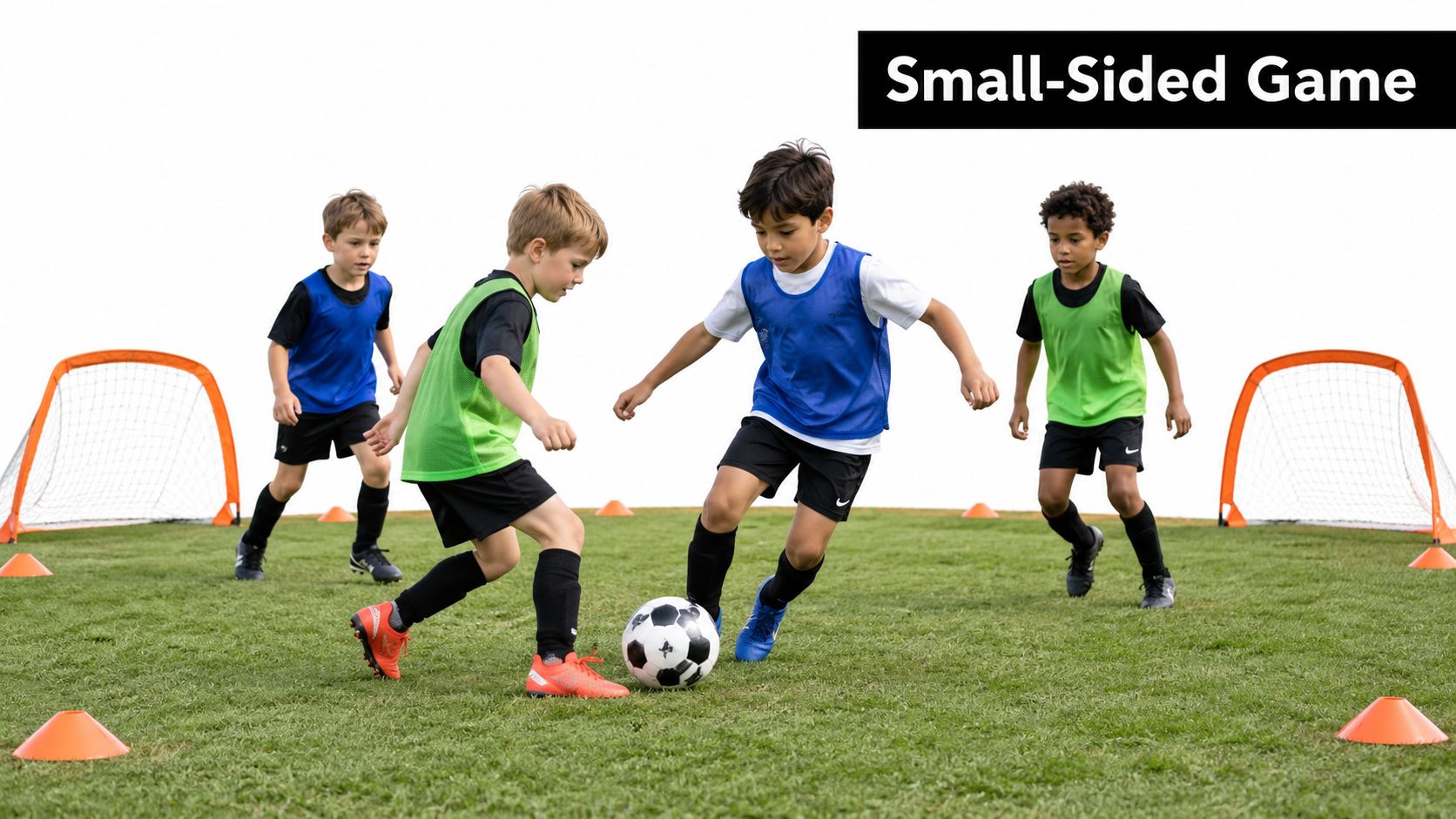
The field becomes a classroom when the earlier skills meet real pressure. Set up a compact 3v3 or 4v4 game with cone goals or small targets, mark clear boundaries, and let players solve problems through play. Each round should last long enough for repeated touches and decisions, while short resets keep attention high.
Choose the format according to the group. 3v3 gives younger or less confident U8 players more room to find the ball and fewer decisions to process. 4v4 adds another teammate and opponent, creating more passing, receiving, defending, and movement choices without removing frequent involvement. U.S. Soccer's U7 and U8 guidance emphasizes formats such as 3v3 and 4v4, which makes both useful settings for applying technical work.
Start with a free-play round so you can observe the group. Then give the players one clear challenge, such as spreading out after winning the ball or supporting the teammate in possession. One focus acts like a single signpost on a busy path. It guides attention without making children follow several rules at once. If passing is the goal, praise a connected team move rather than changing the score.
Use the game to teach, not control every action. Pause after a moment that can help everyone, then ask, “Where was the open space?” or “How could we protect our goal?” Give players time to answer before restarting.
During play, look for these behaviors:
Attacking: Move away from the ball to create space.
Possession: Offer a forward option and a safer option.
Defending: Recover quickly and protect the goal.
Character: Respect teammates, opponents, and the referee.
The small-sided soccer games guide from Villarreal Houston Academy provides further ways to vary conditions while keeping the game realistic. Rotate teams and positions so players experience different responsibilities. Praise brave attempts, quick recovery, helpful communication, and unselfish choices alongside goals.
Research cited in youth-soccer development materials compares 4v4 with 8v8 and reports 135% more passes, 260% more shots, and 500% more goals, as described in this small-sided U8 practice analysis. The practical lesson is clear: more meaningful actions give young players more chances to learn.
7. Wall Pass One-Two Combination
A wall pass gives young players a shared solution to pressure. Set up an attacker, a supporting teammate, and a defender or passive obstacle. The attacker passes, moves beyond the defender, and receives the return ball. The supporting player acts as a wall, helping the runner change the picture through timing, movement, and trust.
Begin with no defender. Player A passes to Player B, accelerates into space, and receives the return pass. Ask the runner to move as the ball travels, rather than waiting several seconds. Player B should control the ball, look up, and play into the runner's path when that space is available. Keep repetitions brief, then rotate roles so every child practices passing, supporting, and running.
Add a passive defender once the movement feels clear. The defender blocks the direct route without attempting to win the ball. After players understand the pattern, allow active pressure and give them time to decide. A one-two is useful when the defender is drawn toward the ball. If the route is closed, a safer pass or a change of direction is the better choice.
Develop timing and trust
Coach the details through simple cues:
Runner's movement: Accelerate after passing and run beyond the defender.
Supporting player's touch: Keep the ball close, face the next action, and stay ready to help.
Return pass: Play into space when the runner has an advantage.
Decision: Use the combination only when the defender's position supports it.
Encourage communication, eye contact, and supportive reactions after mistakes. Safe spacing and controlled pressure keep the activity enjoyable while players build technical quality and character. Coaches seeking more age-appropriate combinations can review Villarreal Houston Academy's youth passing drills.
The wall pass is more than a passing sequence. It develops awareness, cooperation, timing, and the willingness to move for a teammate. Keep the emphasis on cooperation rather than forcing a one-two on every repetition. Intelligent players recognize when a combination is useful and when another pass is better.
8. Directional Dribbling and Turns
Create a lane with turning zones marked by cones, then give each player a ball. Players dribble toward a zone, perform a turn, and leave through a different gate. Begin at walking speed so the movement is controlled. Once the ball stays close, ask players to accelerate after the turn.
Teach one turn at a time. An inside-foot cut moves the ball across the body, while an outside-foot cut helps the player escape toward open space. A sole pullback protects the ball when the forward route is blocked. Introduce the Cruyff turn as a purposeful change of direction, not a trick contest. The best turn is the one that solves the player's problem.
Change the challenge without changing the setup. Call “left,” “right,” “stop,” or “turn” as players dribble. Then replace verbal commands with visual signals, encouraging players to scan before choosing. Vary the approach angle and require both feet across several repetitions.
Give every turn a reason
Place a passive defender beside a turning zone. The defender blocks one route without trying to win the ball, giving the dribbler a clear problem to solve. After the pattern feels comfortable, allow active pressure and limit contact to safe, controlled challenges. Players can then decide whether to cut inside, escape outside, pull the ball back, or continue forward.
Use these short cues:
Approach: Keep the ball close before entering the zone.
Turn: Put your body between the defender and the ball.
Exit: Take a quick first touch into new space.
Purpose: Turn to escape, protect possession, or attack.
The video below demonstrates the movement before players practise it.
Judge control and decision-making alongside speed. A clean turn that keeps possession helps the team more than a fast touch that loses the ball. Praise scanning, persistence, safe spacing, and supportive reactions so technical quality grows with intelligence, enjoyment, and character.
U8 Youth Soccer Drills: 8-Drill Comparison
Drill | 🔄 Implementation complexity | ⚡ Resource & setup | 📊 Expected outcomes | 💡 Ideal use cases & tips | ⭐ Key advantages |
|---|---|---|---|---|---|
Rondo (Possession Circle) | Medium, coach-led rotations and defender management | Minimal, small space, 5–6 players, 1 ball, cones | Improves one-touch passing, first touch, quick decision-making, positioning | Warm-up or technical possession session; rotate defenders every 30–60s, start with 2 touches | High technical transfer to match play, very engaging, space-efficient |
Four-Goal Possession Game | Medium–High, needs quadrant setup and clear rules | Moderate, larger area, 4 small goals (cones), 4v4–5v5 teams | Enhances field vision, multi-directional passing, transitions, creativity | Use 4v4 for U8, mark boundaries clearly, reduce touches initially | Teaches whole-field awareness, continuous play, multiple scoring options |
Cone Weaving and Ball Control | Low, simple individual setups and progressions | Minimal, cones, space per player, optional timers | Develops close control, foot-surface variety, coordination and consistency | Vary patterns (figure-8, zigzag), time trials, practice both feet | Strong technical foundation, easy to scale, great for repetition |
1v1 Gateway Progression | Medium, requires pairing and fair matching | Minimal, cones for gates, small lanes, balls | Builds dribbling under pressure, basic defending, quick decision-making | Keep lanes small for U8, rotate opponents, start with passive defenders | High engagement, simulates competitive pressure, builds resilience |
Pass and Follow Movement | Low–Medium, needs coaching emphasis on movement | Minimal, partners or small groups, cones to mark space | Improves off-ball movement, timing, support play, understanding of triangles | Start 2-player, progress to 3-player triangles, emphasize first touch | Teaches intelligent positioning, simple to run, directly match-relevant |
Small-Sided Game (3v3 or 4v4) | Medium, manage multiple games and rule variations | Moderate, several mini-pitches, cones/goals, multiple balls | Maximizes touches, decision-making, creativity, match realism | Use 3v3 for youngest, short 15–20min games, modify rules to focus objectives | Most game-realistic, highly motivating, excellent assessment tool |
Wall Pass (One-Two) Combination | Low, straightforward pair work with progression | Minimal, pairs, cones, optional passive defender | Teaches timing, combination play, quick movement and passing accuracy | Start without defender, add pressure gradually, practice both feet | Fundamental tactical skill, simple, immediately applicable in games |
Directional Dribbling and Turns | Low–Medium, technical coaching on specific turns | Minimal, cones, marked courses, space for turns | Enhances turning technique, agility, change-of-direction with ball | Teach specific turns (Cruyff, inside/outside), start slow then increase speed | Improves evasion, balance, and control; easily progressed to game speed |
Turn Eight Drills Into One Confident Session
A strong U8 session doesn't need all eight activities. Select a clear theme and build from control to choice. For a dribbling focus, begin with cone weaving or directional turns, add the 1v1 gateway game, and finish with a small-sided match where players can attack space. For a possession focus, start with a rondo, move into pass and follow or a wall pass, then use a four-goal game to make the decisions more realistic.
The U.S. Youth Soccer development model recommends one weekly session lasting 45 to 60 minutes for this age group and advises that players shouldn't play a season longer than three months, with at least one full month off between seasons, as stated in the U.S. Youth Soccer coaching guidance. Those recommendations reinforce a useful coaching habit. Keep the work focused, avoid overload, and protect the child's long-term enjoyment of the game.
A practical session for a small group might look like this:
Individual control: Begin with cone weaving or directional turns so every player has a ball.
Combination play: Use pass and follow or the wall pass with a partner.
Pressure: Add a rondo or 1v1 gateway game.
Game application: Finish with 3v3 or 4v4 and one simple coaching theme.
For a larger group, divide players into compact stations. One group can work on ball control, another on 1v1 play, and another on passing combinations. Rotate groups before attention drops. The coaching guidance for children around ages 7 and 8 commonly recommends changing activities every 10 to 15 minutes, with many players sustaining attention for roughly 8 to 10 minutes per activity, according to this U8 one-objective coaching guide. Use those figures as planning references, not rigid rules. A confident group may stay engaged longer, while a tired group may need an earlier change.
Safety belongs inside the session plan. Check the playing surface, remove unnecessary obstacles, use lightweight cones, and keep waiting players outside active lanes. In 1v1 activities, teach controlled pressure and prohibit reckless contact. Provide water, monitor heat and storms in Greater Houston, and stop activity if a child feels unwell.
Warm-ups should also prepare players to move well. Structured warm-ups and neuromuscular injury-prevention programs have been associated with approximately 35% to 38% lower overall youth soccer injury rates, while FIFA 11+ KIDS-style programs report roughly 50% fewer overall injuries and nearly 60% fewer severe injuries when used consistently, according to this review of youth soccer injury-prevention evidence. For U8 players, prevention can feel like play. Add balance challenges, controlled stops, soft landings, and changes of direction to ball games instead of turning the session into fitness training.
The coach's emotional tone matters just as much. Encourage a player who loses the ball to recover, praise a defender who shows patience, and recognize a teammate who creates space for someone else. Respectful behavior, personal responsibility, and care for teammates are part of development, not extras added after the technical work.
Choose one objective, prepare enough equipment for constant activity, and adjust the space when the group needs more success or more challenge. Villarreal Houston Academy offers age-appropriate teams, camps, clinics, and tryouts in the Greater Houston area, with programming built around technical skill, intelligent play, positive coaching, safety, and character. Families can explore those options and consider how the academy's training environment fits their child's confidence, goals, and enjoyment of soccer.
Villarreal Houston Academy provides youth soccer teams, camps, clinics, and tryouts for boys and girls from age 4 upward across the Greater Houston area. Visit Villarreal Houston Academy to explore age-appropriate programs and find a positive setting where young players can build touches, decisions, teamwork, and character.
Comments