


Soccer Tryouts for Kids: A Parent's Complete Prep Guide

You're in the car, your kid's got shin guards in the backpack, and everybody's pretending to be calm. This tryout matters to your family because it feels like a verdict, even though it's really just one checkpoint in a much bigger youth soccer pathway. That's the right way to think about soccer tryouts for kids, as a test of readiness, fit, and development, not a final judgment.
The best way to prepare is to work backward from what coaches score. Most parent guides obsess over the night before. That's too late. If you know the scorecard, you can turn the next few weeks into a plan with a purpose, and your child walks in looking like they belong.
What the Day Really Looks Like for Kids
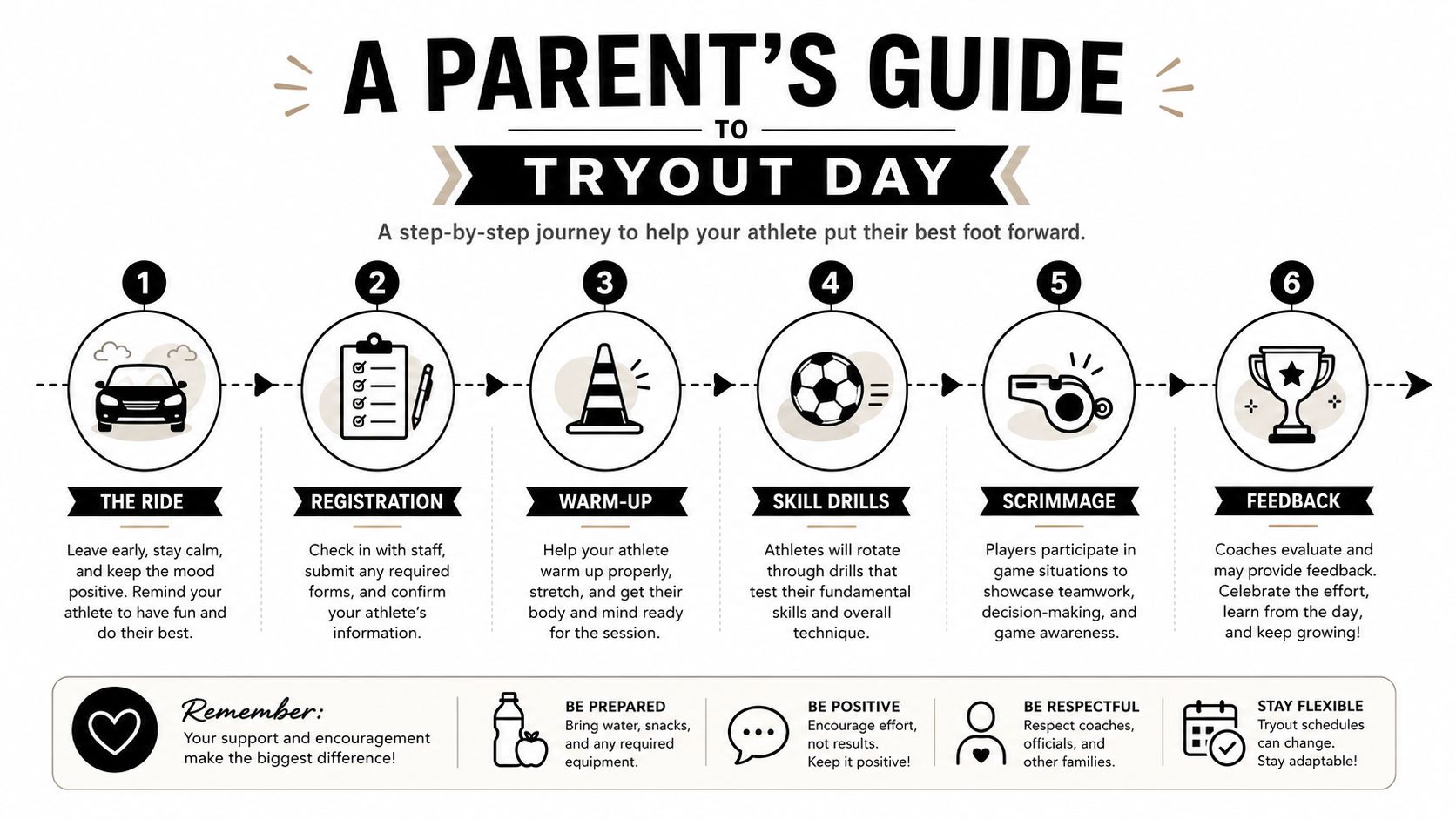
The drive to the field is usually the loudest part of the morning. After that, the day settles into a pattern that's less mysterious than parents think, check-in, warm-up, technical work, games, then a final look. A quality tryout usually happens over 2 to 4 sessions of about 60 to 90 minutes each, with small groups of roughly 12 to 18 players and multiple evaluators so one bad touch doesn't define the whole decision SoccerDrive's tryout structure guidance.
The flow most kids actually experience
Check-in is simple. A coach or staff member wants paperwork, names, and a fast answer to one question, is the player ready to go. The warm-up matters more than parents realize because evaluators are already watching body language, communication, and whether the player looks sharp or scattered.
Practical rule: the first five minutes are not about impressing anybody with flair. They're about looking organized, awake, and coachable.
Technical stations usually come next. That's where coaches see first touch, passing weight, dribbling control, and whether a player can repeat a skill without panic. Small-sided games show something different, how the player moves off the ball, wins it back, and makes choices when the field gets crowded.
The final scrimmage is where the session becomes more honest. A kid who looked good in a cone drill can still disappear when the game speeds up, and a quieter player can suddenly stand out because they keep making the right pass. That's why strong tryouts don't rely on one moment, they rely on repeated looks.
For a parent wanting a plain-English walk-through of what to expect, this Houston tryout overview lines up with the same basic structure most competitive clubs use. Keep that picture in your head, because it changes how you prep. You're not training for a single highlight. You're training for repeated evidence.
The Four Things Coaches Score
Coaches don't hand out spots because a kid scored one nice goal or won one sprint. They look for repeatable traits that hold up under pressure. Analysts at Frontiers in Sports and Active Living found that selection is brutally selective, only about 9% of initially observed players reached professional youth academy level three seasons later in a prospective study of elite youth soccer. That is why one-off moments carry less weight than parents think.
The scorecard is simpler than most families expect
The four buckets are technical execution, decision making, effort and competitiveness, and coachability. If you practice for those four things, you're practicing for the actual tryout. If you practice for tricks, you're not.
Evaluation Bucket | What an A Looks Like | What a C Looks Like |
|---|---|---|
Technical execution | Clean first touch, simple passing, control under pressure, same quality when tired | Heavy touch, rushed pass, loses the ball on basic actions |
Decision making | Sees the next pass, supports teammates, chooses simple play in traffic | Dribbles into pressure, ignores space, forces low-percentage actions |
Effort and competitiveness | Presses, recovers, tracks back, keeps working after a mistake | Coasts after errors, stops moving, waits for the ball |
Coachability | Listens the first time, adjusts quickly, stays composed | Argues, shuts down, repeats the same mistake after feedback |
That is the standard. No drama. No flash. No single perfect drill.
A player can survive one imperfect touch if everything else is solid. They usually can't survive looking lost in game-like situations. The same elite-study logic applies here, coaches should care more about reproducible indicators than one standout rep. A child who keeps showing the same useful habits gets trust. A child who disappears when the drill changes does not.
What This Means in a Tryout Session
Technical execution matters because coaches need players who can play, not just run. Decision making matters because youth soccer tryouts are rarely isolated skill tests, they usually involve some version of small-sided play where the ball moves fast and pressure arrives quickly. Effort and coachability separate kids who look promising from kids who look useful to a team.
Coaches build teams with players they can rely on, not players who look good for ten seconds.
For parents, the hard part is admitting that the “best athlete” is not always the best fit. A quieter player who listens and repeats the right actions often gets farther than the loud player who chases the spotlight. That is the truth behind tryout selection.
For a club-side example of how evaluators think about player fit, this player evaluation overview gives a useful lens on what clubs tend to track across sessions.
A Four-Week Prep Calendar by Age
The right prep plan depends on the child's age and experience, not on a generic “work harder” message. The participation funnel is huge, 27.3 million youth ages 6 to 17 participated on a sports team or took sports lessons in 2023, which equals 55.4% of children in that range in organized sports, while the Aspen Institute's Project Play has set a long-term goal of 63.3% participation by 2030 Project Play participation rates. That's a crowded field, so the player who arrives prepared usually looks more settled from the start.
U7 to U9
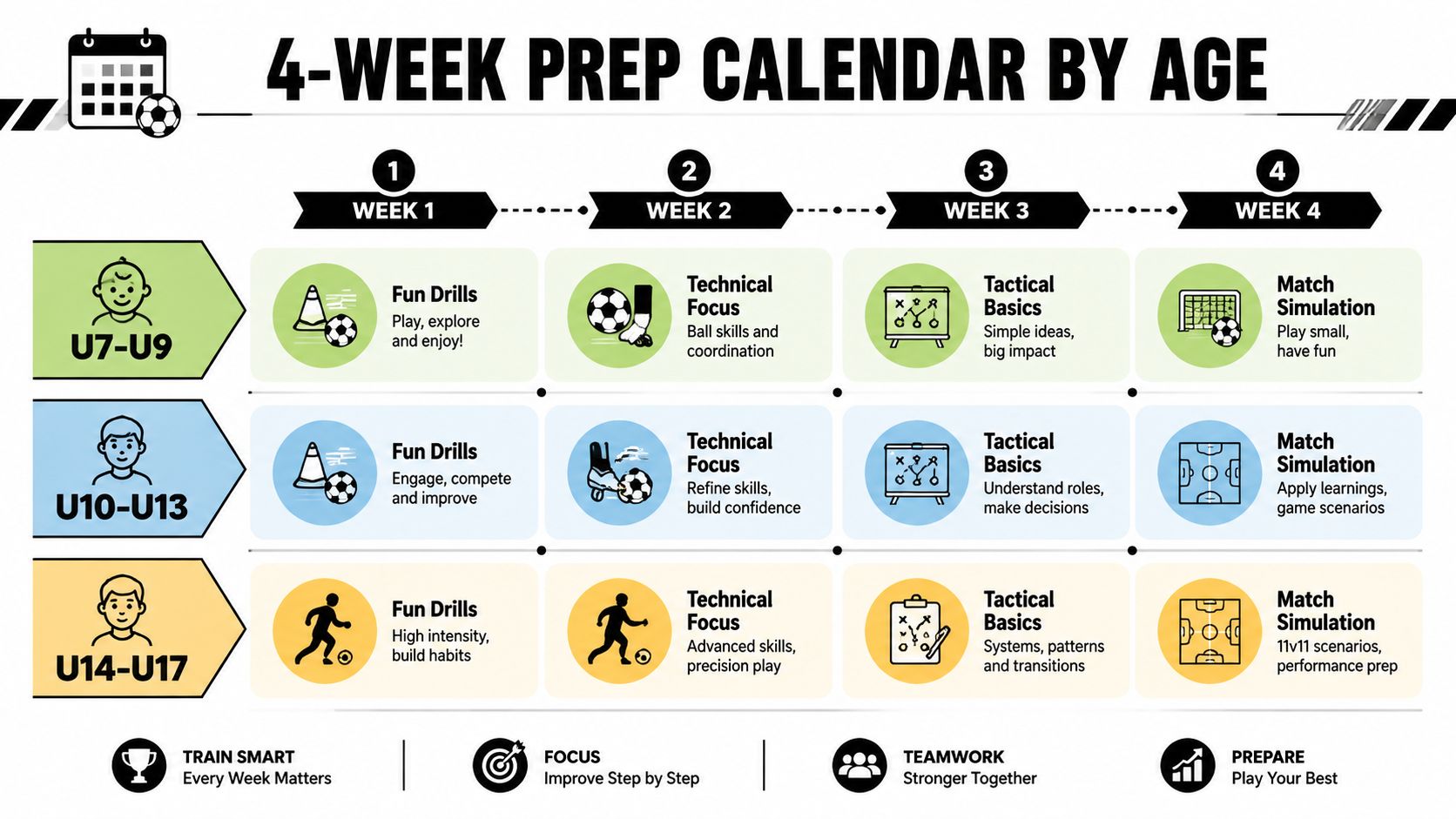
This group needs touches, not punishment. Keep sessions short, playful, and frequent enough that the ball feels familiar. Two or three weekly sessions of 45 to 60 minutes is plenty.
Week 1 should be ball mastery and comfort, dribbling with both feet, turns, and stopping the ball cleanly. Week 2 adds simple passing against a wall and a few fun first-touch games. Week 3 should introduce tiny games like 2v2 or 3v3, because young kids learn fast when they're competing without being overwhelmed. Week 4 is lighter, just short sharp touches and confidence-building reps.
U10 to U13
These players can handle more structure. Two to four sessions a week, 60 to 75 minutes each, works well if the load stays reasonable. Start with technical repetition, then move into decision work.
I'd use ball mastery, rondos, passing patterns, and small-sided games with simple constraints. For example, make them play one- or two-touch in a rondo, then ask them to check their shoulder before receiving. That's how you teach habits that show up in tryouts.
U14 to U17
Older players need sharper demands and better recovery. They should train with intent, but not so much that they show up flat. Add position-specific work, high-intensity intervals, and video review if the player is old enough to understand it without getting overloaded.
This age band should spend week 1 on technical sharpness, week 2 on tactical choices, week 3 on game-speed repetitions, and week 4 on tapering. The last week should not feel like a grind. It should feel like a sharpening.
The best prep plan for any age is the one that finishes with energy in the legs and confidence in the head. If the player only has one week left, cut volume, keep the ball, and protect freshness. For a fuller training structure, this youth soccer training plan is a useful reference point for families who want routine instead of guesswork.
Two Real Players, Two Different Prep Plans
A first-time U9 player and a U14 club switcher do not need the same prep. If you train them the same way, you're wasting somebody's time. The selective nature of the pathway explains why, in a typical state youth Olympic Development Program setting, only 10% to 25% of players advance to the state team, about 7% of those reach a regional team, and senior national-team players are roughly 1/10th of 1% of all registered players PMC youth soccer pathway analysis.
The nervous first-timer
A U9 girl trying her first competitive team doesn't need a conditioning block. She needs confidence with the ball and a lower-pressure relationship with the tryout. I'd focus on dribbling through space, stopping and starting under control, and short games where she gets lots of touches.
Her parent should keep the language simple. “Listen, work hard, and have fun” is enough. Anything more turns the morning into a test before the test. If she's already playing two or three times a week, that's enough. Win is walking in loose, not exhausted.
The older player changing clubs
A U14 boy moving up needs a different lens. He should already have a base, so now the emphasis shifts to position-specific habits, higher tempo, and recovery. If he's a midfielder, he should rehearse checking shoulders and playing out of pressure. If he's a defender, he should practice body shape, first pass, and communication.
He also needs a tighter recovery plan. That means lighter work before tryout day, better sleep, and no hard sessions in the last stretch. If he's been training hard all month, the smartest move is often to back off, not push harder.
The common thread is this, both kids need to look like their game has a place on a team. One needs comfort. The other needs polish. Neither needs panic.
The 72 Hours Before Tryout Day
The last 72 hours matter more than most families admit. By then, the work is mostly done, and the job shifts to being fresh, fed, and calm. A tired kid with good fitness is still a tired kid, and tired kids make slower decisions.
Sleep, food, and hydration
Don't reinvent breakfast. Keep meals familiar and easy to digest. The night before, eat the same kind of dinner your child already handles well, then stop trying to “fuel up” with random new snacks. The morning of, keep it light, simple, and boring in the best possible way.
Hydration should start before the car ride. Bring water, keep it visible, and don't wait until the field to begin drinking. For younger kids, the routine matters more than a perfect hydration formula. The point is to arrive ready, not to experiment.
Simple rule: if the morning turns into a nutrition science project, you waited too long.
Warm-up and mindset
The last hard training session should already be behind you. In the final stretch, replace extra fitness with short touches, mobility, and a few quick bursts. The goal is to wake the body up, not to build it from scratch.
Parents should talk less at breakfast than they think. A calm ride beats a speech. Use short cues, not lectures, “be brave,” “make simple plays,” and “keep going after mistakes.” If your child is nervous, tell them nerves are normal and useful. They mean they care.
A simple visualization works better than hype. Have the player picture three things, a clean first touch, one hard run, and one good decision. That's enough. Don't overload them with ten imagined highlights. Keep the mind on repeatable actions.
The child who arrives at the field with fresh legs and a quiet head usually gives the best version of themselves. That's the goal.
How to Read the Club Back
A tryout is also your chance to evaluate the club. Too many families act like they're the only ones being judged. They're not. You're deciding whether the club is structured well enough to deserve your child.
Questions that expose the quality of the process
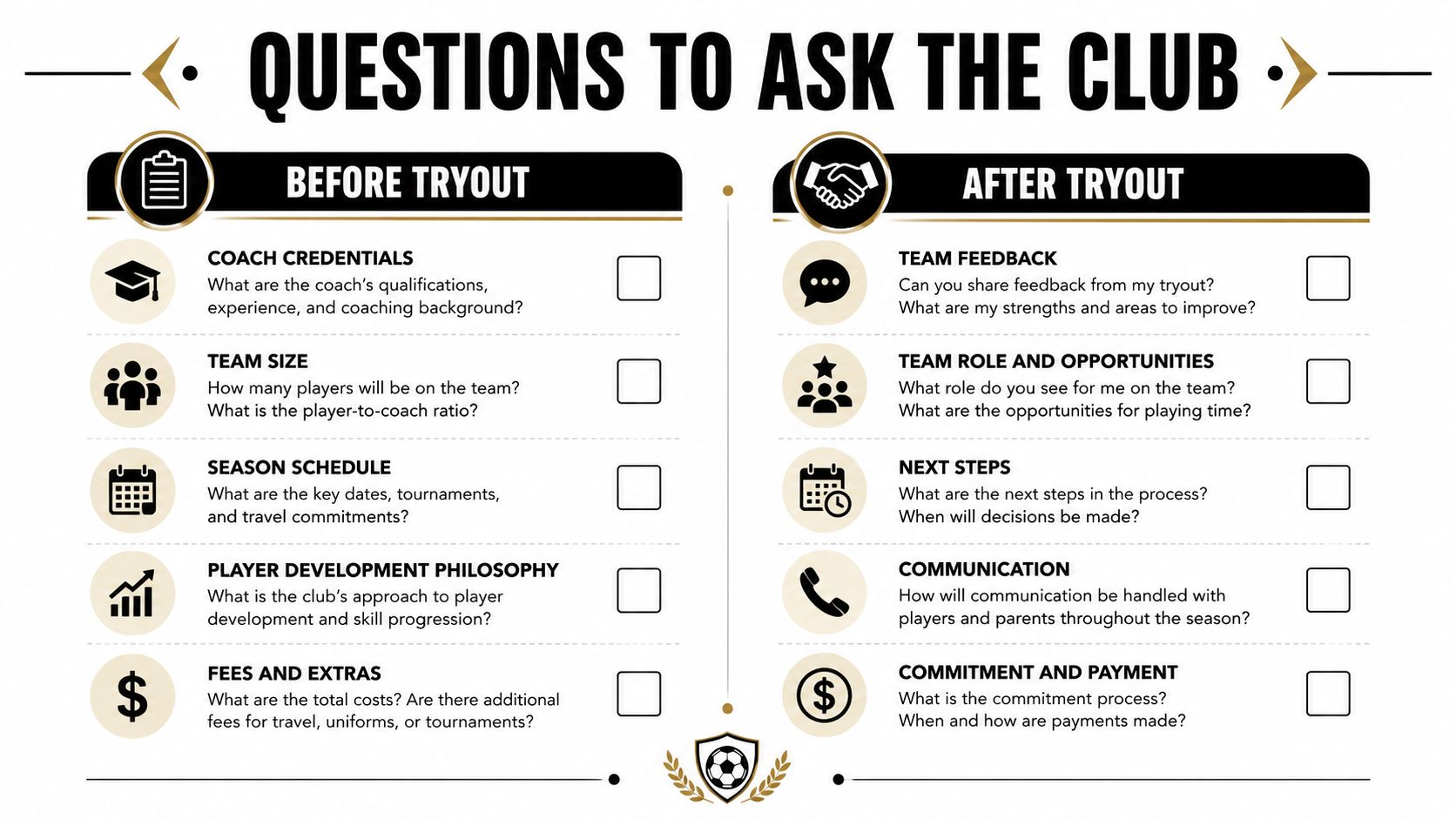
Ask how many evaluators are on the field, and whether the club uses repeated looks or just one session. Ask about the player-to-coach ratio, the team size, and what happens after tryouts are over. Ask how playing time is handled, because a club that won't talk about development minutes before you sign is probably vague for a reason.
You should also ask about access. The need for lower-barrier pathways is real, and public nonprofit soccer access efforts exist because traditional competitive routes leave families out. If a club acts like affordability and entry barriers are somebody else's problem, that's a bad sign.
Watch the process, not the pitch. A fair tryout looks organized, repeatable, and transparent. A sloppy one feels rushed, opaque, and mostly designed to funnel families toward payment.
Red flags you should not ignore
Single-day selection is a problem if the club is using it to make a major roster decision with no meaningful second look. Vague feedback is another one. So is pressure to commit before results are released. If they can't explain the development pathway in plain language, they're asking you to trust branding instead of structure.
That's where a serious club separates itself. Villarreal Houston Academy, for example, runs select and competitive programming with open tryouts across age brackets and asks players to submit a tryout request form before attending. That kind of structure gives families a clearer process than a last-minute scramble.
If the club can answer your questions clearly, that's a good sign. If they dodge, keep shopping.
After the Whistle, Before the Next Season
Tryouts should create information, not drama. If your child makes the team, great. If they don't, that's still useful. Either way, the right response is calm, specific, and forward-looking.
Same day and the week after
On the ride home, don't interrogate. Ask whether they had fun, what felt hard, and what they learned. That keeps the debrief useful without crushing confidence. If they're upset, let them be upset. Don't try to fix the emotion in the parking lot.
During the next week, ask the club for written feedback if they offer it. Then compare any offer against actual development, not the uniform or the badge. A better title with no real player plan is a trap. Decline politely if the fit isn't right.
The 30-day view
The bigger question is what happens next. A player needs a training runway after tryouts, whether they made the roster or not. That means choosing a season plan, building technical habits, and keeping the body ready for the next evaluation point.
For some families, a structured academy environment gives that runway. Villarreal Houston Academy offers a clear development pathway, select and competitive programming, and a route that can extend beyond local team selection, including opportunities to train and play in Spain through the Villarreal CF connection. That matters because tryouts are only useful if they lead somewhere.
The right next step is simple. Pick a club, a training rhythm, and a season goal. Then stick with it long enough to matter.
If you want your child in a setting that values technical growth, clear evaluation, and a real development pathway, take a look at Villarreal Houston Academy. Their tryout structure and year-round programming give families a more organized path than a one-day decision, and that's exactly what ambitious young players need.
Comments