


Soccer Shin Guards Sizing: How to Measure for Youth Players

You're standing in the hallway with a laptop open, a pair of shin guards in the cart, and a child who keeps saying, “Those look fine.” That's usually the moment when parents buy too fast and end up with guards that slide, pinch, or leave the knee exposed by the second practice. Getting soccer shin guards sizing right online isn't complicated, but it does require measuring the right way and trusting the brand chart instead of a guess.
The biggest mistake is treating shin guards like shoes. Kids can wear the same shoe size and still need very different guards, because the useful measurement is the shin, not just the age on the label. The result of a bad buy is familiar to every coach and equipment manager, a player who keeps tugging at the guards, gets distracted, and ends up with bruised shins or a mid-season return.
Why Most Parents Get Shin Guard Sizing Wrong
A parent opens a shopping cart, checks the age label, and feels confident. That confidence is usually what leads to the wrong purchase. Age charts can point you in the right direction, but they do not measure the player's leg, and two children in the same age group can still need very different guards. The fit problem starts there, which is why so many online orders miss the mark the first time.
The next mistake is reaching for the smallest guard because it seems like it should fit more snugly. A snug guard is fine. A guard that is too short or too tight is not. If it ends too high, the lower shin stays exposed, and if it presses into the ankle bend or squeezes the leg, the player will notice it every time they sprint, stop, or change direction.
Brand charts add another layer of confusion. One company's medium can overlap another company's large, so the label alone does not tell you much unless you compare it to the brand's own chart. That is where parents run into returns, because a guard that rides up or slides down will not stay where it needs to stay during play.
Practical rule: buy for the leg in front of you, not the age on the box.
That rule helps with safety and with comfort. Players who are not tugging at their gear can stay focused on the ball, and parents avoid the cycle of ordering the same item twice. Careful sizing also fits the same injury-prevention thinking used throughout the sport, including this injury prevention in soccer guide.
The Exact Measurement Protocol That Works Every Time
A parent ordering shin guards online often runs into the same problem. The size looks close, the chart seems simple, and the guard arrives just a little off. A careful at-home measurement avoids most of those returns, and it works across major brands because it starts with the leg itself, not the label on the box.
Start with a chair, a tape measure, and a calm child. Have the player sit down with the knee bent at 90°, because that position keeps the lower leg steady and easier to measure the same way every time. You are measuring shin length, not the full leg, and the useful line runs from about 2 inches below the tibial tuberosity to the medial malleolus.
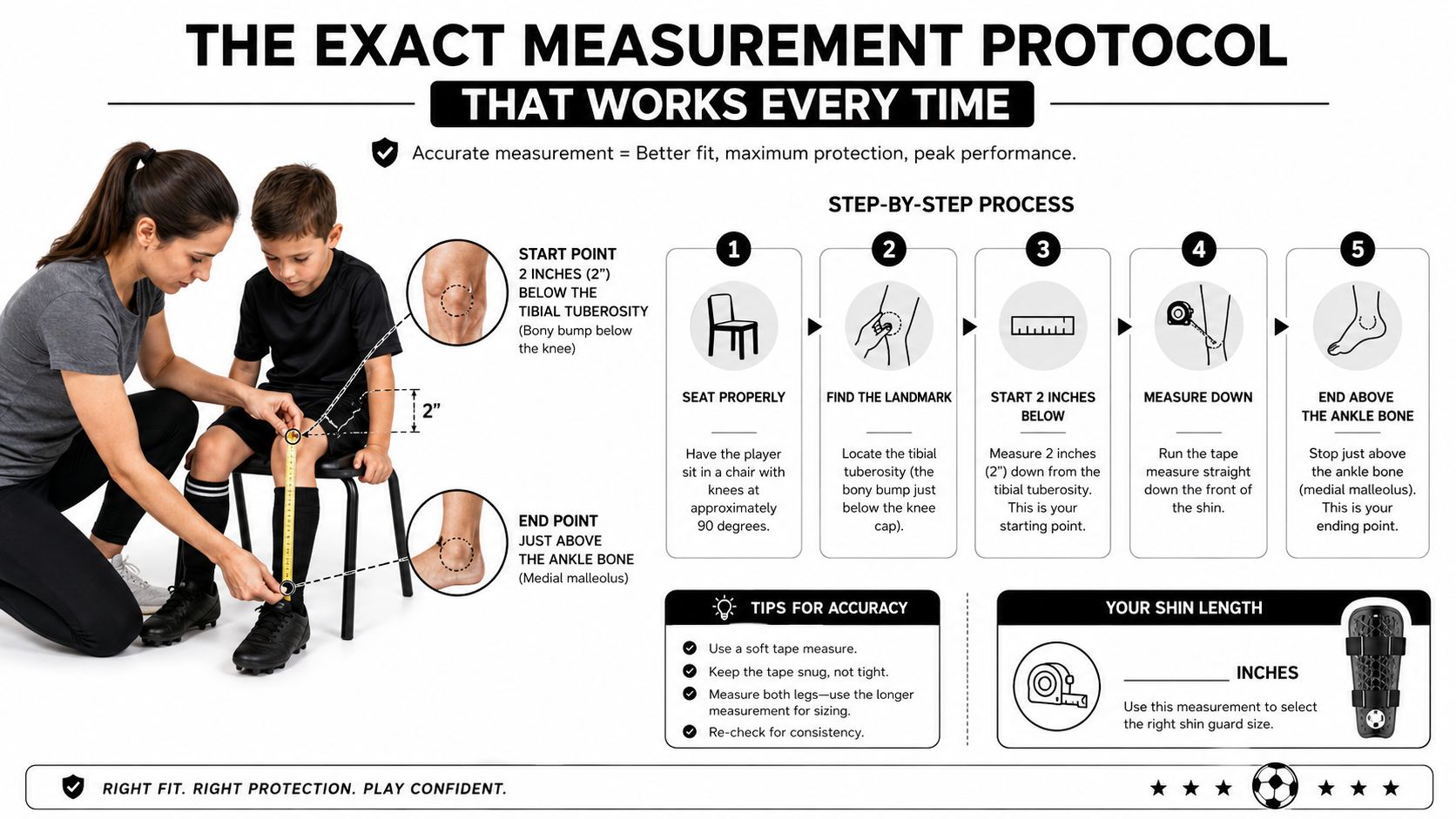
Measure from the right landmarks
The top point is not the kneecap itself. It sits about 2 inches below the tibial tuberosity, the bony bump just under the kneecap, because starting too high can make the guard press into the patellar tendon while the child runs. The bottom point is the inside ankle bone, the medial malleolus, and the guard should finish just above that area once it is on.
That placement follows the common sizing rule that guards should cover about 70% to 80% of the shin bone and sit from roughly 2 inches below the kneecap to just above the ankle Storelli sizing guide. It also matches the fit checks used by major brand charts, which are built around shin length and height rather than guesswork.
Keep the measurement honest
Wiggly kids make bad measurements. Ask them to sit still with the foot relaxed, then measure twice and write down the number both times. If the two numbers do not match, measure a third time and use the middle result.
If the child keeps straightening the knee, the number will look longer than the guard really needs to be.
A quick way to reduce mistakes is to measure on the same leg twice, then compare it with the brand chart before you click buy. That gives a parent a simple check against the chart instead of trusting the size label alone. For a second reference point while shopping, use find your right size as a reminder to match the measurement to the chart, not to the age group.
Reading Brand Size Charts Without Getting Confused
A parent orders shin guards online, opens the box, and sees a size label that looks close enough. The problem is that close enough often leads to returns. Nike, Adidas, and other brands all use height-based charts, but the labels do not line up perfectly from one brand to the next, especially when a child sits near the border between youth and adult sizing Azusa Sports.
Translate height into chart language
Nike's adult chart lists XS at 55 to 59 inches, S at 59 to 63 inches, M at 63 to 67 inches, L at 67 to 71 inches, and XL at 71 to 79 inches. Its kids chart maps S to 48 to 51 inches, M to 51 to 55 inches, and L to 55 to 59 inches Azusa Sports. Adidas uses a similar structure, with youth S at 100 to 120 cm, M at 120 to 140 cm, and L at 140 to 160 cm, while adult sizes begin at XS for 120 to 140 cm and extend to XL for 185 to 195 cm Azusa Sports.
That overlap is where parents get tripped up. A 52-inch player can land in one size category for one brand and a different label for another. The number on the chart matters more than the letter on the package, and the safest approach is to follow the exact chart for the exact brand instead of guessing from the size tag alone. If you want a second reference point while shopping, use find your right size to match the measurement to the chart rather than to the age group.
Youth Shin Guard Size Comparison Across Major Brands | Player Height | Nike Kids Size | Adidas Youth Size | Generic Retail Size |
|---|---|---|---|---|
Comparison example | 52 inches | M | Youth M range, depending on chart overlap | Medium |
When to round up and when not to
If the measurement lands right on the edge, check the guard's width as well as its length. Larger sizes do not only add length, they also add width, which can suit a thicker lower leg more naturally Azusa Sports. Rounding up only works if the top edge still sits below the knee and the bottom edge stays above the ankle bend.
Simple test: if the brand chart and the leg measurement disagree, trust the leg measurement first, then check whether the guard still sits in the safe zone.
A coach or equipment manager can often clear up the confusion fast in person. A quick look at the player's height, shin length, and brand chart usually answers the question better than staring at the box in the shopping cart. For families comparing multiple brands, the chart stays the reliable guide, not the product title.
The Five-Minute Fit Test Before First Practice
A new pair of guards can look right in the package and still fail on the field. Have your player put on socks and, if possible, cleats, then run a short movement check at home before the first practice. Paper measurements help, but they do not tell you whether the guard stays put once the player starts cutting, stopping, and turning.
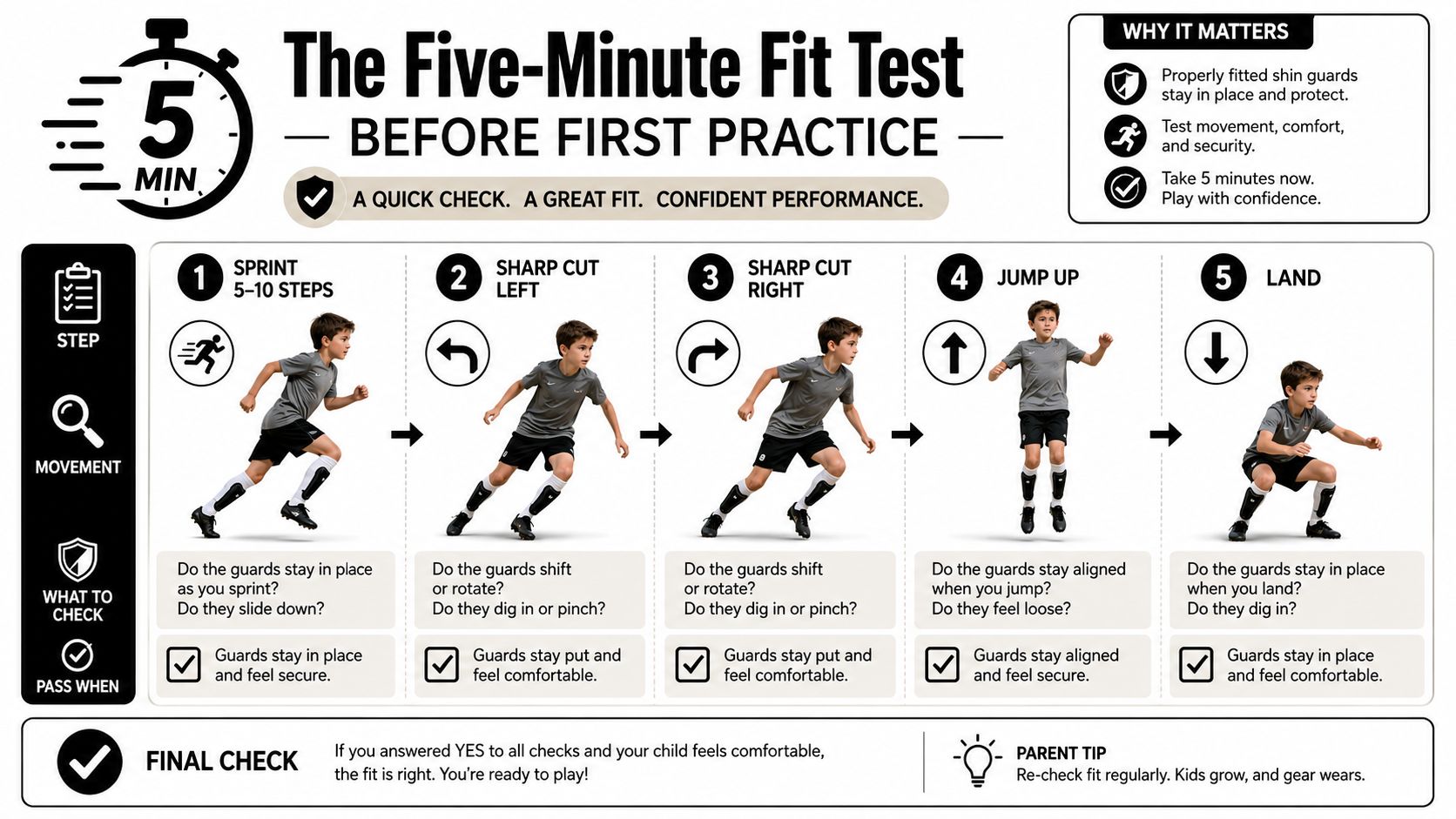
Start with a short sprint of 5 to 10 steps. That is enough movement to show whether the guard slides. Then have the player cut left and right, followed by a squat. If the guard shifts, pinches, or taps the ankle or knee, the fit is not ready yet.
What proper fit feels like
A correct guard sits about 2 inches below the knee and ends just above the ankle bend when the foot is flexed. It should cover roughly 70% to 80% of the shin bone, stay centered, and feel secure without squeezing. The guard should not dig into the kneecap, strike the ankle with hard plastic, or need constant adjusting after every movement.
The easiest way to judge this is to watch the guard during the movement test, not just ask whether the child says it feels fine. Kids often accept a bad fit because they want to get on the field. The guard has to stay in place while the body is moving, the same way a bicycle helmet has to stay stable when the rider turns their head.
Fixing small problems before you return them
If the guard is only a little long, sock placement may help, especially when the sock can hold the top edge without folding. If the guard is too short, do not solve that by pulling it higher, because that shifts the hard edge into the wrong spot. Exchange it.
For families who want one more check, the practical gear testing guide gives a simple field-style approach that matches what a player feels during motion. Pair that with warm-up exercises for soccer, and the first practice is more likely to start with gear that already feels settled.
Choosing Between Slip-In Guards and Ankle Protection Styles
There are three common styles in youth soccer: slip-in guards, guards with ankle protection, and sleeve-style guards. Each one solves a different problem, and the right choice depends on age, comfort, and how much the child still needs help keeping the gear in place. If a player hates fussy equipment, the style matters almost as much as the size.
Match the style to the player
Slip-in guards slide under the sock and feel light. Older players usually like them because they're less bulky and let the leg move freely, but they rely on the sock or sleeve to stay centered.Ankle protection guards add padding and straps around the ankle area. Younger children often do better with this style because it gives extra security when they're still learning how to manage their gear.Sleeve-style guards sit inside a compression sleeve, which helps hold the guard still. They make sense for players with sensitive skin or for kids who dislike the feel of a loose guard under the sock.
For a general gear overview, Villarreal Houston Academy also publishes soccer training gear, which can help parents think through the full setup, not just the shin guards.
Think about comfort before position
A defender doesn't automatically need a different style than a forward. The bigger question is whether the child can keep the guard centered through running and contact. If a player pulls at the guard every few minutes, the style isn't working, even if the size is technically correct.
The right style is the one the player forgets about during play.
That's why some families start younger children with ankle protection, then move to slip-ins once the player can keep gear stable on their own. Sleeve-style guards sit in the middle, especially for kids who want a snug feel without tape or constant adjustments. The best choice is the one that fits the leg, the sock setup, and the child's tolerance for extra hardware.
Planning for Growth Spurts and Mid-Season Replacements
Growing players create a different sizing problem, because a guard that fits in September can feel short by winter. The temptation is to buy big and “let them grow into it,” but shin guards are not a place to add extra room. If the top edge creeps toward the knee or the lower edge starts bumping the ankle, the guard is no longer doing its job.
A guard that's only a touch roomy can sometimes work for a short stretch if it still sits in the safe zone, stays centered, and passes the movement test. Once it slides, pinches, or exposes part of the shin, it's time to replace it. That's the line parents should use instead of guessing by how long the child has owned the pair.
The most practical approach is to watch for three signs: the guard looks short on the leg, the child keeps adjusting it after sprints, or the fit test starts failing during cuts and squats. At that point, waiting usually costs more than replacing, because returns, bruises, and distraction add up fast. A sturdier pair can make sense for a child who's near the top of a size band and likely to stay there awhile, while a budget pair is often the more sensible call for a fast-growing younger player who may outgrow it soon.
Keep the current pair in good shape by air drying it after use, storing it in a cool, dry place, and checking the padding regularly for wear. That simple habit helps the guard stay usable for more than one season, even as the player's body keeps changing.
Villarreal Houston Academy supports youth players with structured training, camps, clinics, and teams built around age-appropriate development for boys and girls. If you're sorting out shin guard sizing and want your child training in an environment that takes safety, technique, and long-term development seriously, visit Villarreal Houston Academy and see how their programs fit your family.
Comments