


Soccer Programs for 8 Year Olds: A Parent's Guide

The Saturday drive to soccer can feel like a small family referendum. Your child might be chattering about trying a new move, or staring out the window and asking how long practice will last. On the sideline, you're watching for more than goals: does your eight-year-old feel involved, capable, and glad to be there?
That's a useful way to evaluate soccer programs for 8 year olds. At this age, the quality of the experience depends less on trophies or a famous badge than on whether children get chances to make decisions, learn without fear of mistakes, and feel they belong.
Why Age 8 Is a Specific Kind of Soccer Window
An eight-year-old can learn a lot from soccer, but not by being treated as a smaller adult. Children this age are still building coordination, attention, confidence, and the ability to read what's happening around them. They're ready for lively challenges and simple team ideas. They usually aren't helped by long lectures, rigid positions, or practices where they spend more time waiting than playing.
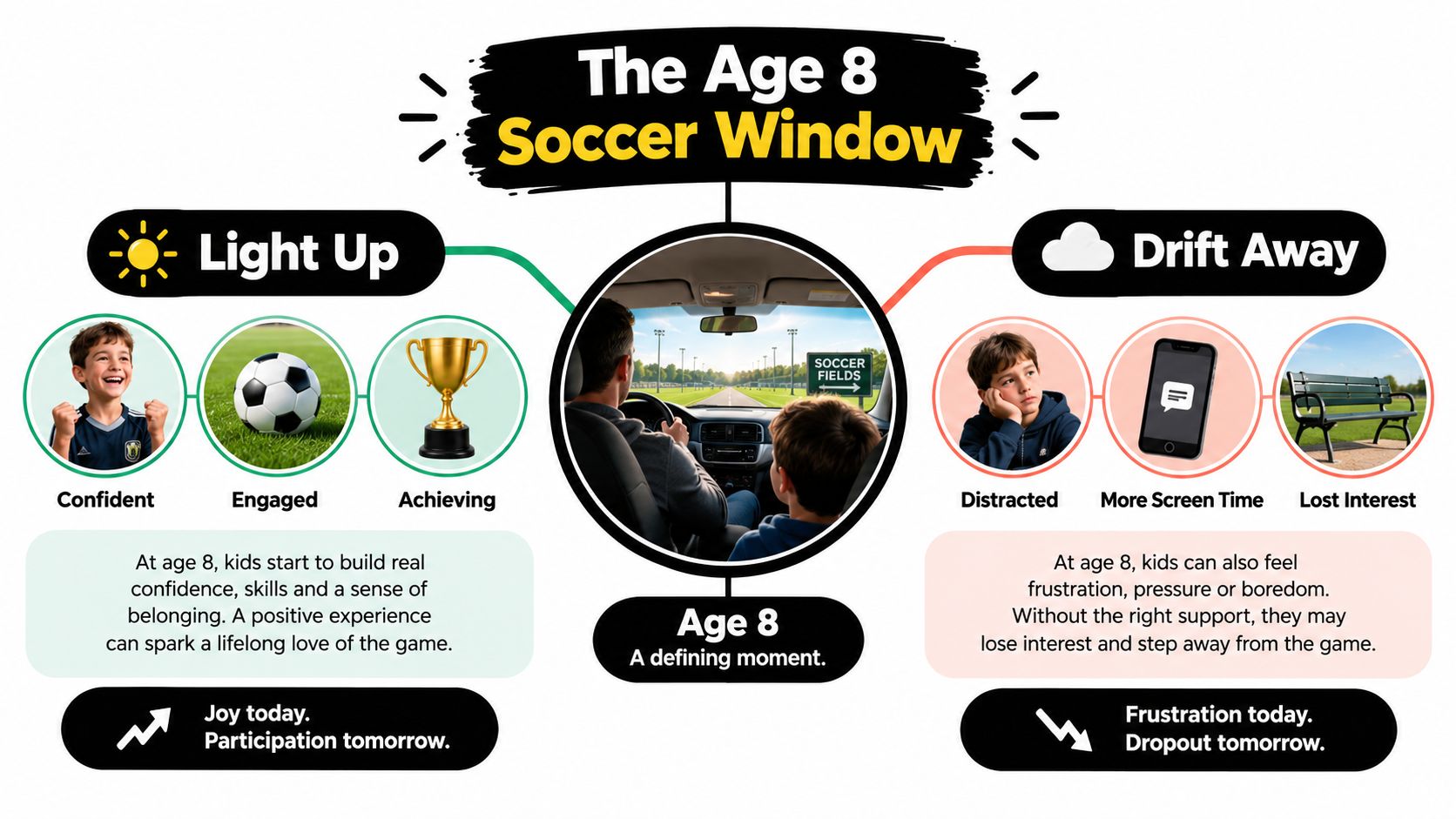
The experience often turns on three things: fun, competence, and belonging. Fun makes a child want to return. Competence grows when a player gets repeated chances to try, adjust, and succeed at something meaningful. Belonging comes from being included by teammates and treated with patience by coaches. When one of these disappears, a child may start drifting toward the sideline, even if the family is still attending every session.
Age eight also sits within a broad window of youth sports participation. During 2023–2024, 56.7% of children ages 6–8 took part in a sports team or sports lessons after school or on weekends during the preceding year. The rate was 60.0% among ages 9–11 and 50.8% among ages 15–17, according to the U.S. Health Resources and Services Administration's youth sports data. Those figures describe participation, not what makes a particular program good. For a parent, the practical point is that a positive experience can help keep a child engaged as they grow.
A strong program doesn't promise that every child will become a high-level player. It offers an environment where children can enjoy the ball, build confidence through practice, and feel welcome while they learn.
What an 8-Year-Old Should Actually Be Learning
At this age, progress is easier to see in a child's actions than in the final score. Look for growing comfort with the ball, awareness of teammates and space, and a willingness to try again after losing possession.
U.S. Soccer's U7–U8 guidance recommends formats ranging from 1v1 and 2v2 to 4v4, with objectives that include using both feet, short passing and receiving, ball-winning, acceleration, and fundamental movement skills. It also recommends trying different positions and avoiding heading at this age. The U7–U8 player development framework gives parents a practical reference for asking whether a curriculum fits their child's stage.
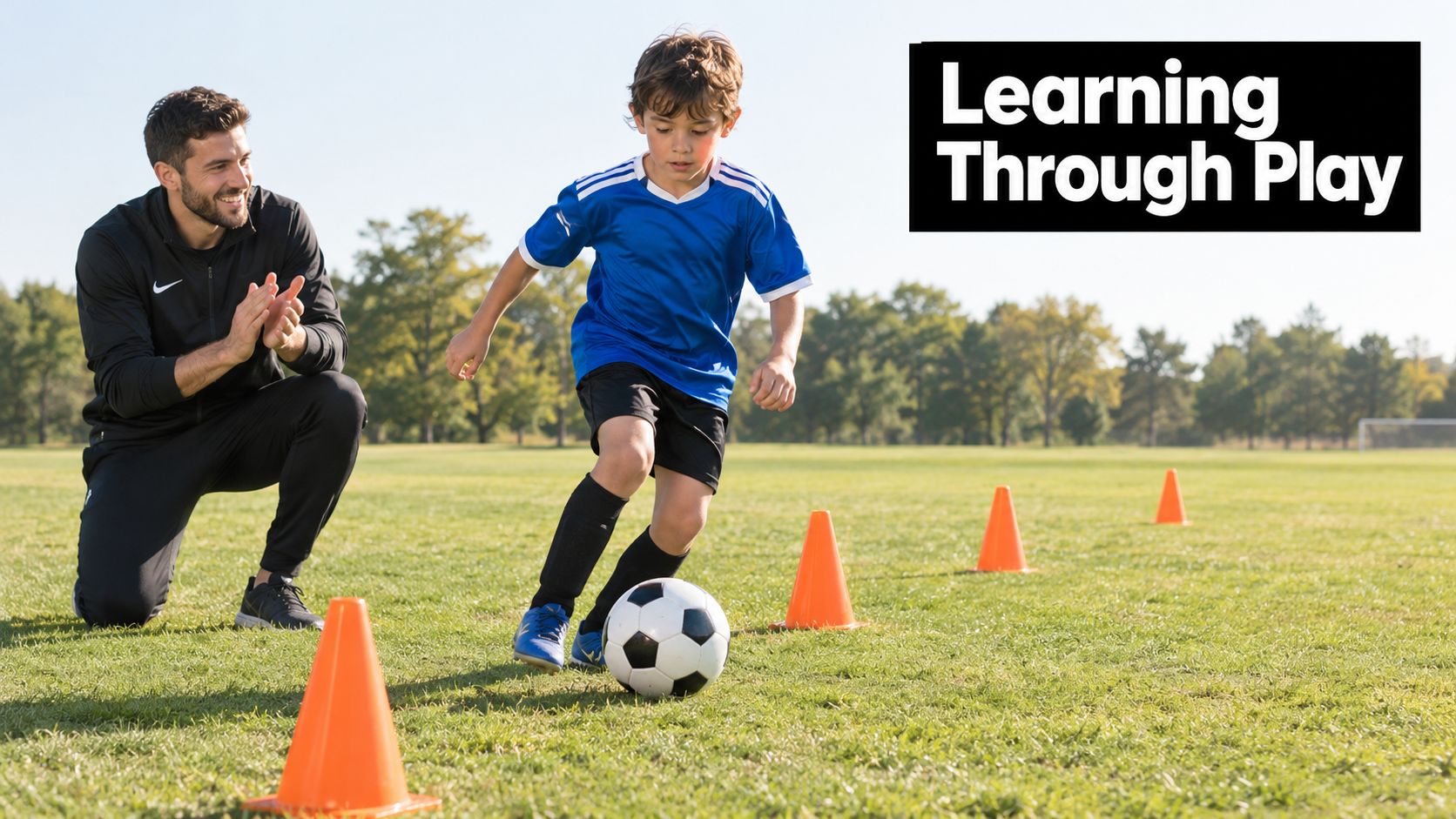
On the field, notice whether your child:
Uses either foot: They're willing to receive, dribble, or pass with both feet, even when one feels less comfortable.
Looks before receiving: They glance around, notice a teammate or defender, and start to choose what to do before the ball arrives.
Changes direction with purpose: They turn into open space or protect the ball instead of just chasing it in a straight line.
Helps after the pass: They move to support the teammate with the ball rather than watching from a distance.
Responds after losing possession: They try to win the ball back or help defend, instead of giving up on the play.
Those behaviors matter more than whether a child scores in a match. Heading, locking a young player into one position, adult-style tactical systems, and conditioning built around long, tiring repetitions should not crowd out the basic work of learning to move and solve simple game problems.
For a broader view of age-related priorities, compare a program's curriculum with this guide to soccer development by age. Then watch your child in practice. A player who starts scanning or tries a turn they previously avoided is showing development, even if the scoreboard doesn't reflect it.
Inside a Well-Designed 60-Minute Session
A good session doesn't need to be a parade of drills. It should move children through activity, challenge, recovery, and play, with enough variety to keep them learning without overwhelming them.
One possible structure uses several short games and practice blocks rather than long lines. The exact activities can change with the group, but the coach should be able to explain what players are practicing and how it connects to playing soccer.
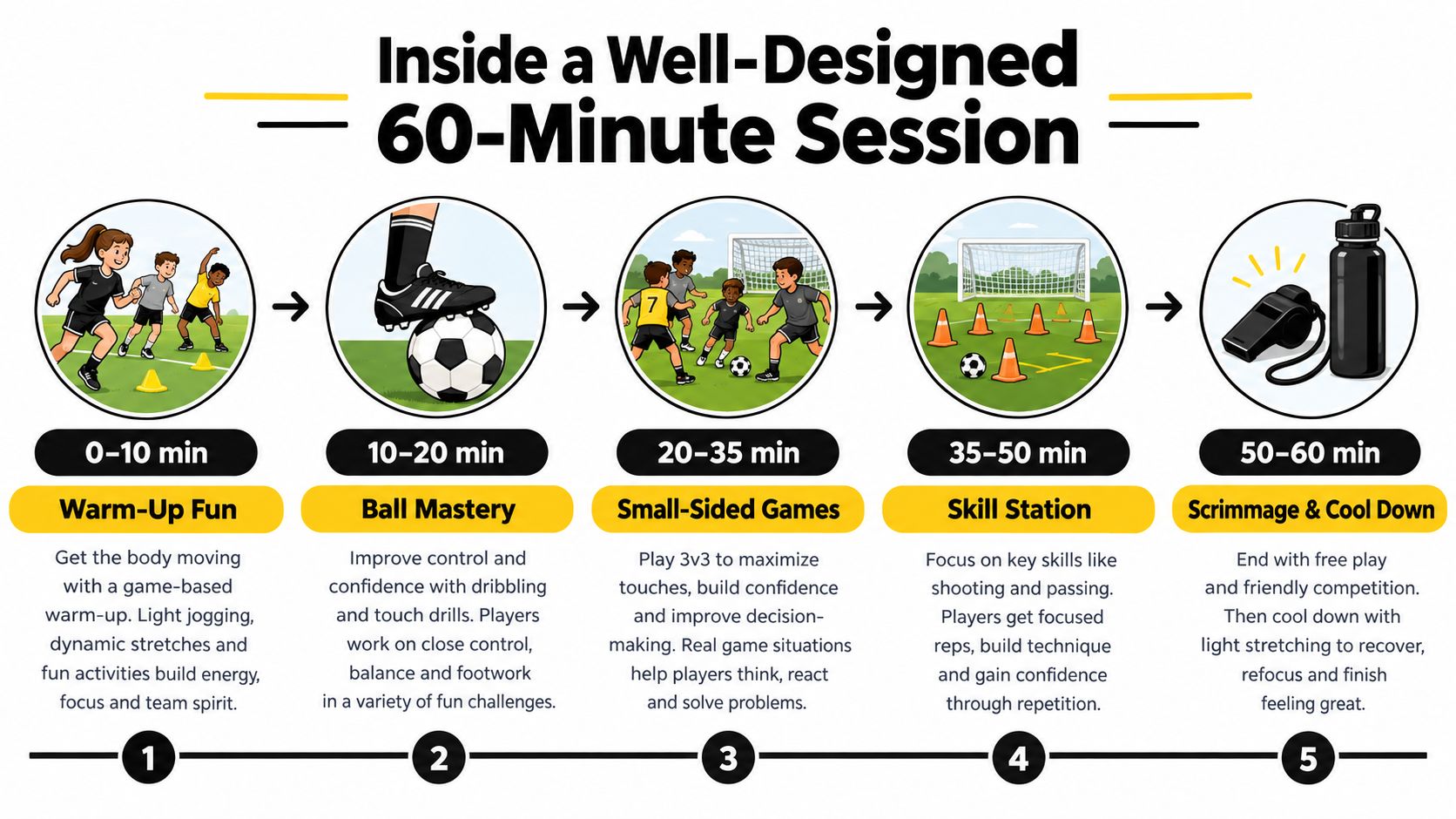
A session might begin with a playful movement warm-up, followed by ball mastery where each child has a ball and can experiment with dribbling and changing direction. The coach can then set up a 1v1 or 2v2 game that asks players to protect the ball or find a way past an opponent. After a drink break, a 3v2 or 3v3 game can give players chances to find a teammate, offer support, and decide when to dribble or pass.
Later, the group might play 4v4 before finishing with a short scrimmage. Coaches can rotate positions so children experience different roles, and they should build in breaks rather than expecting young players to keep going when they're tired or thirsty.
FIFA's coaching guidance for ages 8–12 recommends starting with a small-sided game that presents a real problem, then changing the numbers or playing space so children can discover a solution. For example, a coach might add a neutral player to create an extra passing option, or adjust the field to change how much space players have. The FIFA guidance on learning through numerical progression games also supports brief interventions, such as asking, “Where is the free player?” and quickly restarting play.
What to watch from the sideline: Children should spend much of practice moving, trying, and making choices. If they're waiting in a long line while one player takes repeated turns, ask what skill the activity is meant to develop.
The coach's voice should guide, not fill every quiet moment. A question, a quick adjustment, and a chance to play again often teach more than stopping the game to explain every possible answer.
How Practice Design Shapes How Kids Think on the Ball
Two practices can use the same ball and field but give children very different learning experiences. In one, players follow instructions step by step: stand in line, receive a pass, dribble around a cone, and wait for another turn. In another, they play a small game and must decide where to move, whether to pass, and how to respond when the situation changes.
The second approach makes the child an active problem-solver. In a 3v3 game, a coach can make the field narrower to encourage players to find passing lanes under pressure, or wider to encourage them to spread out. Adding a neutral player gives the team in possession an extra option. The coach doesn't need to dictate every pass; the changed conditions help players notice what's available.
That doesn't mean instructions have no place. An eight-year-old may need a clear demonstration or one short cue, especially when learning a new movement. But constant directions can leave little room for children to look up, make a choice, and learn from the result. If the coach stops the game repeatedly, players also get fewer chances to experience how their choices work in motion.
When you watch a session, notice what the coach changes when children struggle. Do they adjust the space or numbers to make the problem clearer? Do they ask a question and let the players try again? Or do they mostly call out exactly where everyone should stand and where the ball should go?
The practical test is not whether a practice looks complicated. It's whether your child gets chances to make decisions and try different solutions. Parents comparing activities can also review these youth soccer drills for U-8 players with that question in mind. A useful drill should connect to a real choice a player might face, not just keep everyone busy.
What to Look For in a Coach and Curriculum
A coach's manner can shape whether a child feels safe enough to try something difficult. The curriculum matters too, but parents don't need to judge it by technical language. Watch what happens during a trial session and ask direct questions.
Start with the people running the program. Ask whether coaches hold relevant qualifications or have experience teaching this age group. A credential alone can't guarantee that a coach will connect with children, so pay attention to how they explain activities, respond to mistakes, and communicate with families.
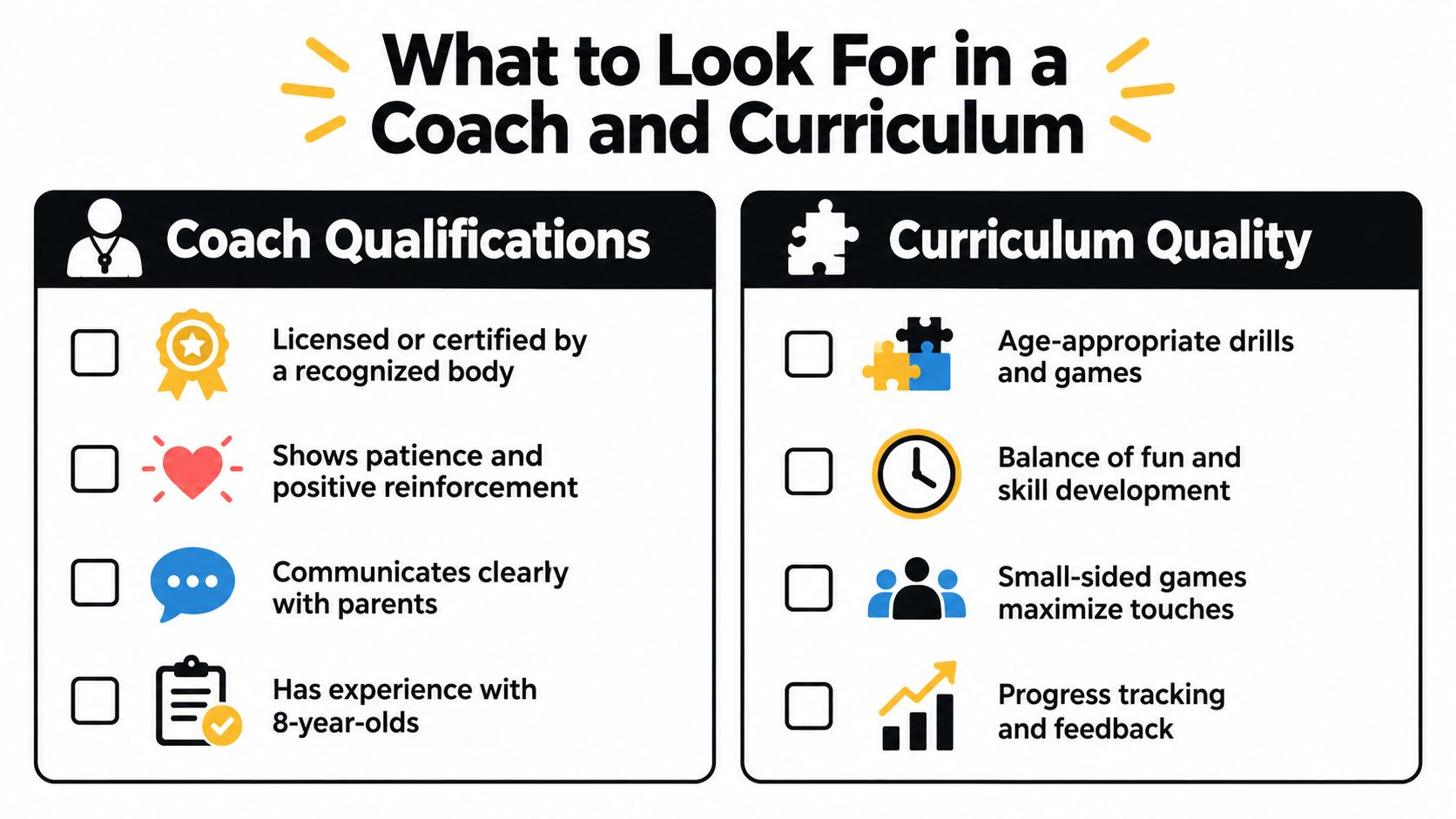
During a trial, focus on three things: how the coach talks to a child after a mistake, how long players wait in lines, and whether children get frequent chances to use the ball. A coach who corrects calmly and gives a simple next step can help a child stay involved. A coach who shames players or reacts angrily to ordinary mistakes deserves closer scrutiny.
Before registering, ask:
About the curriculum: What skills and game ideas does the program focus on for this age, and how do sessions build on each other?
About activity: How much time do children spend playing small-sided games compared with standing, listening, or waiting?
About rotation: Do players try different positions, and how does the program make sure each child takes part?
About feedback: How do coaches handle mistakes, effort, and different levels of confidence?
About communication: Who should a parent contact with a question, and how will the family hear about changes or concerns?
A written plan isn't the only sign of quality, but the coach should be able to describe what players are learning and how the program adapts to children who develop at different speeds. For more practical evaluation guidance, read about what makes a good soccer coach. You're choosing an environment for your child, not just a place to fill a schedule.
Safety Questions Every Parent Should Ask Before Registering
A program's safety claim is only useful if staff can explain what it means in practice. Ask for specific policies, who is responsible for carrying them out, and how the program communicates with families when something happens.
Start with heading and head impacts. Children's Healthcare of Atlanta says children under age 10 should not head the ball during practices or games. CDC coach materials emphasize removing an athlete with a suspected concussion from play the same day and requiring healthcare-provider clearance before return, as described in this guidance on concussion prevention for children and teens.
Ask the program director:
What's your heading policy? Confirm that children this age aren't asked to head the ball in practice or games.
What happens after a head impact? Ask who removes the player, contacts the family, and documents the incident.
What training do coaches have? Find out how staff recognize possible concussion symptoms and what they're instructed to do.
How does return to play work? Ask whether the program requires healthcare-provider clearance before a player returns after a suspected concussion.
How do you manage heat and hydration? In Houston's warm weather, ask when players can drink, how staff respond to overheating, and how they adapt activity during hot conditions.
Supervision matters before and after practice too. Ask who watches children during transitions, how emergency contacts are accessed, and how staff respond if a child becomes ill or injured. For general facility upkeep during hot weather, this resource on summer hygiene for sports facilities offers useful context alongside questions about the club's own cleaning and equipment routines.
A development-focused program can be competitive without treating contact as proof of commitment. At this age, technical learning and smart play don't require unnecessary physical risk.
How a Clear Pathway Still Protects Age 8
Parents may want their child to have room to improve, especially if the child loves training and asks for more soccer. A pathway can provide structure and future opportunities, but a child's early placement shouldn't be mistaken for a permanent prediction of what they'll become.
The National Center for Health Statistics' analysis of the 2020 National Health Interview Survey found that 54.1% of U.S. children ages 6–17 had participated in organized sports during the previous year. Participation was 52.5% among ages 6–11 and 48.7% in the South, according to the NCHS report on organized sports participation. The figures show that participation varies by region and age. For families in North Houston, convenient locations and a welcoming atmosphere can help make it easier to keep showing up.
A sensible pathway can still challenge a child. It should offer age-appropriate training, helpful feedback, and opportunities to grow without making early selection or constant travel the measure of success. Children develop at different rates, and playing other sports or enjoying unstructured play can remain part of a healthy childhood.
Villarreal Houston Academy is one local option for families exploring a structured route. It offers select and competitive programming for boys and girls from age four upward across North Houston, with age-appropriate training guided by Villarreal CF methodology and delivered by qualified coaches. The academy also supports players with sports psychologists and offers later opportunities to travel to Spain to train and play alongside Villarreal CF's elite academy.
Those opportunities may appeal to a child who wants a longer soccer journey. Still, the first measure of a good fit is local and immediate: does your child have a chance to learn, feel included, and enjoy playing? A pathway is most valuable when it leaves room for that answer to stay yes.
Five Questions to Bring to Your First Session
You don't need a coaching badge to evaluate a practice. Bring a few clear questions, watch what happens, and notice how your child feels afterward.
How many decisions does my child get to make? Look for moments when they choose whether to pass, dribble, defend, or move into space. A child who's involved in a small game has more opportunities to try choices than a child waiting for a turn in line.
How does the coach respond to mistakes? Listen for calm, useful feedback and encouragement to try again. A mistake should be treated as part of learning, not as a reason to embarrass a player.
Do players experience different positions? At this age, moving around the field gives children a chance to develop a broader understanding of the game. Ask how the coach rotates players, rather than assuming the child will be assigned one role for the season.
What does the coach do when play gets physical? Watch whether the coach steps in promptly, teaches players to compete safely, and takes injuries seriously. Ask the program how it handles head impacts and what it expects from parents.
How is heading handled? Ask the coach or program director to explain the policy plainly. Their answer should match the age-specific safety guidance described earlier.
After the session, ask your child what they enjoyed and what felt hard. Their answer can help you judge whether the environment offers the right balance of challenge, confidence, and fun.
Villarreal Houston Academy offers age-appropriate youth soccer programming, competitive pathways, camps, and clinics across North Houston, with training guided by Villarreal CF methodology. If you're comparing soccer programs for 8 year olds, visit Villarreal Houston Academy to learn about current options and decide whether its approach fits your child.
Comments