


Soccer Camps and Clinics for Houston Youth Players

You're standing beside a Humble-area field on a Saturday morning, watching your child chase the ball while weighing two very different options. A one-week summer camp could fill the school break with daily activity. A Tuesday evening clinic could build one skill steadily over several weeks. Both may be called youth soccer training, but they create different learning environments.
That difference matters in Greater Houston. A family in Atascocita, Kingwood, Cypress, or Porter has to consider more than the program name. Travel time, heat, school schedules, facility access, playing experience, confidence, and long-term goals all affect whether a player benefits from a camp or clinic. The right choice for a four-year-old trying soccer for the first time may be completely wrong for a teenager preparing for competitive play.
Why Houston Parents Are Choosing Soccer Camps and Clinics
Soccer has a substantial youth participation base in the United States. US Youth Soccer reports registering nearly 2.5 million players annually through its member network, and the sport ranks among the country's three largest youth team sports alongside basketball and baseball, as summarized by FC National's youth soccer statistics overview. Broader participation also remains strong. The Aspen Institute's Project Play tracking found that 65% of U.S. youth ages 6–17 participated in a team sport at least once during 2024, the highest level recorded in that series since at least 2012, according to the same source.
For Houston families, that national scale translates into many local choices. A child can start with a playful introductory camp, attend a focused technical clinic, join a year-round team, or move between formats as confidence and ability develop. The challenge isn't finding a soccer label. It's identifying the setting that matches the child's current needs.
Practical rule: Choose the program based on the change you want to see, not on the longest list of advertised features.
A camp may be the right entry point when your child needs positive exposure, new teammates, and a broad sample of soccer activities. A clinic may be more useful when the player already enjoys the sport and needs repeated practice with receiving, passing, finishing, goalkeeping, or transition play. Neither format guarantees progress by itself. The quality of the session design, coaching, grouping, feedback, and follow-up matters more than the word on the registration page.
Greater Houston adds practical complications. A family traveling from Kingwood to Cypress may face a very different weekly commitment from a family near Humble or Fall Creek. Summer heat can change the usable intensity of an outdoor session, while school, work, and traffic can make a theoretically excellent program difficult to attend consistently.
The useful questions are straightforward: What does a camp deliver each day? What does a clinic build over time? Which format suits my child's age and stage? How are safety, cost, access, and progression handled? The answers begin with the structure of each format.
Camps vs Clinics and How Each Format Actually Works
A soccer camp is concentrated training during a school break. Players usually attend daily sessions for a short, defined period, often with a mixed roster drawn from different teams, schools, or clubs. Coaches can move from ball mastery to passing, finishing, games, and competitions within the same day because the schedule creates more contact with the sport in a limited window.
A soccer clinic is a recurring session built around continuity. Players typically return with the same peer group and coaching staff, often for a focused theme such as first touch, striking, goalkeeper technique, or positional play. The coach can introduce a concept, observe how players apply it, and revisit the problem at the next session.
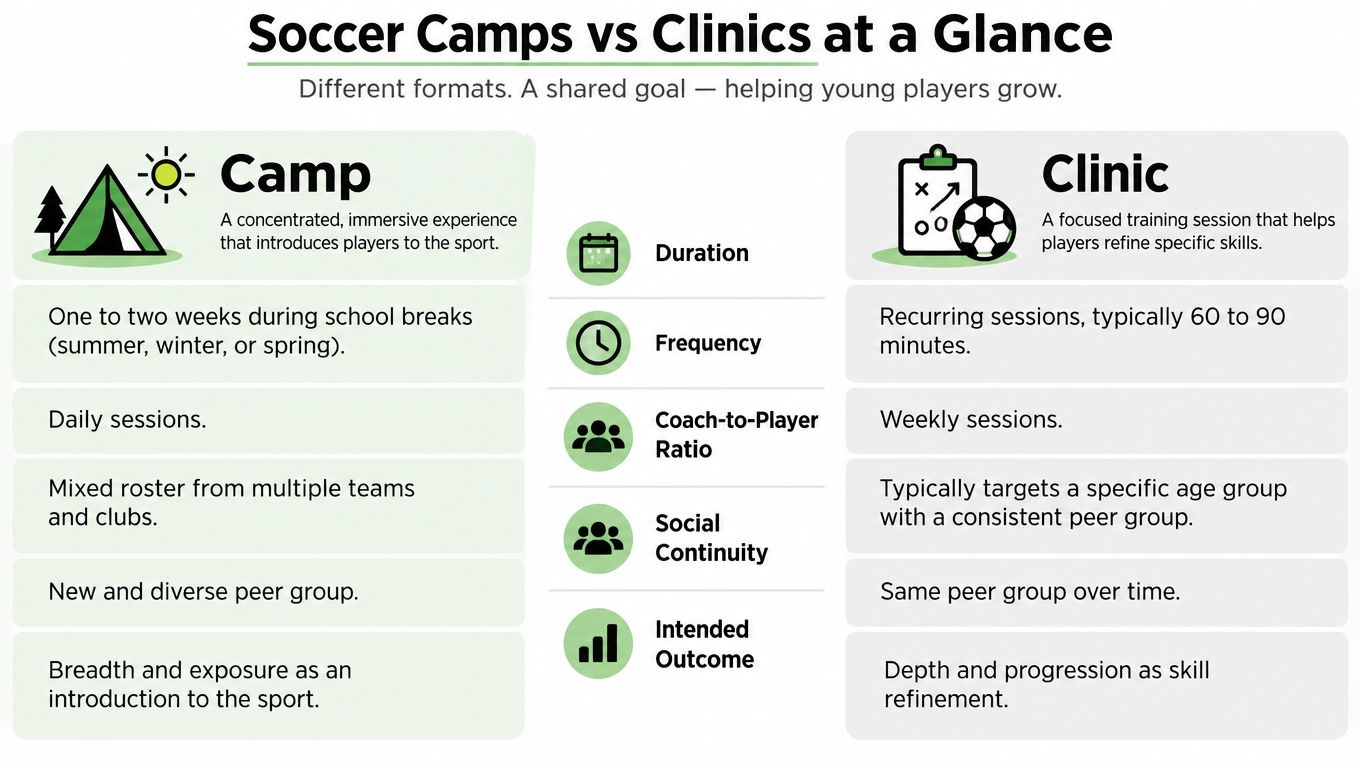
Soccer Camps vs Clinics at a Glance
Dimension | Camp | Clinic |
|---|---|---|
Duration | Concentrated program over a short school-break period | Ongoing sessions across a longer training cycle |
Frequency | Daily contact during the camp period | Usually a recurring weekly appointment |
Coach-to-player ratio | May vary as mixed groups are organized by age and level | Often more stable, allowing coaches to understand individual needs |
Social continuity | Players meet teammates from different clubs and backgrounds | Players develop familiarity with a consistent peer group |
Intended outcome | Introduction, breadth, exposure, and a burst of activity | Refinement, repetition, and progressive skill development |
The ratio deserves careful attention. A small group can give a coach more opportunities to correct body position, demonstrate a movement, and ask a player to repeat the action under pressure. A larger group may still work well if coaches divide players intelligently and keep everyone active, but parents should ask how much waiting occurs between repetitions.
Camp rosters can also be a benefit. A recreational player may gain confidence by meeting athletes outside their usual circle, while an experienced player may encounter new problems and playing styles. Clinics offer a different advantage, the ability to build shared language and expectations over time.
The simplest rule is this: camps provide breadth and exposure, while clinics provide depth and progression. A child can use both, but the sequence should match the goal. Start with a camp when the player needs to discover the game. Add a clinic when the player wants to improve a specific part of it.
Matching the Right Program to Your Player's Age and Stage
Age helps organize a program, but it doesn't tell the whole story. A confident four-year-old, a cautious seven-year-old, and an experienced ten-year-old may need different levels of challenge even if they attend nearby groups. Coaches should consider attention span, coordination, prior experience, confidence, and willingness to make decisions.
Ages 4–6
For a first-time player, success means leaving the field eager to return. Sessions should use short activities, lots of ball contact, imaginative games, simple movement challenges, and small groups. Coaches should demonstrate rather than lecture, and parents should be able to observe without turning every mistake into a correction.
A poor fit looks like long lines, adult-style tactical explanations, or children standing still while one player performs. For families near Atascocita, Humble, or Fall Creek, an introductory camp can work well if the day includes shade, water breaks, and an environment that welcomes beginners.
Ages 7–9
Players in this band can begin connecting technique to decisions. First touch, passing with the correct surface, dribbling away from pressure, and changing direction should appear in activities that resemble real play. A clinic can help because the coach has time to revisit the same skill, while a camp can introduce the player to new teammates and game situations.
Warning signs include drills that never progress beyond unopposed repetition or games where the strongest players dominate every action. Look for coaches who adjust field size, rules, and groupings so every child has meaningful involvement.
Ages 10–12
Players are ready for more tactical information, including support angles, defensive cover, transition moments, and basic positional responsibilities. They still need technical repetition, but the coach should increasingly ask, “What did you see?” and “Where could you move next?” instead of giving every answer.
A good program separates challenge from pressure. Advanced players should have problems to solve, while developing players should receive clear tasks they can complete. Families can use this age-based soccer development guide to compare a child's current stage with an appropriate training emphasis.
Ages 13 and older
Teenagers may need performance training, position-specific work, competitive matches, and a clearer route toward select teams or showcase opportunities. A clinic can target finishing, goalkeeper distribution, or playing under pressure. A camp can expose an athlete to new coaches and competitive environments, but it shouldn't be mistaken for a complete development plan.
Poor fit appears when every player receives the same drill regardless of position, ability, or goal. For serious players, ask how the program connects camps and clinics to year-round training, team assessment, and future opportunities. The best entry point is the one that challenges the player without asking them to skip foundational work.
A Realistic Look at Daily and Weekly Schedules
A well-designed camp day should feel active without becoming a continuous test of endurance. The coach's job is to alternate effort, instruction, competition, recovery, and reflection so players can learn while maintaining movement quality.
A sample camp day
A morning might begin with arrival, attendance, and a progressive warm-up. Players then move through technical stations focused on touches, turns, passing, or finishing. The coach should keep lines short and provide a clear purpose for each activity.
After the first training block, players need hydration and shade. A midday break allows food, recovery, and lower-intensity social time before the afternoon session. The later block can introduce tactical games, transition challenges, and small-sided competition, followed by a cool-down and a clear pickup routine.
The schedule should change the demand without losing the theme. For example, a day about receiving could move from an unopposed first touch, to receiving with a passive defender, to receiving in a 2v2 or 3v3 game. That progression helps players understand why the technique matters.
A typical weekly clinic
A recurring clinic may last 60 to 90 minutes, depending on the program and age group. A session focused on receiving under pressure could follow this sequence:
Activation: Movement, balance, and ball familiarity.
Technique: Receiving across the body with the inside or outside of the foot.
Pressure: A defender closes space while the receiver scans before the ball arrives.
Application: Players use the skill in 2v2, 3v3, or 4v4 games.
Review: The coach identifies one decision the player can repeat next time.
Research on small-sided games supports this progression. In a six-week randomized study of 26 highly trained youth players, the group using small-sided training achieved greater improvements in sprinting, agility, passing accuracy, and interception outcomes than the comparison group using a dribbling circuit, as reported in the Scientific Reports study on small-sided games. Smaller formats increase opportunities for ball contacts, scanning, accelerations, decelerations, and decisions, provided coaches manage fatigue and difficulty.
Parents can expect a child to feel tired after an active first week, with some soreness that should be monitored rather than ignored. After a month of consistent clinic attendance, useful signs include quicker decisions, more willingness to receive the ball, better spacing, and greater confidence after mistakes. A weekly soccer training schedule should make those progressions visible rather than hiding them behind general promises.
Safety, Coaching Quality, and What a Well-Run Session Protects
Safety starts before the first ball is kicked. A serious program has a repeatable process for warming up, grouping players, managing weather, responding to injury, communicating with families, and supervising transitions between activities.
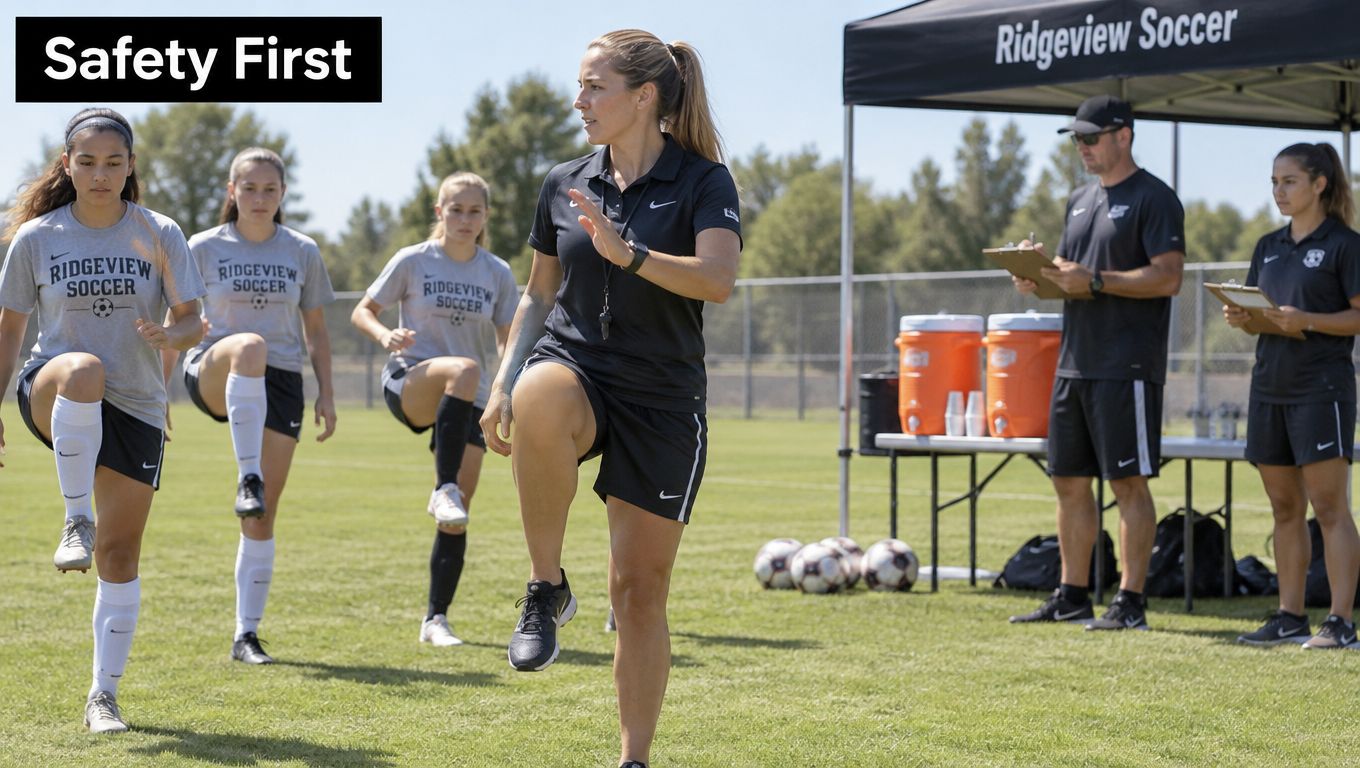
The session should prepare the body
A structured neuromuscular warm-up should include progressive running, balance, core and leg strength, eccentric hamstring work, landing control, agility, and sport-specific changes of direction. Randomized trials of programs such as FIFA 11+ report roughly 30%–46% reductions in overall and lower-extremity injury incidence compared with traditional warm-ups, while one youth-focused trial reported 37% fewer training injuries and nearly 50% fewer severe injuries when teams completed the program at least twice weekly, according to the evidence review on neuromuscular warm-ups.
The exercises should be scaled to age and ability. A young player may practice quiet landings and controlled stops, while an older athlete may add faster changes of direction. Coaches should watch knee alignment, trunk control, symmetrical movement, and signs of pain before increasing speed.
Houston conditions require procedures
Outdoor programming in Houston should explain how staff monitor heat and humidity, schedule hydration and shade breaks, respond to lightning, and address poor air quality. Parents should know where players rest, who carries first-aid supplies, and how the program contacts families if weather forces a change.
Concussion procedures also need to be specific. A player with a suspected concussion should be removed from activity until appropriate medical evaluation and clearance. The same operational clarity should apply to allergies, medication, asthma, illness, and persistent pain.
People and grouping matter
Ask whether coaches receive background screening, concussion-response training, and clear safeguarding guidance. Also ask how groups are formed. A beginner shouldn't spend a week embarrassed by faster players, and an advanced athlete shouldn't spend every session waiting for basic instructions. Coaches can solve that problem through age bands, ability-based activities, rotating groups, adjusted rules, and appropriate supervision.
Psychological safety matters as much as physical protection. Players learn more when they can make a mistake without ridicule, ask for clarification, and take a controlled break when needed. This guide to what makes a good soccer coach offers useful questions about communication, teaching behavior, and player support.
A safe session isn't passive. It gives each player the right level of challenge, keeps the environment predictable, and makes returning next week feel manageable.
How to Choose the Right Program in Greater Houston
Start with the child, not the facility. A nearby program that matches the player's goal and schedule may produce more progress than a distant program that creates missed sessions and family stress.
Use these questions before comparing registration pages:
Age and stage: Is the player discovering soccer, building fundamentals, refining a position, or preparing for competitive play?
Primary goal: Does the family want introduction, technical improvement, confidence, fitness, team assessment, or competitive exposure?
Schedule fit: Can the child attend consistently without sacrificing sleep, school responsibilities, or recovery?
Travel burden: How will traffic and weather affect the trip from Humble, Kingwood, Porter, New Caney, Cypress, or Tomball?
Teaching philosophy: Do coaches prioritize intelligent decisions and player development, or do they mainly run games and isolated drills?
Total cost: What will tuition, equipment, transportation, meals, uniforms, and future team commitments require?
A trial session can answer questions that a brochure can't. Watch how coaches speak to players after mistakes. Notice whether every child gets involved, whether groups are adjusted intelligently, and whether the session has a clear progression from technique to decision-making.
For families in North Houston, Villarreal Houston Academy offers camps, clinics, tryouts, and year-round programming across Humble, Fall Creek, Cypress, Tomball, and the Kingwood, Porter, and New Caney area. Its stated pathway connects age-appropriate training with competitive teams and, for serious players, international development opportunities such as Villarreal CF's Player Development Program. Treat that as one option to investigate, then compare its format, location, coaching, schedule, and costs with other local programs.
The strongest question is not, “Is this program prestigious?” Ask instead, “Can my child attend consistently, receive appropriate challenge, and see a clear next step?” That answer should guide the decision.
Registration, Costs, and What to Ask Before You Sign Up
Before paying, ask for the complete commitment in writing. Advertised tuition may cover training but leave families responsible for equipment, uniforms, meals, transportation, tournament costs, travel, or later team fees. You need the full picture before deciding whether a program fits your household.
Questions for the registration office
Included costs: What does tuition cover, and which items cost extra?
Access options: Are payment plans, sibling discounts, scholarships, loaner equipment, or lower-cost introductory sessions available?
Weather policy: What happens when heat, lightning, air quality, or field conditions stop play?
Refund policy: Can the family receive a credit or refund if the player withdraws or becomes injured?
Player grouping: How are athletes placed, and when are groups reassessed?
Medical support: Who handles first aid, concussion concerns, allergies, medication, and modified activities?
Progression: What program follows the camp or clinic if the child wants more training?
For families balancing work and transportation, ask about arrival and pickup procedures, shade, water access, lunch arrangements, and whether the location changes during the week. A low-cost clinic isn't useful if the schedule creates repeated missed sessions or if the player spends most of the time waiting.
A first-week observation guide
Watch the coach's communication first. Does the coach give one clear correction and let the player try again? Do they explain the purpose of an activity? Do they address all players, not only the most skilled?
Then watch your child's body language. Tiredness is normal after active training, but persistent withdrawal, fear of touching the ball, or repeated confusion deserves a conversation with staff. Positive signs include asking questions, attempting new actions, recovering after mistakes, and describing a specific skill from the session.
Finally, check the structure. Players should move, make decisions, receive feedback, and recover. Lines should be short, transitions should be organized, and the level of challenge should change as the coach learns more about the group.
Write down your answers before registering:
What is my child's immediate goal?
Which format supports that goal, camp or clinic?
Can we attend consistently?
What is the complete cost beyond tuition?
What happens if weather, injury, illness, or access needs interrupt participation?
What is the next step if the experience is successful?
When those answers are clear, review current program information and tryout opportunities rather than registering on impulse.
Villarreal Houston Academy provides age-appropriate camps, clinics, tryouts, competitive teams, and year-round soccer development for boys and girls from age 4 upward across North Houston. Visit Villarreal Houston Academy to compare program options, locations, and next steps for your player.
Comments