


Soccer Coaching Terms Every Parent and Player Should Know

You're standing at the edge of a youth soccer session when the coach calls, “Scan! Press! Switch play!” Your child reacts, but you're not sure what the instructions mean or whether the response was correct. Soccer coaching terms can sound like a private language until someone connects each word to a visible action.
A useful glossary should do more than define vocabulary. It should help a parent recognize the coaching cue, help a player understand the decision, and help a new coach design a practice that has a clear purpose. The terms below connect technical skill, team tactics, physical preparation, and psychological development to practical examples you can observe at training.
Why These Terms Matter on the Sideline
Soccer language becomes useful when it tells a player what to see, what to do, and why the action matters. “Scan” means checking the space before receiving the ball. “Press” means applying immediate pressure to limit the opponent's options. “Switch play” means moving the ball away from crowded space toward a teammate in a more useful area.
That translation matters for families. A parent who understands the cue can ask a better question after training, rather than judging a player only by goals, assists, or visible effort. A new coach can replace vague instructions such as “work harder” with observable behaviors, such as supporting at an angle or recovering behind the ball.
UEFA's coach-education framework helped standardize terminology across European coaching. The convention was ratified on 17 January 1998 by six national associations, and its qualification structure connected coaching levels with ideas such as tactical organization, technical development, and youth development. You can explore the wider cultural side of the sport with this browse futebol worksheet for class, while families interested in coaching behaviors can read what makes a good soccer coach.
Who benefits from this vocabulary
Parents can understand instructions heard from the sideline and discuss training without turning every conversation into a match review.
Players can connect a word such as “support” or “cover” to a decision they can repeat.
New coaches can build practices around a consistent language instead of collecting disconnected drills.
Older players can begin to recognize how an individual action fits the team's game model.
Villarreal Houston Academy uses a structured vocabulary connected to Villarreal CF's methodology. That consistency gives families a clearer view of what coaches are teaching and helps players hear familiar ideas as the demands of the game increase.
How Coaching Vocabulary Is Organized
Most soccer coaching terms fit into four connected pillars: technical, tactical, physical, and psychological. The categories make planning easier, but they shouldn't be treated as separate compartments. A player's first touch affects a tactical decision, a tactical decision creates a physical demand, and confidence influences whether the player attempts the action.
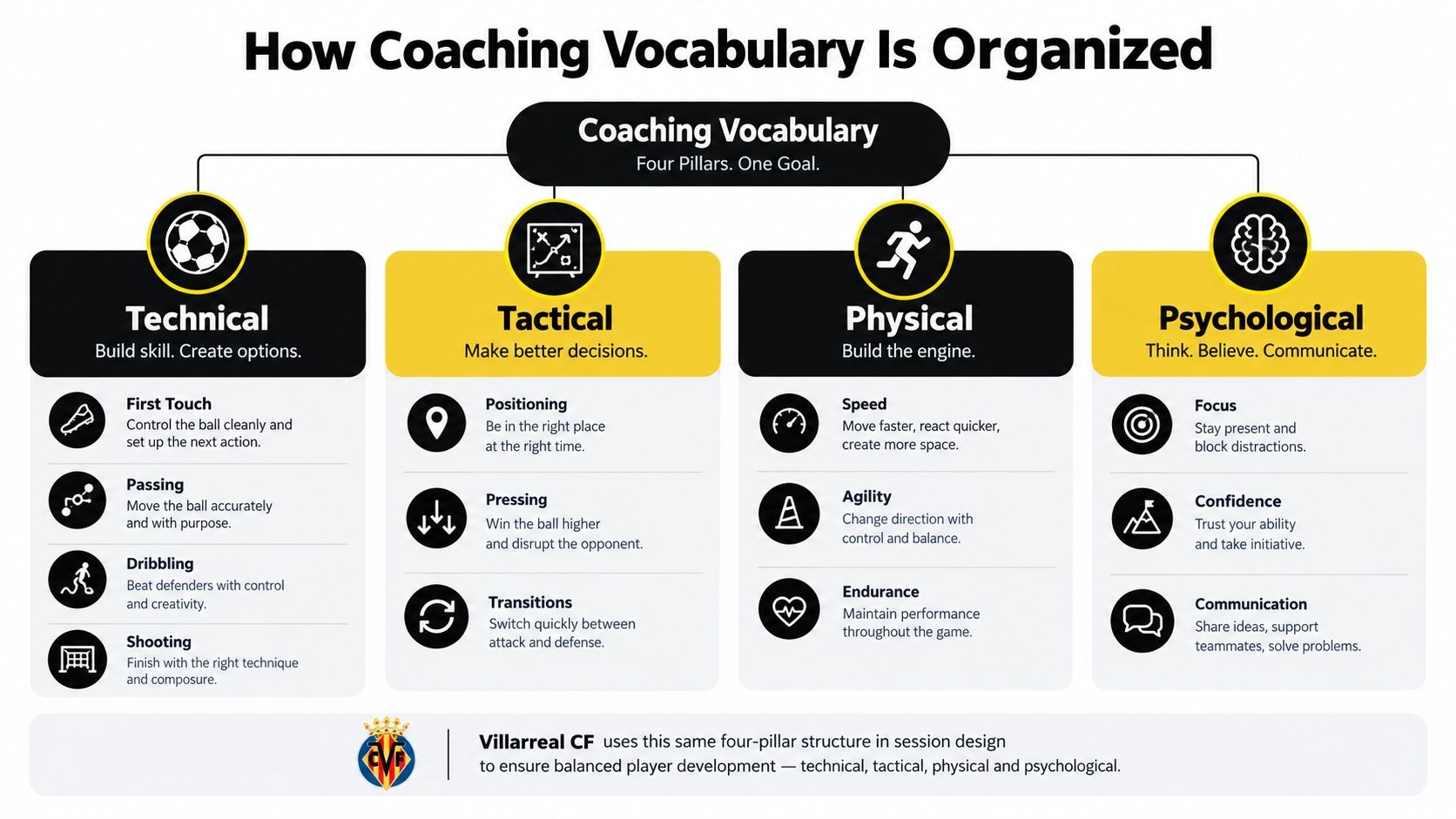
The four pillars in plain language
Technical terms describe how a player controls and strikes the ball. First touch, receiving, passing, dribbling, shielding, and finishing belong here.
Tactical terms describe how players solve problems together. Positioning, pressing, compactness, transitions, width, depth, and switching play help organize decisions.
Physical terms describe the body's ability to perform and recover. Speed, agility, coordination, endurance, workload, and recovery all affect what a player can repeat safely.
Psychological terms describe attention, motivation, confidence, communication, autonomy, and response to mistakes.
Villarreal CF's methodological structure uses these areas to support balanced development. A session might begin with ball mastery, move into a small-sided game about creating space, include repeated accelerations, and finish with a player reflecting on a decision. The coach isn't changing subjects randomly. The coach is asking the player to connect the parts.
Practical rule: When you hear a coaching term, ask which pillar it belongs to and which other pillar it affects.
The sections that follow use this map to make sideline language easier to recognize. The final reference index brings the terms back into a compact field-side format.
Technical Terms Coaches Use Every Session
Technical coaching begins with comfort around the ball. FIFA's grassroots guidance recommends maximizing touches and movement, using game-based learning, and progressing from technical foundations toward tactical application, with active players and minimal queues at every age (FIFA grassroots coaching guidance).
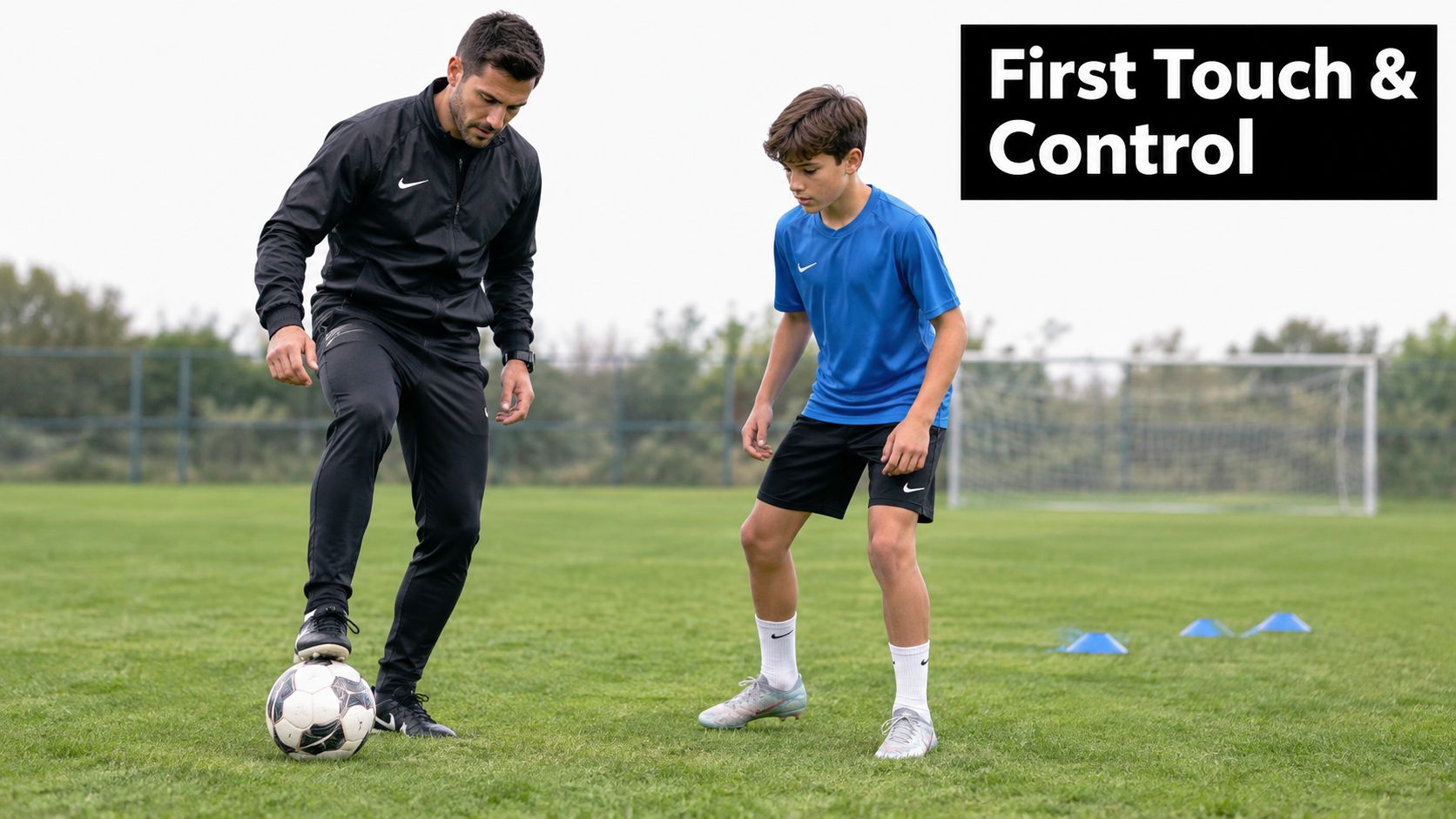
The words behind the actions
First touch means the first contact that moves the ball into a useful space. The cue is “open your body and cushion the ball.” For a U7 player, it may mean stopping the ball beside the body. For a U14 player, it means taking the ball away from pressure and toward the next action. A simple practice is a receiving square where a player checks a shoulder, receives from a partner, and takes the first touch through a gate.
Receiving means controlling the ball while preparing for what comes next. A young player can receive with the sole, inside, or outside of the foot. An older player should adjust the body shape based on pressure, speed, and the location of the next pass.
Passing includes an inside-foot pass for accuracy, a driven pass for speed, and a lofted pass for distance or pressure relief. The cue changes from “pass to feet” for a beginner to “play into the receiver's next action” for an older player. Use a passing triangle, then add a defender who can intercept predictable passes.
Dribbling means moving with the ball while keeping control and changing direction or speed. For a U7 player, encourage small touches and simple changes of direction. For a U14 player, ask whether the dribble attracts a defender, beats a defender, or creates a passing lane. A 1v1 channel gives the player a clear decision between carrying the ball and passing.
Shielding means using the body to protect possession. The cue is “get between the defender and the ball.” Younger players can practice holding the ball for a few seconds in a safe area. Older players should use the far foot, arm position, and body angle before turning or laying the ball off.
Finishing means striking the ball to score. Teach a young player to look at the target and use a controlled surface. Older players must choose between placement, power, a first-time finish, or a touch before shooting.
Heading requires timing, body control, and an appropriate training environment. Coaches should match the activity to the player's age and development, using clear technique and safe repetition rather than treating every ball as a contest.
Ball-striking surfaces include the inside, instep, outside, sole, and laces. Each surface changes the ball's speed, direction, or spin. A coach may ask a player to use the inside for accuracy and the instep for a driven strike.
Villarreal-style technical work values repetition with a purpose. Villarreal Houston Academy schedules individual ball-mastery phases into sessions so players can build control before pressure increases. Families looking for another explanation of technical development at JC Sports Houston can compare how individual actions are taught and connected to play.
Tactical Terms That Shape How a Team Plays
Tactical vocabulary tells players how to use space and coordinate with teammates. In youth soccer, principles of play describe how a team creates and exploits space in attack while staying compact in defense. Common attacking ideas include numerical advantage, support, width, depth, movement off the ball, and switching play (US Soccer coaching guide).
Four moments organize the decisions
Tactical periodization commonly frames the game through organized attack, organized defense, defensive transition, and attacking transition. These moments help a Villarreal-style session connect technique with decisions instead of practicing each skill in isolation.
Possession means keeping the ball to maintain control, attract pressure, or create a better opportunity. The cue is “can we keep it or play forward?” In a small-sided game, a team earns the chance to attack a target after completing connected passes.
Playing out from the back means building an attack from the goalkeeper or defenders instead of immediately sending the ball forward. A young player may spread out and offer a safe pass. An older player must recognize when to use the goalkeeper, split defenders, or play beyond the first line.
Pressing means applying pressure to the player with the ball. For a child, “show inside” may mean guiding the opponent toward a teammate. For an older player, the press includes a trigger, cover, and a coordinated direction.
Counterpressing means trying to regain the ball immediately after losing it. The cue is “react together.” In a small-sided game, nearby players close the ball while teammates protect the central space.
Transitions are the moments when possession changes. After winning the ball, players decide whether to attack available space or secure possession. After losing it, they decide whether to pressure or recover shape.
Compactness means keeping teammates close enough to support pressure and protect dangerous spaces. “Shift across” asks the team to move together rather than leaving isolated defenders.
Numerical advantage means creating more attackers than defenders in a useful area. Support, width, and depth help produce that advantage. A 3v2 exercise makes the idea visible because the player with the ball has more than one forward option.
Switching play means moving the ball from a crowded side to an open side. The coach may ask players to recognize when the defending team has shifted too far toward the ball.
Game model describes how a team wants to play. It gives meaning to repeated instructions, because “press” and “play forward” depend on the team's preferred behaviors.
A parent can learn more about these decisions through understanding soccer tactics. The important question isn't whether a child can repeat a term. It's whether the child can recognize the situation in which the term applies.
Physical Terms Parents Hear About Workload and Recovery
Physical language often worries parents because it can sound clinical. A coach who says “we're managing load” isn't necessarily reducing opportunity. The coach may be adjusting the total stress placed on a player so the athlete can continue developing safely.
Periodization organizes training loads and objectives across the season, month, week, and individual session. Tactical periodization, associated with Vítor Frade in the mid-1990s, treats physical, technical, tactical, and psychological qualities as connected through the team's game model (tactical periodization and load planning).
Sideline translations
Load management means considering training, matches, travel, school, sleep, and growth-related stress, not only minutes played. Watch for coaches changing intensity, repetitions, or recovery time.
Volume means how much work a player performs. More passes, more runs, or more repetitions increase volume.
Intensity means how demanding the work is. A short sprint, a hard duel, or a fast small-sided game can be intense even when the activity is brief.
Recovery is the process of returning the body and mind to a state that supports the next training demand. Watch whether players receive appropriate rest, hydration, and lower-intensity work.
Aerobic base supports repeated movement over time. A coach may build it through games that require continuous involvement rather than long inactive running lines.
Agility is the ability to change direction and body position in response to a stimulus. A cue might be “slow down before you turn.”
Coordination connects the eyes, brain, and body. Ball work, footwork, and reaction games can develop it.
Biological age describes maturation and growth status, while chronological age describes the number of years since birth. Two players in the same age group may need different demands.
Component | Example | Why It Matters |
|---|---|---|
Training | Technical work and small-sided games | Builds skill while creating soccer-specific movement |
Matches | Competitive minutes and repeated efforts | Adds decision-making and physical stress |
Travel | Long journeys and disrupted routines | Can affect freshness and recovery |
School | Concentration, sitting, and daily demands | Adds mental and physical stress outside soccer |
Growth | Changes linked to maturation | May influence coordination, tolerance, and injury risk |
Ask this question: “How is my child's training adjusted for their age and stage of growth?”
That question invites a useful conversation. It also helps parents understand why individualized training can look different for players who share a birth year.
Psychological Terms That Shape the Player
A coach's psychological vocabulary becomes valuable when it describes behavior rather than personality labels. Coachability shouldn't mean silent compliance. It means listening, trying to understand feedback, asking appropriate questions, and applying a correction.
Growth mindset describes a player's willingness to treat ability as something that can develop through practice and reflection. Resilience is the ability to respond constructively after a mistake, a difficult selection decision, or a frustrating match. Focus means directing attention toward the next relevant action, not pretending distractions don't exist.
What parents can hear and see
Autonomy means giving players meaningful choices. An autonomy-supportive coach might ask, “Would you like to receive with the inside or outside of your foot here?” rather than issuing every instruction.
Positive reinforcement identifies a useful behavior, such as checking a shoulder before receiving, instead of offering empty praise.
Intrinsic motivation comes from enjoyment, curiosity, and personal improvement. Extrinsic motivation comes from rewards, selection, praise, or external consequences.
Confidence grows when players experience preparation, appropriate challenge, and permission to make decisions.
Communication includes clear information, encouragement, and respectful correction between players and adults.
Sports psychology support helps players develop skills for attention, emotional regulation, confidence, and performance routines.
Research shows that praise, understanding, and attendance are associated with favorable motivational outcomes, while directive behavior, pressure, and performance expectations are associated with adverse outcomes in youth athletes (review of parental involvement in youth sport).
Villarreal Houston Academy integrates sports psychologists into its coaching staff, reflecting the idea that character and mental skills deserve deliberate coaching. Families can also learn more about what is sports psychology when deciding what support a developing player may need.
A better postgame conversation
Instead of asking only, “Did you win?”, try:
“What decision felt good today?”
“What did you notice before receiving the ball?”
“What would you like to try in the next training session?”
“How can I support that goal?”
This approach keeps the player connected to learning. It also gives the athlete room to describe the match before an adult supplies an interpretation.
How Coaches Build a Session Around These Terms
The Global-Analytical-Global model, often called GAG, moves from a game-like activity to focused repetition and back to a game. The opening game reveals a problem. The analytical phase gives players repeated opportunities to work on a related technique. The final game tests whether the technique transfers into decision-making.
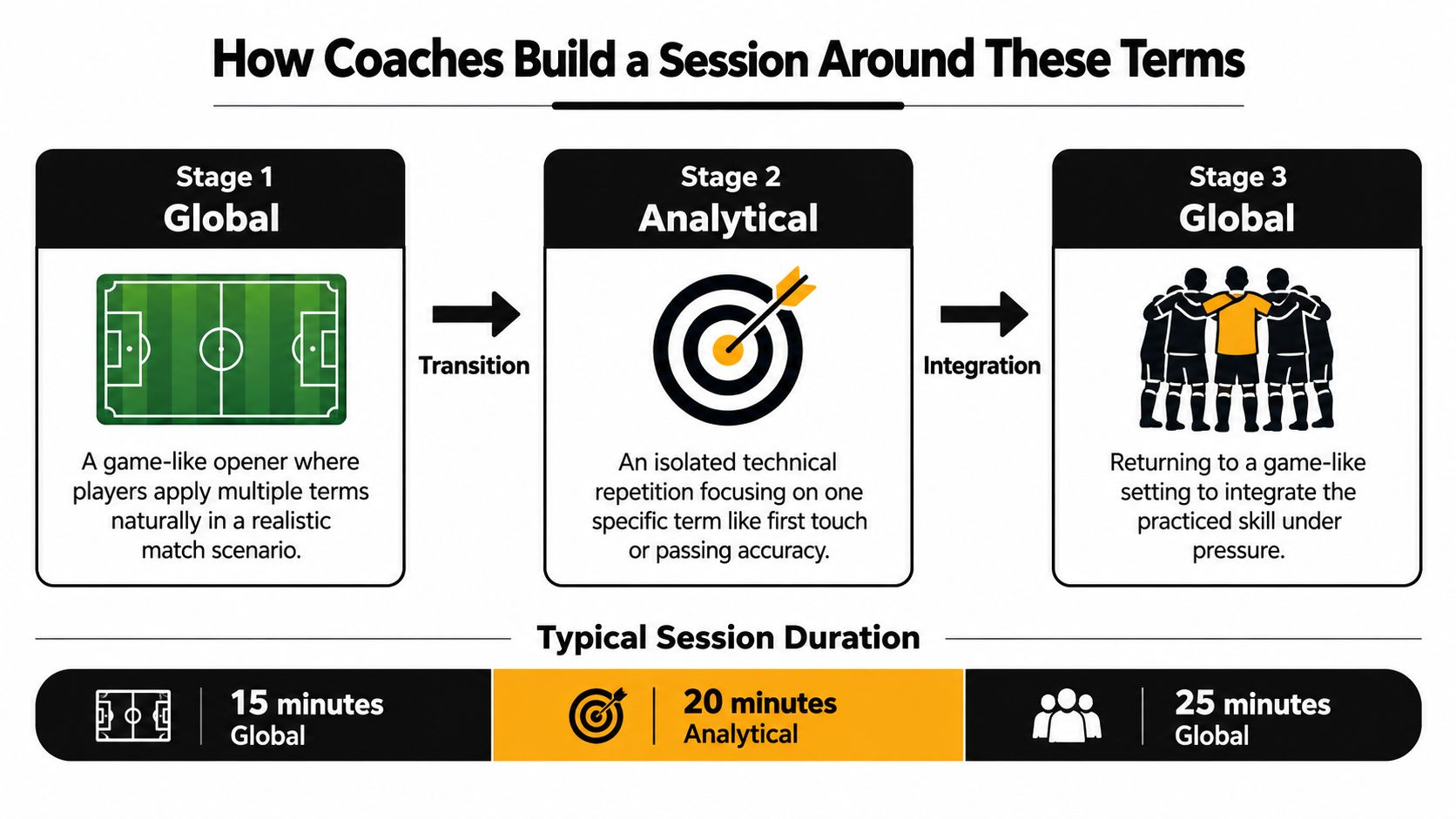
A practical U10 example
Global opening: Players compete in a small-sided game with target goals. The coach watches for scanning, first touch, support, and pressing after a turnover. The coach doesn't interrupt every mistake. The opening activity shows whether players see the problem naturally.
Analytical phase: Players work in groups on receiving across the body and passing through a gate. The coach uses cues such as “check your shoulder,” “receive away from pressure,” and “play the next pass quickly.” The practice includes many touches and short decisions rather than long queues.
Final global game: The same players return to a game with a condition that rewards receiving into space and reacting after possession changes. The coach looks for transfer. Did the first touch create time? Did nearby players support the ball? Did the player who lost possession press or recover?
A single small-sided game can train all four pillars:
Technical: first touch, passing, dribbling, and finishing.
Tactical: width, depth, support, pressing, and transitions.
Physical: acceleration, deceleration, agility, and repeated movement.
Psychological: focus, communication, confidence, and response to mistakes.
The coach's role changes across the session. During the opening, observation matters most. During the analytical phase, precise feedback matters. During the final game, the coach checks whether players can solve the problem with less interruption.
A clean drill isn't the final test. The real test is whether the player can use the skill when space, time, and pressure change.
Why Development Comes Before Results
“Development over results” doesn't mean results are irrelevant. It means a youth program measures success through the player's learning, decisions, habits, and long-term pathway rather than treating a single score as the complete judgment.
A player who moves up an age group should do so because the environment offers an appropriate challenge, not because the label feels prestigious. Starting is not the goal; learning is. A player who faces meaningful problems in a demanding environment gains more than a comfortable starter who rarely has to solve anything difficult. Picture a winger who starts every match but only receives the ball in familiar situations, then compare that with a substitute who trains against older, faster defenders twice a week. The substitute may be developing faster even with fewer minutes on match day.
Terms parents should understand
Player development pathway means the connected progression from foundational skills to more complex technical, tactical, physical, and psychological demands.
Age-appropriate coaching means changing instructions, pitch demands, complexity, and expectations as players grow.
Talent identification window describes the period in which coaches evaluate potential and development, not just current physical dominance.
Development over results means coaches protect learning objectives even when a short-term adjustment might improve a score.
The coach-education framework mentioned earlier, established through UEFA coaching convention background, helped connect terms such as game model, session design, player development pathway, and age-appropriate coaching with formal coach education.
At tryouts or team meetings, ask:
“What is the development plan for this age group?”
“How do you handle players whose biological age differs from their chronological age?”
“What does success look like for this age group this season?”
“How will you communicate progress to families?”
“Which behaviors matter more than the match result?”
A thoughtful coach should be able to describe what players will practice, how feedback will work, and how the environment will adapt as players develop.
Same Term, Different Age
Age-appropriate coaching changes the meaning of a word without abandoning the word itself. “Pressing” can begin as a child learning to move toward the ball and develop into a coordinated team action with triggers, cover, and recovery.
Term | U7–U8 | U11–U12 | U15–U16 |
|---|---|---|---|
Pressing | Move toward the ball and slow the opponent | Apply pressure with a nearby teammate and protect a passing lane | Use coordinated triggers, cover shadows, and compact team distances |
Scanning | Look before receiving | Check shoulders to identify pressure and support | Scan repeatedly to interpret lines, space, opponent movement, and the next action |
Positioning | Spread out and avoid standing beside teammates | Find useful angles for passing and defending | Adjust position in relation to the ball, teammates, opponents, and game model |
Communication | Use simple words such as “mine” or “turn” | Give information about pressure, support, and space | Organize teammates with timely, specific information |
Decision-making | Choose between dribbling and passing | Recognize when to combine, switch, or attack space | Select actions based on risk, opponent behavior, game state, and team principles |
A parent shouldn't expect a U8 player to perform a U16 version of scanning. The earlier player is learning to look and notice. The older player must interpret what was seen and act before the opportunity disappears.
The same progression applies to mistakes. Younger players need permission to explore basic options. Older players can handle more detailed reflection about why a decision worked, what information was missed, and how the team could respond next time.
Quick Reference Index of Key Soccer Coaching Terms
Use this index when a term comes up during training. The cue gives you a short translation, while the section reference points toward the fuller explanation.
Technical terms
First touch: Move the ball into useful space. See “Technical Terms Coaches Use Every Session.”
Receiving: Control the ball while preparing for the next action.
Passing: Deliver the ball with the surface and speed the situation requires.
Dribbling: Carry the ball while changing direction, speed, or intention.
Shielding: Protect possession with the body between the defender and ball.
Finishing: Strike toward goal with an appropriate choice of placement or power.
Heading: Use timing and controlled technique to play the ball safely.
Ball-striking surfaces: Select the foot surface that suits the intended pass or shot.
Tactical terms
Possession: Keep the ball to control the game or create a better option.
Support: Offer a playable angle and distance.
Width and depth: Stretch the defense horizontally and vertically.
Pressing: Apply pressure to reduce the opponent's time and choices.
Counterpressing: React immediately after losing possession.
Transitions: Recognize the change between attacking and defending.
Compactness: Move together to protect space and support pressure.
Numerical advantage: Create more players than opponents in a useful area.
Switching play: Move the ball from congestion toward open space.
Game model: Define how the team wants to play.
Physical and psychological terms
Load management: Adjust total stress, including soccer and life demands.
Periodization: Organize objectives and workload across different time cycles.
Biological age: Account for maturation rather than relying only on birth year.
Growth mindset: Treat improvement as a process supported by effort and reflection.
Coachability: Listen, engage, and apply useful feedback.
Autonomy: Give players meaningful choices and ownership.
Resilience: Respond constructively after setbacks.
Focus: Direct attention toward the next relevant action.
Scanning connects technical receiving to tactical support. Load management connects physical demands to psychological readiness. The terms make more sense when you notice those relationships.
Putting the Glossary to Work at Villarreal Houston Academy
Take this checklist to a tryout or team meeting:
Listen for observable cues: Does the coach explain what “press,” “support,” or “scan” should look like?
Watch player activity: Are players moving, touching the ball, and making decisions rather than waiting in long lines?
Ask about adaptation: How does the coach adjust training for age, growth, experience, and workload?
Notice the feedback: Does the coach correct a specific action or label the player?
Request the pathway: Can the staff describe how today's session connects to future development?
Bring these questions to the first meeting:
“Which principles of play are you prioritizing?”
“How will you communicate individual progress?”
“How do you balance competition with development?”
“What support is available for confidence, motivation, and recovery?”
“What opportunities exist for players who want a more advanced challenge?”
Villarreal Houston Academy applies Villarreal CF methodology through age-appropriate teams, camps, clinics, tryouts, and training across Humble, Fall Creek, Cypress, Tomball, and the Kingwood, Porter, and New Caney area. Its development pathway includes opportunities to train and play alongside Villarreal CF's elite academy in Spain.
Villarreal Houston Academy offers structured youth soccer training that connects technical skill, tactical understanding, physical preparation, and character development through the vocabulary covered here. Visit Villarreal Houston Academy to explore camps, clinics, competitive teams, and tryouts for your player.
Comments